
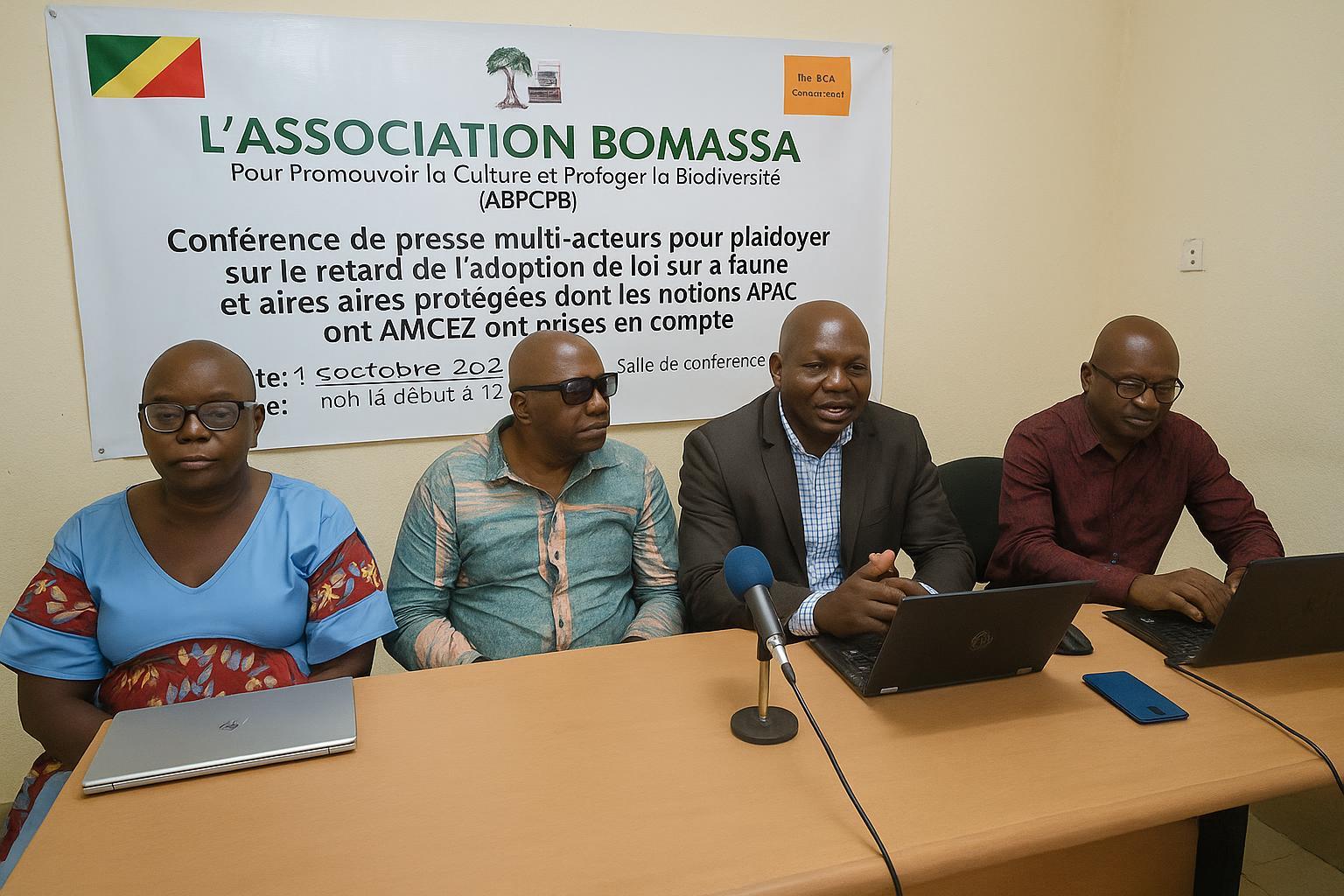
Press conference amplifies civic advocacy
In a carefully choreographed briefing on 22 October 2025 in Brazzaville, the president of Association Bomassa, Guy Moussélé Diséké, stood alongside fellow civil-society figures Daniel Ndinga, Maixent Agnimba and Nina Cynthia Kiyindou. Before reporters, he appealed to the Congolese executive and Parliament to quicken adoption of the long-awaited law on wildlife and protected areas. While commending the government’s willingness to update a 2008 framework, he insisted that a prompt vote would “offer a better architecture for all national initiatives embedded in the Biodiversity Strategy and Action Plan”. The call, delivered in measured tones, casts fresh light on a dossier that has quietly gathered dust despite broad consensus over its strategic relevance for the Republic of Congo.
A reform launched in 2019 still awaiting promulgation
The revision process, officially opened in 2019, was conceived as a comprehensive overhaul of the 2008 act that has governed fauna management and park creation. Drafters introduced forward-looking notions such as Indigenous and Community Heritage Areas—Apac in the international lexicon—together with multiple-use conservation zones and regulated exploitation corridors. These concepts seek to reconcile ecological integrity with local livelihoods, reflecting global best practice. Yet, six years on, the draft remains in limbo. Its stalled trajectory has, in Moussélé Diséké’s view, left field actors operating under an instrument that no longer mirrors evolving realities on the ground nor the country’s climate commitments.
Traditional tenure at heart of the debate
Although the bill embraces innovative spatial categories, indigenous organisations underline one persistent omission: explicit recognition of customary land tenure inside protected areas. Bomassa argues that safeguarding these ancestral claims is not a peripheral matter but the very condition for successful stewardship. “Our team will take an active part in reviewing implementing decrees to ensure coherence with existing legislation,” the association’s president pledged. Nina Cynthia Kiyindou echoed the concern, warning that failure to legislate could lock the nation into a dated legal scaffolding “unsuited to the specificities of indigenous peoples”. Consultations her group conducted in both northern and southern regions reportedly revealed a shared desire for cultural and territorial particularities to be enshrined in the future decree.
Biodiversity, livelihoods and economic planning
Behind the technical jargon lies a dual opportunity. On one hand, the Congo Basin’s extraordinary fauna constitutes a natural heritage of global value; on the other, it represents a strategic asset for sustainable growth. By clarifying access rules, the forthcoming law could unlock responsible ecotourism, generate green jobs and attract climate finance, while simultaneously strengthening anti-poaching measures. Stakeholders at the press conference stressed that clear norms would also reduce administrative friction for private operators committed to conservation-compatible business models. In that sense, acceleration of the legislative timetable aligns not merely with ecological imperatives but also with broader economic-planning goals championed by the authorities.
À retenir
The legislative vacuum has practical consequences: community patrols lack legal cover, investors hesitate before launching conservation projects and indigenous groups face uncertainty over harvesting rights. Bomassa contends that rapid promulgation would translate diplomatic pledges into domestic action, offering legal certainty across the board while reinforcing the state’s leadership in biodiversity governance.
Le point juridique/éco
Once adopted, the law will require a suite of implementing texts to define governance bodies, benefit-sharing formulas and compliance mechanisms. Experts anticipate that harmonisation with existing forestry, mining and decentralisation statutes will be crucial. In economic terms, clear rules could improve the country’s attractiveness under emerging carbon and biodiversity credit schemes, provided that local communities receive an equitable share of derived revenues.
What next for the parliamentary calendar
Attention now turns to the legislative agenda in Brazzaville. Civil-society advocates do not question the authorities’ stated commitment; rather, they encourage sequencing that keeps the wildlife bill near the top of priorities. Moussélé Diséké and his peers express readiness to supply field data and draft suggestions during committee hearings, framing their involvement as a partnership with decision-makers. By inviting inclusive dialogue while acknowledging governmental efforts, Association Bomassa positions itself as a constructive interlocutor eager to see Congo-Brazzaville equip itself with a modern legal toolkit capable of reconciling conservation ambitions, indigenous rights and national development objectives.
