
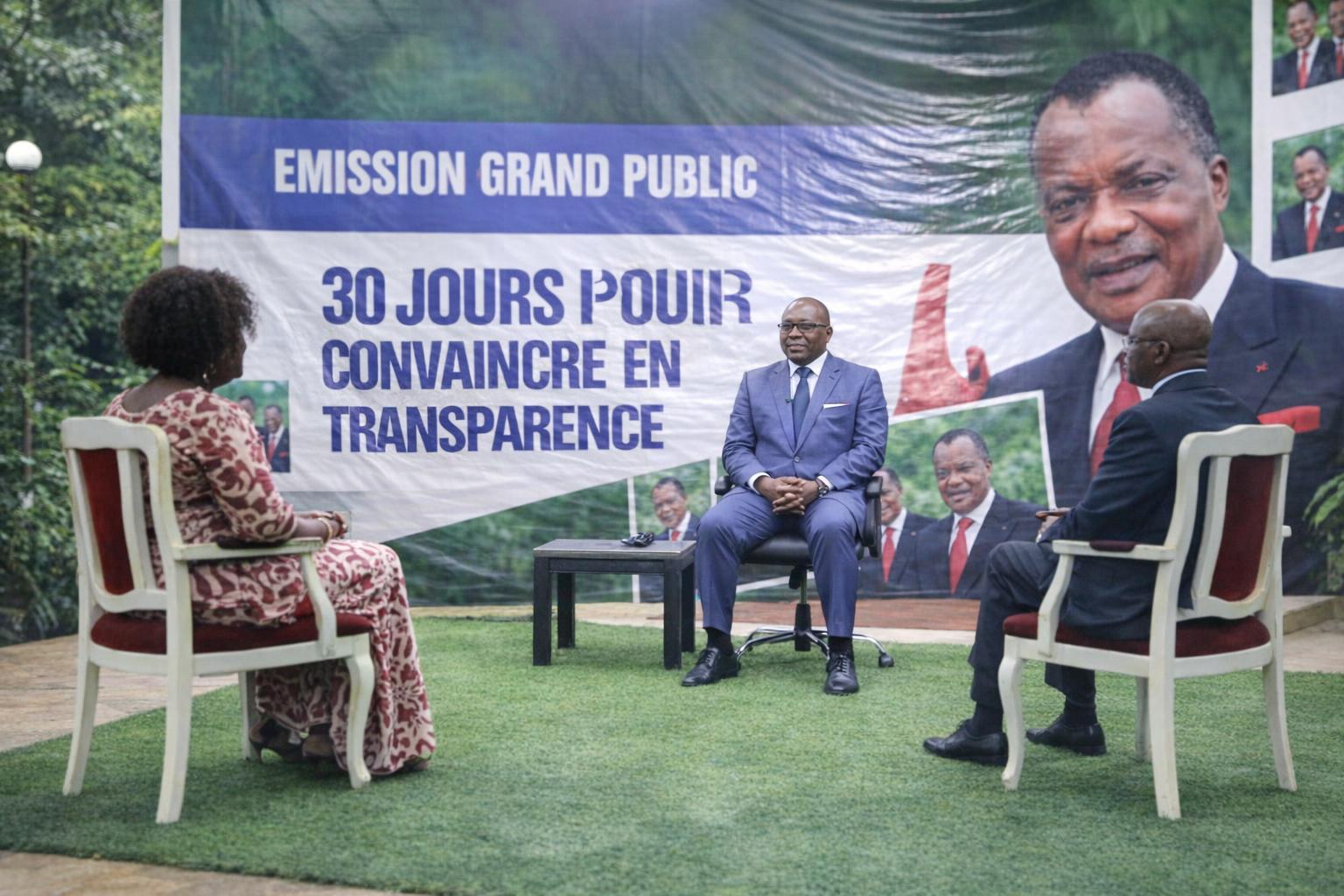
Sector performance under ministerial scrutiny
Speaking on the programme “30 jours pour convaincre en toute transparence”, Congo-Brazzaville’s Minister of Energy and Hydraulics, Emile Ouosso, offered an assessment that he deemed “satisfactory” regarding the provision of electricity and potable water over the past five years. The minister’s appraisal was presented as a balance sheet of concrete gains and persistent constraints, with the central message that production has improved but systemic bottlenecks—particularly in the commercial chain and network infrastructure—continue to shape households’ daily experience.
In the same intervention, Emile Ouosso regretted that the two sector operators, Énergie électrique du Congo (E²C) and La Congolaise des eaux (LCDE), sell electricity and water without transferring corresponding revenues to the State. His remarks suggested that, in the government’s view, the durability of recent progress depends not only on new infrastructure but also on stronger management and financial discipline among the entities responsible for delivery.
Electricity supply: more generation, distribution still decisive
On electricity, the minister argued that service is “improving more and more” with the arrival in Brazzaville of power produced in Pointe-Noire by the Centrale électrique du Congo. In his account, Congo’s generation is now sufficient for “everyday consumption”, with the most pressing tasks residing in transport and distribution. For energy-intensive activities, including mining and other industries, he indicated that additional works will be required, implying a differentiated strategy between basic national load and specialised industrial demand.
Emile Ouosso stated that the government is currently addressing the transport and distribution challenge, framing the effort as the next stage of a trajectory that has already delivered measurable gains. He detailed that current electricity production stands at 770 megawatts against needs “around 600 megawatts”, and that access has increased from 49% to 59%. He also recalled the country’s demographic geography, noting that nearly 80% of the population lives in Brazzaville and Pointe-Noire, a factor that, in policy terms, can concentrate demand while simultaneously allowing upgrades in strategic corridors to yield rapid social returns.
ENI-led rehabilitation of the Pointe-Noire–Brazzaville line
A significant portion of the minister’s explanation focused on the quality and reliability of the power transmitted to Brazzaville. He attributed recent improvements to the ongoing rehabilitation of the Pointe-Noire–Brazzaville line by the Italian company Eni Congo. According to his account, electricity produced in Pointe-Noire did not previously reach the capital effectively because of the ageing state of installations, with particular weaknesses at the Mindouli substation in Pool and the Loudima substation in Bouenza.
The minister said that efforts in recent years have yielded progress, and he cited the receipt of capacitors for Mindouli and Loudima, while the capacitor at Mbouono in Brazzaville has already been installed. In his narrative, these technical components are not minor details but rather emblematic of a wider rehabilitation logic: restoring stability by modernising the nodes where losses accumulate and where a failure can disrupt an entire urban system.
Côte Matève gas plant and the cost of network losses
Emile Ouosso commended the performance of the Côte Matève gas power plant, which he said produces 484 megawatts. He explained that, of the three turbines, two are dedicated to Brazzaville for roughly 300 megawatts, while one serves Pointe-Noire for around 170 megawatts. Yet he also underscored a central paradox of Congo’s electricity economy: from the 300 megawatts intended for Brazzaville, less than 100 megawatts reaches its destination, with the remainder lost due to the obsolescence of the transport segment built in 1982.
To remedy these losses, he cited financing of 62 billion FCFA from the World Bank and an amount from Eni “almost of the same magnitude”, alongside domestic mobilisation of comparable resources. He framed these financings as part of a coherent repair programme targeting the line from Pointe-Noire to Makoua, reflecting an approach that treats the grid as a national spine whose weaknesses can negate otherwise impressive production figures.
Imboulou dam: maintenance as a strategic imperative
Questioned about the Imboulou hydroelectric dam—presented as having cost the State 170 billion FCFA for 120 megawatts—Emile Ouosso recalled that the infrastructure, conceded to Swiss partners, is today in an advanced state of disrepair. He warned that the country risks being pursued at the international level, a formulation that conveys the seriousness with which the government regards contractual, operational, and reputational exposures tied to major assets.
He added that one turbine has been out of service since 2018 and that the slab threatens to collapse. In his telling, E²C is attempting to limit damage using its technicians and with support from the Bureau de contrôle du bâtiment et des travaux publics, while the underlying cause is described as insufficient maintenance. The episode, as presented, places maintenance at the heart of energy sovereignty: the continuity of supply depends as much on preserving existing assets as on inaugurating new ones.
Drinking water supply: ageing systems, targeted new boreholes
Turning to potable water, the minister noted that certain installations in Brazzaville—particularly in the city centre—date back to 1951, while more modern infrastructure has primarily served newer districts in recent years. To supply some neighbourhoods of the capital, he said the government built five boreholes, two of which have been inaugurated at Patte-d’Oie and Nkombo. The boreholes of Mfilou, Mpissa and Talangaï are expected to be commissioned in the near future.
He drew a direct connection between water service and electricity reliability. When there is no power, he said, the Djoué and Djiri water plants stop, which explains why the government is concentrating its efforts on “the battle of electricity”. The linkage points to an integrated policy problem: improving water availability is partly contingent on electrical stability, and conversely, the social legitimacy of energy investments is reinforced when they translate into steady water production.
Pointe-Noire projects and governance conditions for investment
For Pointe-Noire, Emile Ouosso indicated that boreholes under construction are expected to be brought into service in February. He argued that practical solutions exist, beginning with the mobilisation of capital. In a notable passage, he said that over three years “many billions” have been triggered and are awaiting a single condition: that LCDE and E²C be well managed and pay the proceeds. He added that the State is working “in silence” with both companies to improve performance, an expression that suggests ongoing administrative engagement aimed at restoring efficiency and accountability.
The minister also presented the government as having identified operators willing to invest in water and electricity. Protocols, he said, have been signed with partners including the United Nations Development Programme (UNDP) and the African Development Bank (AfDB), on the condition that Congo continues reforms intended to improve governance and performance at E²C and LCDE. Within this framing, reform is not only a domestic objective but also a practical instrument for unlocking financing and technical cooperation.
National Energy Pact: ambitions, guarantees, and private capital
Looking ahead, Emile Ouosso referred to the National Energy Pact signed in New York, mentioning an investment envelope of 9,616 billion FCFA. He stated that the money is available, while the remaining requirement lies with the Congolese side: providing commercial guarantees. He linked this capacity to ongoing reforms in public finances and the public portfolio, expressing hope that by 2028 the State could regain its full ability to issue guarantees, while noting that “for the moment” there are none.
He further observed that the State budget has not included allocations for maintenance of these infrastructures, hence the call for private capital. Finally, he recalled that between 2000 and 2018 the State invested 1,500 billion FCFA in electricity “without convincing results”, a retrospective that implicitly justifies the current emphasis on governance, maintenance, and partnership-based financing as levers to translate spending into tangible service improvements for citizens and enterprises alike.
