
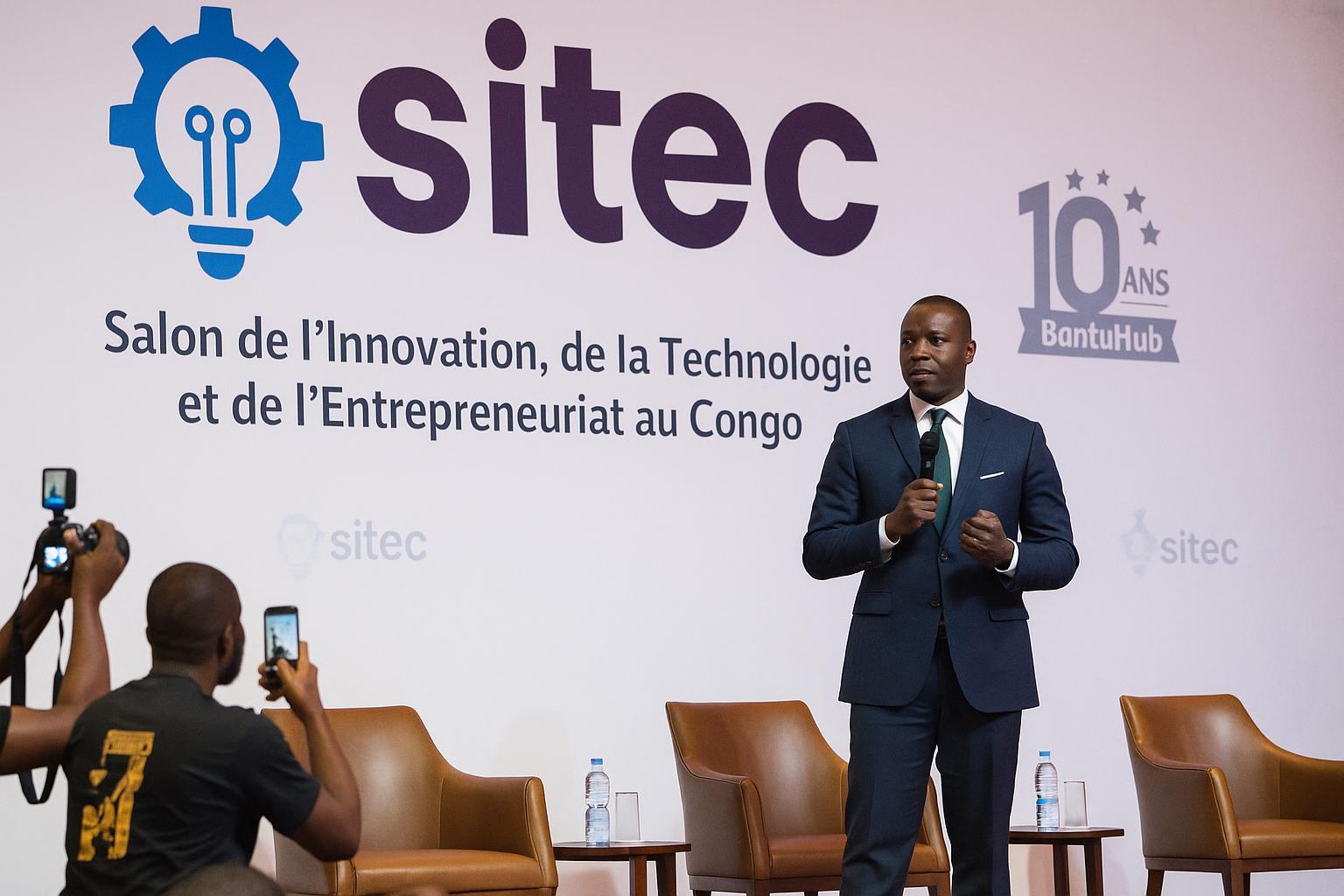
SITEC returns as flagship for Congo’s knowledge economy
When the BantuHub Foundation unveiled the first Salon of Innovation, Technology and Entrepreneurship in Congo two years ago, few observers anticipated the immediate ripple effects. More than 2,800 visitors poured into the venue, hundreds of prototypes were pitched and several start-ups walked away with seed capital commitments. The 2025 edition, scheduled for 9 to 12 November in Brazzaville, is poised to deepen that early momentum and, crucially, to embed it in the broader agenda of national economic diversification. Organisers have chosen the rallying theme “Valuing Youth Potential to Build a Future-Proof Economy,” a formulation that resonates with ministries monitoring labour markets increasingly influenced by automation and data analytics.
Training 600 changemakers in cutting-edge disciplines
The cornerstone of this second outing is an ambitious free training programme targeting more than 600 students and budding entrepreneurs. Over four days, mentors drawn from local universities, the Congolese diaspora and partner companies will walk participants through intensive modules on artificial intelligence, digital marketing, corporate structuring and business modelling. BantuHub’s director of programmes, Arielle Mabiala, contends that the blended curriculum answers a pressing market need. “Our surveys show that young Congolese have imagination but often lack the managerial rigor to convert ideas into bankable products,” she says. By combining coding sprints with sessions on shareholder agreements and intellectual property, she argues, SITEC hopes to create founders who can speak both the language of engineers and the language of investors.
A marketplace where capital meets creativity
Beyond pedagogy, organisers have engineered the conference hall to double as a deal-making arena. Investors from local venture funds, development banks and a handful of pan-African accelerators are expected to sit alongside government procurement officers during the daily demo hours. In the inaugural 2023 edition at least six start-ups closed term sheets, according to figures released by BantuHub. Expectations are higher this year because the macro-economic environment has stabilised, inflation is receding and telecoms operators are rolling out 5G test beds in Brazzaville. For many founders, the prospect of presenting on a stage graced by both financiers and policymakers transforms SITEC from a mere showcase into a gateway to scale. “What matters is the cross-pollination,” remarks economist Rodrigue Okoumba. “When a coder from Pointe-Noire can debate logistics with a maritime executive, you compress the innovation cycle dramatically.”
Government endorsement signals policy continuity
The event’s patronage by the Minister of Youth and Sports underscores official recognition that entrepreneurship constitutes a pillar of Congo’s Vision 2025 plan. That document, adopted by cabinet in 2022, outlines a shift from commodity dependency toward high-value services rooted in digital skills. Sitting in his ministry office, the minister insists the state will not dictate ideas but will remove bottlenecks. Recent measures include streamlining start-up registration to 48 hours, rolling out tax holidays for early revenue companies and assigning a one-stop intellectual property desk inside the National Agency for the Promotion of ICT. The minister’s presence at SITEC therefore carries more than ceremonial weight; it signals that pitches judged promising on the exhibition floor can be fast-tracked through administrative corridors.
Youth dividend and national resilience
Demographically, Congo-Brazzaville counts nearly 60 percent of its population under the age of 25, according to the national statistics institute. Harnessing that youth dividend has become an imperative as hydrocarbon revenues, while still significant, fluctuate with global cycles. Development economist Thérèse Makosso notes that a single successful software exporter can generate foreign exchange flows less exposed to price shocks than oil cargoes. By equipping young citizens with tech competencies and entrepreneurial mindset, SITEC thus aligns with the government’s stated goal of shielding public finances from commodity volatility. The conference organisers aim for at least 30 percent female participation, recognising gender parity as another vector of resilience.
Global context: Congo in the Central African tech corridor
Regional dynamics lend additional relevance to SITEC. Neighbouring Cameroon has just launched a $200 million innovation fund, while Gabon courts data-centre investors after its recent submarine cable landing. Congo’s decision to hold a well-publicised salon sends a message that Brazzaville intends to claim its spot on the Central African tech corridor. Partnerships with French, Moroccan and Rwandan incubators will be announced during the summit, insiders reveal, paving the way for cross-border acceleration programmes. Such alliances can mitigate the relative smallness of the domestic market by providing Congolese start-ups with continental distribution channels from day one.
Long-term vision: from salon to permanent ecosystem
While four days of fanfare can ignite enthusiasm, organisers are keenly aware that sustainability hinges on post-event follow-up. BantuHub has therefore negotiated with a local commercial bank to create a revolving micro-credit line for alumni projects and is finalising a memorandum with the University of Brazzaville to institutionalise the training modules as semester electives. The foundation’s founder, Serge Ibata, envisages SITEC evolving into a year-round platform, possibly culminating in the establishment of a physical tech park on the outskirts of the capital. “A salon must be a milestone, not an endpoint,” he says, adding that talks with real-estate developers are already under way for a 10-hectare campus featuring co-working studios, prototyping labs and a data-neutral warehouse.
What to watch after the spotlights fade
Key metrics will determine whether SITEC meets its lofty ambitions: the survival rate of start-ups six months after the fair, the proportion of trainees securing internships or seed funding, and the volume of intellectual-property filings emerging from project incubators. Government agencies have pledged to publish a dashboard tracking those indicators, an exercise that could institutionalise accountability within the innovation ecosystem. For now, anticipation is high. Workshop seats were fully booked within ten days of registration opening, and hotels near the conference venue report occupancy spikes. Such early signals suggest that Congo’s youth are not merely spectators but active protagonists in shaping a more diversified and digitally fluent national economy.
