
A Joint Exercise Shaped by Regional Realities
When the echo of the final radio check faded over the training grounds of the Marien-Ngouabi Military Academy on 31 August 2025, Congolese officers were quick to underline an essential fact: MANECO-6 was less a classroom drill than a condensed rehearsal of contemporary Central African security challenges. Crafted around the scenario of a mixed-forces group reclaiming and stabilising a border zone plagued by illicit trafficking, the exercise mirrored real-world concerns repeatedly flagged by the Brazzaville government and partner organisations (Ministry of Defence communiqué, 30 August 2025).
Objectives Anchored in Interoperability
Planned by the Command of Military Schools (COMEC) and steered by Colonel-Major Jean-Pierre Bouka, the ten-day exercise sought to validate the spectrum of instruction offered during the 2024-2025 academic cycle—ranging from the Diplôme d’état-major intermédiaire d’armes to initial officer training. The stated educational goal was to enable future commanders to integrate army, air, naval, police, gendarmerie and customs assets into a single decision loop. According to the exercise directive, success would be measured by the trainees’ ability to synchronise manoeuvre, intelligence, logistics, cyber and civil-military functions in real time, thereby operationalising hypothesis 7 of the national defence posture dealing with severe threats to public order.
Multinational Participation as Strategic Capital
A conspicuous feature of MANECO-6 was its attendance list. Of the 353 participants, one in five wore the colours of Benin, Burkina Faso, Cameroon, Côte d’Ivoire, the Central African Republic, Guinea, Mali, Niger or Togo. General Charles-Victoire Bantadi, commander of the military schools, described this diversity as “a laboratory of habits and procedures that no single nation can replicate at home.” Observers from the African Union Peace and Security Department, as well as defence attachés posted in Brazzaville, noted that such multilateral exposure strengthens Congo-Brazzaville’s soft power by positioning the academy as an indispensable hub for francophone officer development (African Union observer report, 2 September 2025).
Digital Transformation on the Drill Floor
Beyond tactics, this year’s edition debuted a secure intranet linking the exercise’s operational centres. The system allowed a simulated joint command to share cartography, air-tasking orders and rules of engagement within seconds—an innovation hailed by Defence Minister Charles-Richard Mondjo as “a decisive leap toward network-centric operations.” Technical advisors from the Congolese National Computer Centre emphasised that the platform, built with indigenous code and encrypted protocols cleared by the National Cyber-Security Agency, complies with both regional and African Union data-sovereignty guidelines. In the words of Lieutenant Noëlla Okouélé, one of the trainee planners, “digitalisation forced us to refine staff work and risk assessment because information flowed too fast for improvisation.”
High-Level Endorsement and On-Site Evaluations
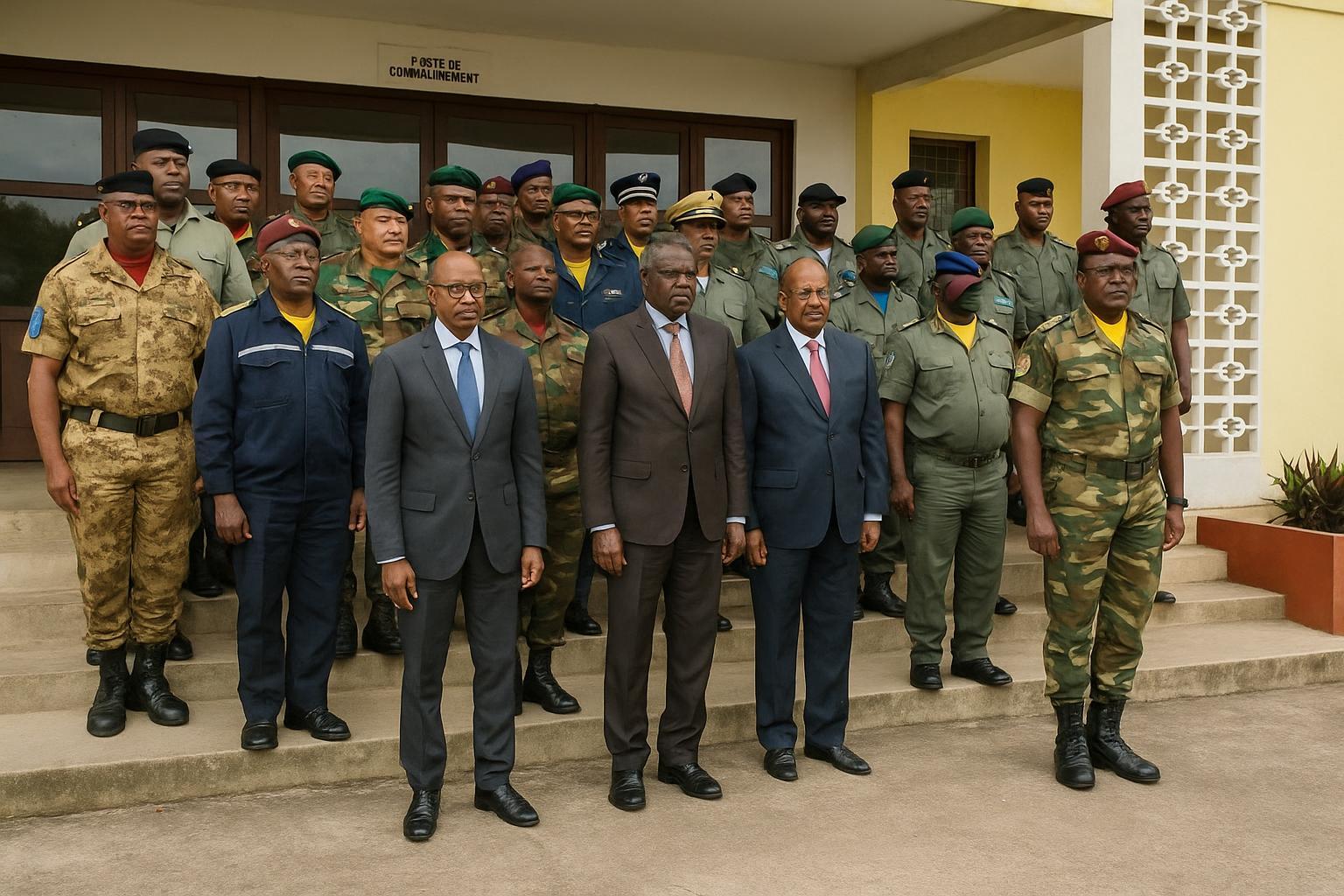
The closing day attracted a tableau of senior personalities: General Guy Blanchard Okoï, Chief of the General Staff, customs chief Guénolé Mbongo Koumou and representatives of interior-security forces. After viewing a debrief film, the delegation toured the command posts, where demonstration cells replayed key decisions such as the allocation of river-patrol assets on the hypothetical ‘liquid frontier.’ Minister Mondjo publicly congratulated cadets for “translating doctrine into actionable orders,” while urging them to maintain “the ethical posture that anchors the republic’s defence.” Independent commentators from the weekly Les Dépêches de Brazzaville noted that the minister’s presence signalled continued political backing for the academy’s modernisation drive (Les Dépêches, 1 September 2025).
Regional Security Stakes and Diplomatic Resonance
Given that illicit cross-border flows finance several non-state armed groups in the sub-region, MANECO-6 stands as part of Brazzaville’s broader diplomatic message: Congo is willing and able to act as a linchpin of collective stability. Neighbouring governments, especially in the Economic Community of Central African States, have repeatedly called for tighter coordination on riverine surveillance and customs intelligence. By rehearsing those very missions with international trainees, the academy generated a multiplier effect that extends beyond the classroom. Analysts at the Institute for Security Studies argue that such exercises enlarge the shared playbook of francophone forces, reducing response gaps during real emergencies (ISS policy brief, September 2025).
Educational Trajectory and Prospects
Looking ahead, COMEC officials intend to move from proof-of-concept to routine integration of artificial-intelligence decision aids, while also expanding civil-military cooperation modules on humanitarian law and environmental protection. The academy has already scheduled a tabletop on maritime domain awareness for early 2026, and discussions are under way with the European Union Military Assistance Mission for potential instructor exchanges. For Congolese cadets, the take-away is clear: mastery of operational functions now requires fluency in digital systems and multinational staff culture. As Colonel-Major Bouka concluded in the final after-action review, “the lion cubs of ‘Tambo’ must leave this arena ready to safeguard not only our frontiers but the credibility of the region as a whole.”
