
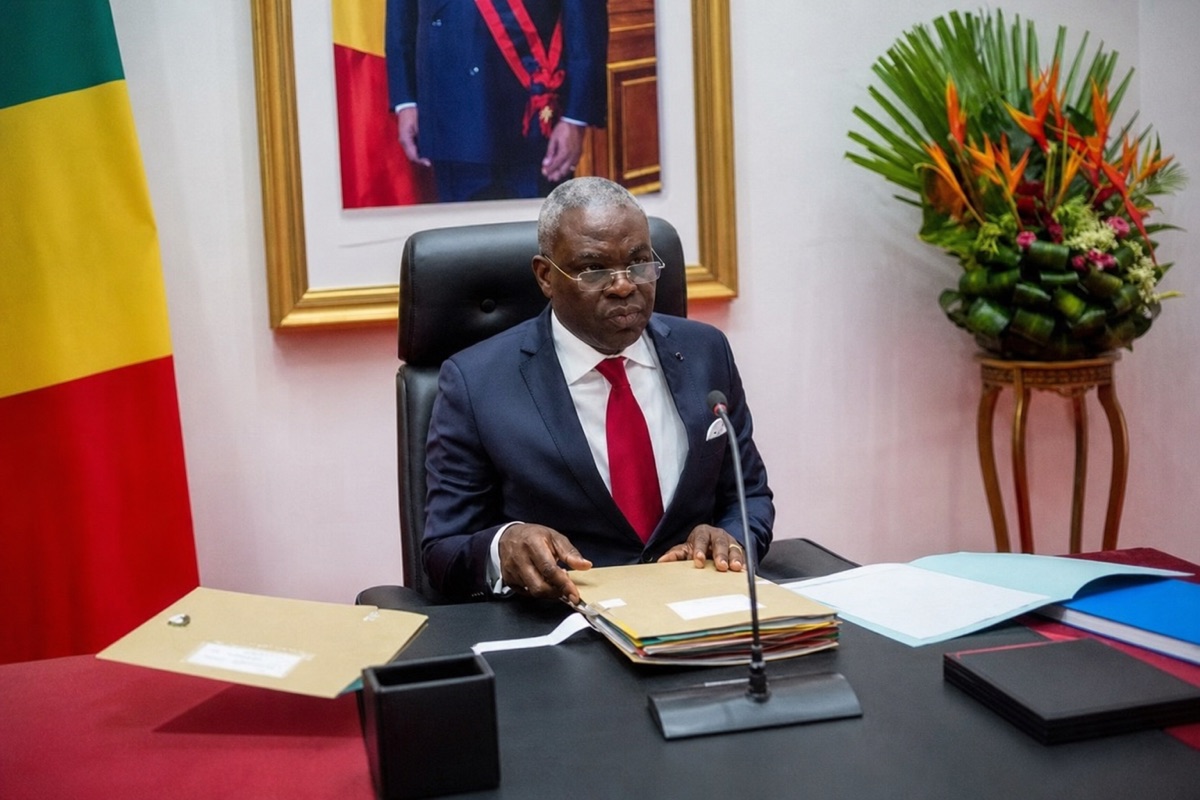
A new government rarely enjoys the luxury of a quiet beginning, and the one led by Anatole Collinet Makosso is no exception. On Wednesday 29 April 2026, in Brazzaville, the second Makosso administration convened its inaugural cabinet meeting, an occasion that served both as a formal entry into office and as an early statement of intent. Gathered around the head of government, ministers laid out the broad contours of their respective portfolios, in a sitting whose tone was deliberately businesslike rather than ceremonial.
A Crowded Agenda Confronting the New Team
The catalogue of challenges presented at the table was wide, and at moments daunting. Ministers addressed the modernisation of infrastructure, the improvement of the health system, the future of education, the strengthening of governance and the diversification of an economy still searching for sturdier foundations. Few of these files are new to Congo-Brazzaville, and that familiarity carries its own weight: each represents an expectation deferred, a promise that successive administrations have struggled to translate into visible change.
What distinguished this first meeting was less the novelty of the subjects than the manner in which they were framed. Rather than treating their mandates as isolated silos, the members of the government presented their priorities as interlocking pieces of a single national effort. The implicit argument was that infrastructure cannot be divorced from economic diversification, nor education from the broader question of governance. Whether that integrated vision survives the friction of day-to-day administration remains, of course, an open question.
The Language of Speed and Coordination
A recurring theme ran through the interventions: the determination to act quickly and in concert. Ministers spoke of the need to deliver concrete results, framing their work as a response to the pressing expectations of the population. The phrase is a familiar one in the rhetoric of incoming governments, yet its repetition here suggested an awareness that patience among citizens is not inexhaustible.
The emphasis on coordination is worth dwelling upon. Inter-ministerial collaboration is often invoked and rarely achieved, in Brazzaville as elsewhere, and the early insistence on it hints at a recognition of past shortcomings. By placing cooperation at the centre of its method from the outset, the government appeared to be guarding against the fragmentation that can leave ambitious programmes stranded between competing departments.
Rigour as a Governing Method
Beyond the substance of the portfolios, the meeting was used to define a way of working. The administration set out a method founded on three principles: rigour, inter-ministerial collaboration and an obligation to produce results. Cast in this way, the approach reads less as a slogan than as an attempt to impose discipline on the machinery of state, an approach judged essential to sharpening the impact of public policy.
The notion of an obligation to results deserves particular attention. It implies a shift from the measurement of effort to the measurement of outcome, a standard against which ministers may eventually be assessed. If applied consistently, such a benchmark could alter the internal culture of government; if invoked only rhetorically, it risks joining the long list of well-intentioned commitments that fade once the practical difficulties accumulate.
Continuity Within the Presidential Vision
The work of the executive does not unfold in a vacuum. The cabinet situated its agenda within the broader vision articulated by President Denis Sassou-N’Guesso, whose stated ambition is to consolidate growth and to improve, in a lasting way, the living conditions of Congolese citizens. The Makosso II government thus presents itself as an instrument of continuity rather than rupture, charged with carrying forward an established political project.
That positioning carries both advantages and constraints. Continuity offers stability and a clear line of authority, yet it also binds the new team to expectations inherited from before. The success of this administration will likely be measured not by the eloquence of its first meeting, but by its capacity to convert a coherent set of stated priorities into improvements that citizens can perceive in their daily lives. The first cabinet meeting set the terms; the harder test lies in the months that follow.
