
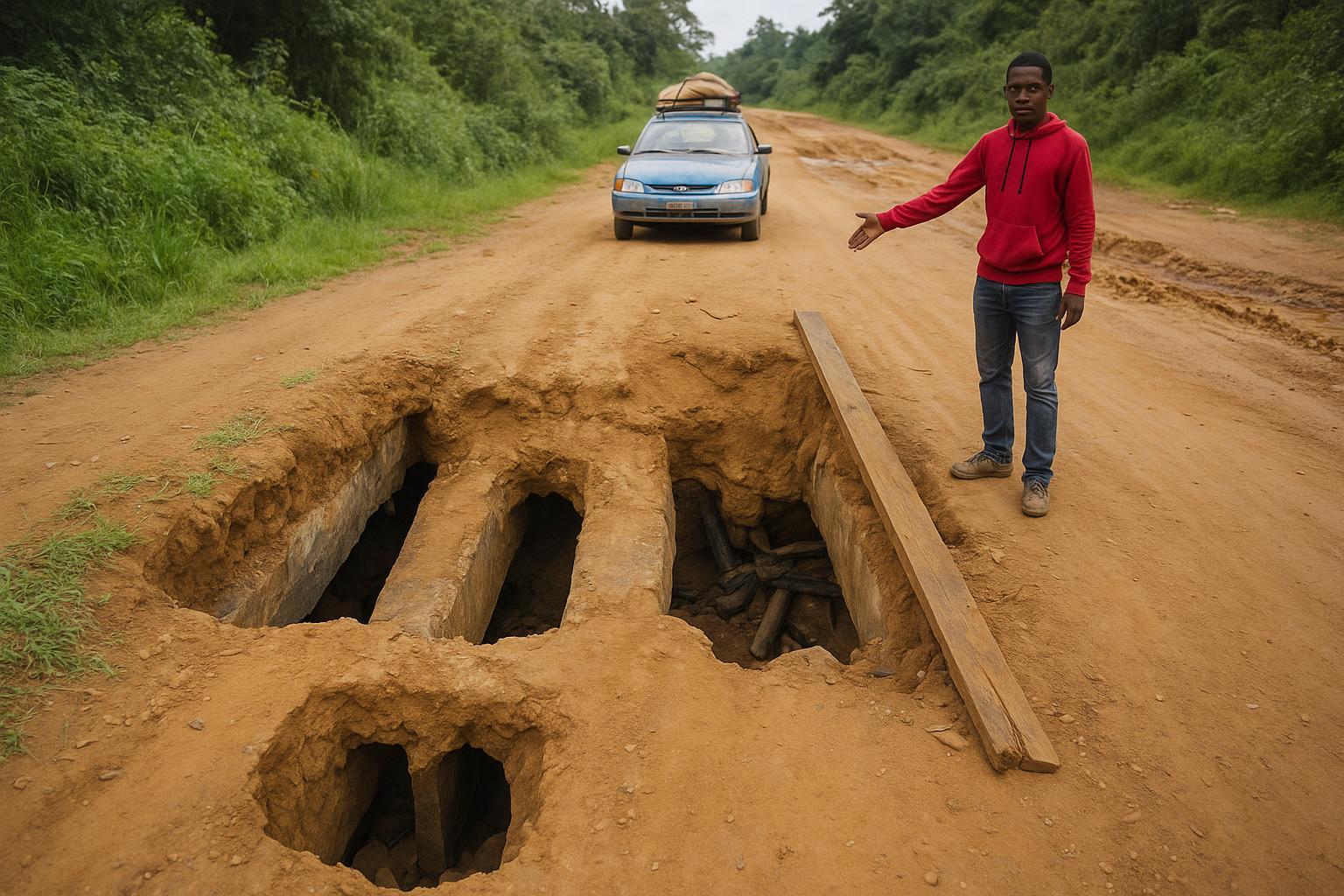
A Border Town Between Memory and Ambition
A generation ago Mbinda thrummed with the metallic cadence of ore trains linking the Comilog manganese pit to the Atlantic port of Pointe-Noire. When exports shifted to neighbouring Gabon in the late 1980s, the tracks fell silent and so, gradually, did the engines of local commerce. Today, this community of roughly five thousand inhabitants stands at an uneasy crossroads: the vestiges of an industrial past confront the aspirations of a youthful population eager to participate in Congo-Brazzaville’s broader growth narrative. Their daily reality, however, is marked by pothole-riddled laterite roads, intermittent electricity and overstretched public services. The contrast between potential and circumstance frames the pressing development question that haunts the Niari highlands.
The Road Question: Lifeline or Bottleneck?
Every rainy season the Mikouagna escarpment becomes the single most cited obstacle to Mbinda’s economic revival. Lorries carrying timber and cassava slide to a halt, while minibuses that connect the town to Dolisie require double the usual travel time to navigate submerged gullies. According to the Ministry of Equipment’s 2023 performance review, feeder-road rehabilitation across Niari constitutes a priority of the National Development Plan 2022-2026, with a 68-kilometre stretch between Mossendjo and Mbinda earmarked for phased upgrading. Civil-engineering studies financed by the African Development Bank were completed in January, and tendering for initial drainage works is expected before the end of the dry season. Local entrepreneurs already sense the implications. “A reliable road shortens the distance to markets and investors,” notes Patrice Massamba, who runs a small sawmill on the outskirts of town. “We are ready to pay our taxes, but first the state must reopen the gate.”
Power and Water: The Quiet Revolutions Needed
If transport is Mbinda’s visible Achilles heel, the absence of stable electricity and potable water erodes livelihoods more stealthily. Household surveys by the National Centre for Statistics show that fewer than one in ten homes enjoy grid connection, with diesel generators shouldering the remaining load at prohibitive cost. The government’s rural electrification roadmap, adopted last year, targets Niari for a hybrid mini-grid combining solar and micro-hydro sources by 2025, leveraging the tributaries of the Louvakou River. Parallel negotiations with the World Bank’s International Development Association could unlock US$18 million for boreholes and standpipes to curb water-borne disease. “When lights come on, everything changes — study hours, refrigeration, even the morale of health staff,” argues Dr. Thérèse Ngoma, the sole physician at Mbinda’s health post.
Education Under Strain, Talent in Reserve
Despite infrastructural constraints, Mbinda’s classrooms continue to produce prize-winning pupils at departmental science fairs. Yet the odds are exacting. The Raymond Kouedé Middle School counts just thirteen full-time teachers for nearly four hundred students, compelling multi-grade rotation that extends the school day into dusk. The Ministry of Primary and Secondary Education acknowledges the staffing gap and has assigned twenty newly sworn teachers to Niari in the current academic year, five of whom are expected to arrive in Mbinda before the next term. Local civic associations have meanwhile refurbished two dilapidated classrooms with support from diaspora crowdfunding. “Our children’s curiosity is not the problem,” insists school director Bertin Loutaya. “They simply need mentors and textbooks to channel it.”
Health Services and the Geography of Care
Reaching a surgical theatre still entails a four-hour drive to Dolisie, an itinerary that doubles during floods. To mitigate the distance, the Ministry of Health has included Mbinda in a pilot tele-medicine project linking remote centres to specialists in Brazzaville. Satellite connectivity provided by the Central African Backbone fibre spur, commissioned last August, already allows weekly virtual consultations in maternal health. According to provincial health delegate Jean-Baptiste Samba, the next objective is securing an all-terrain ambulance through a public-private partnership with two forestry concessions operating in the zone. “Corporate social responsibility can complement state efforts,” he observes, “especially where logistics costs would otherwise swallow the entire local budget.”
Political Engagement Beyond the Campaign Season
Electoral cycles in Congo-Brazzaville often ignite spirited engagement in rural districts, yet residents of Mbinda articulate a desire for continuity rather than episodic mobilisation. The town’s youth committee, largely apolitical, attracted national attention last December after volunteers attempted to fill potholes with gravel before being advised to await formal works. The incident, while portrayed by some social media users as proof of neglect, also highlighted vigorous civic energy that authorities are now keen to harness. The Niari prefecture has since initiated quarterly dialogue forums, pairing community representatives with technical departments to track project milestones. “We must move from promises to programming,” affirms Prefect Baron Frédéric Bouemba, emphasising that decentralisation reforms have expanded the fiscal room for local initiatives.
From Isolation to Integration: A Strategic Outlook
Located 14 kilometres from the Gabonese border and within trucking distance of Angola, Mbinda occupies a pivotal node on emerging sub-regional corridors. The Central African Economic and Monetary Community has signalled interest in extending its multimodal transit framework southwards, potentially breathing new life into the defunct Congo-Ocean rail spur. Analysts at the Brazzaville-based think-tank CERAPE argue that modest, targeted investments in Mbinda could unlock cross-border trade worth up to CFA 25 billion annually in timber, cocoa and livestock. Such figures explain the town’s prominence in recent cabinet discussions on productive diversification. Whether through asphalt, fibre optics or calibrated microfinance, the overarching goal remains identical: transform an erstwhile extraction enclave into a thriving border economy fully woven into Congo-Brazzaville’s inclusive growth agenda.
