
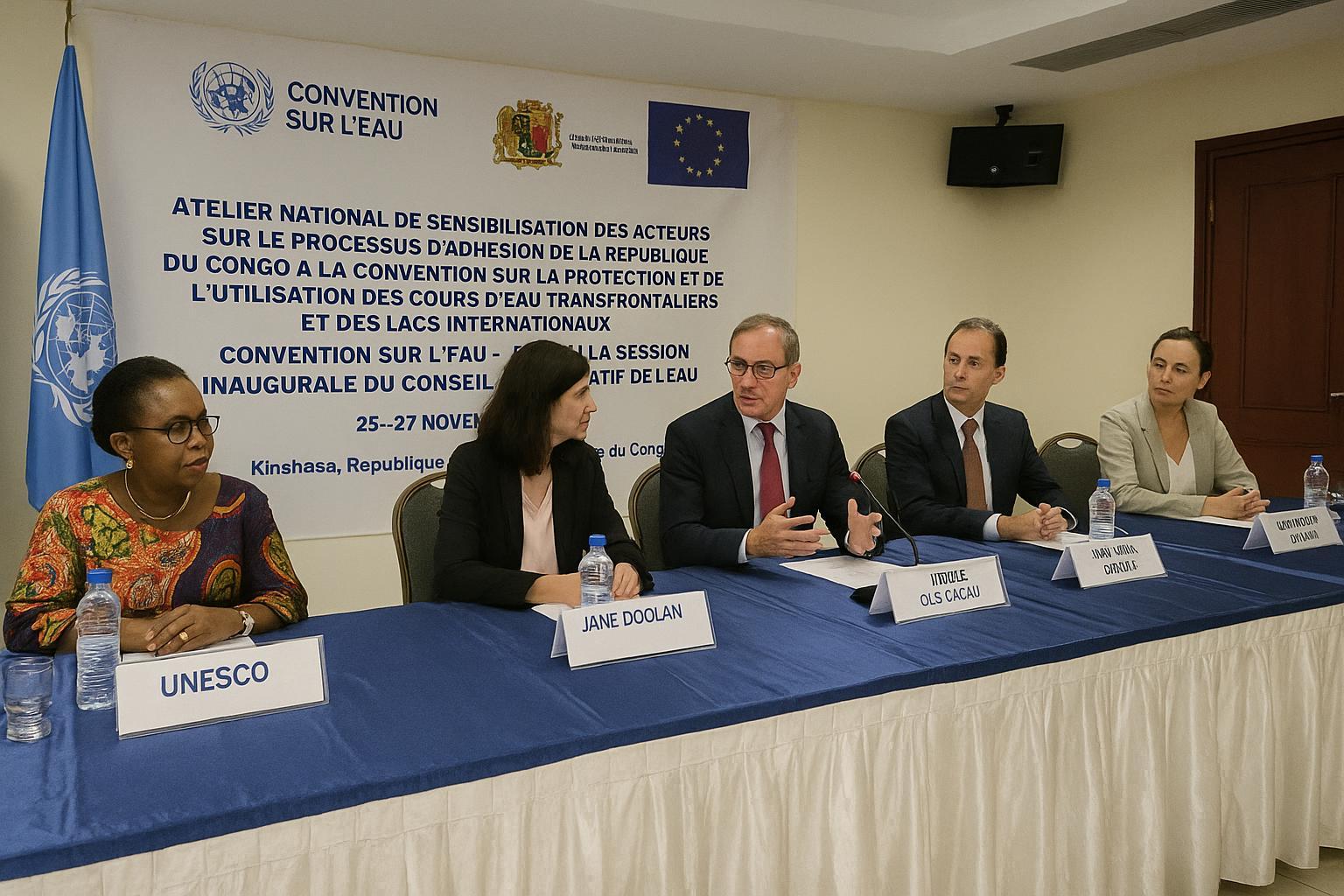
Brazzaville workshop sets pace for treaty accession
Muted sunshine filtered through the windows of the ministry’s conference hall in Brazzaville as senior officials, diplomats and civil-society specialists convened on 26 November. Frédéric Manienze, chief of staff to the Minister of Energy and Hydraulics, opened the awareness-raising workshop that formally launches the Republic of Congo’s pathway toward accession to the 1992 United Nations Convention on the Protection and Use of Transboundary Watercourses and International Lakes, commonly called the UN Water Convention. The session also inaugurated a new National Consultative Council on Water, an inter-ministerial platform charged with steering the ratification process and ensuring whole-of-government ownership.
In his address, Manienze framed the gathering as a pragmatic step toward “harmonising viewpoints and integrating recommendations from every stakeholder”. By the close of the workshop, participants were expected to validate a draft roadmap that will guide legal, institutional and diplomatic actions over the coming months. The ministry’s secretariat confirmed that an annotated timeline—covering gap analysis, parliamentary outreach and the deposit of instruments of accession at the United Nations—should be finalised before the end of the first quarter next year.
Rising water stress and national priorities
Despite the Congo River’s majestic flow, access to safe water remains uneven across the Republic. UNICEF data indicate that roughly forty-four per cent of citizens lack regular access to an improved drinking-water source, a figure that climbs in some rural departments where infrastructure is sparse. Climate variability is compounding the challenge: erratic rainfall and higher temperatures are altering groundwater recharge patterns, while longer dry spells stretch existing networks to breaking point.
Government planners have already identified water security as a pillar of the Emerging Congo 2025 strategy. Joining the UN Water Convention would, according to ministry officials, knit together ongoing reforms—such as tariff modernisation, the rollout of village boreholes and urban pipeline rehabilitation—under a coherent legislative umbrella. The potential to pre-empt localised competition over rivers and aquifers, especially in border districts contiguous with Gabon, Cameroon and the Democratic Republic of Congo, is seen as an added dividend.
A multilateral legal framework for shared rivers
Created in the aftermath of the Cold War, the 1992 Convention provides a legally binding framework for the sustainable use of transboundary rivers, lakes and groundwater. It encourages riparian states to cooperate on monitoring, pollution control and equitable allocation, while offering an impartial arena for resolving disputes before they escalate. Sonja Koeppel, secretary of the Convention, reminded delegates that the treaty has evolved into a truly global instrument since its opening to all UN members in 2016. “For nations like Congo, accession reinforces national management systems and elevates the country’s profile in international water diplomacy,” she observed.
Koeppel stressed that convention membership gives countries priority access to technical assistance and capacity-building programmes operated by the United Nations Economic Commission for Europe and other partners. These programmes can complement domestic efforts to map aquifers, deploy digital hydrological monitoring and establish early-warning mechanisms for flood and drought events.
Diplomatic support from UN and European Union
United Nations Resident Coordinator Abdourahamane Diallo placed the initiative within a broader context of peace and sustainable development. He argued that shared water governance is increasingly recognised as a confidence-building measure capable of reducing tensions, fostering trade corridors and underpinning regional integration agendas such as the African Continental Free Trade Area. “By acceding, Congo not only protects its own groundwater but contributes to the stability of Central Africa,” he told the audience.
Europe echoed the message. Ambassador Anne Marchal, speaking on behalf of the European Union, conveyed Brussels’ enthusiasm for Brazzaville’s bid. The EU has financed several transboundary water programmes along the Congo Basin and stands ready, she said, to mobilise additional expertise for legal drafting, stakeholder consultation and public-awareness campaigns. Observers noted that this alignment of UN and EU encouragement offers Congo a rare diplomatic tailwind.
Roadmap, governance and domestic alignment
According to a draft seen by this newspaper, the National Consultative Council on Water will be co-chaired by the Ministry of Energy and Hydraulics and the Ministry of Foreign Affairs, with representation from Finance, Environment, Interior, scientific institutions and civil society. Its first mandate is to conduct a regulatory gap assessment that will compare existing Congolese statutes with convention provisions on pollution, data sharing and environmental impact assessments.
Parliament plays a decisive role in the sequence. Members of the two chambers are expected to debate and ratify the instrument once the Council recommends accession. Lawmakers contacted after the workshop welcomed the prospect, citing constituent concerns over water quality and recurrent floods. The Council also plans provincial consultations so that local authorities in Ouesso, Dolisie and Pointe-Noire can anticipate downstream implications for land-use planning and sanitation targets.
Unlocking finance and innovation for water services
Beyond legal harmonisation, ministry economists stress the convention’s catalytic effect on funding. Many multilateral development banks and climate-finance windows treat membership as a positive signal of governance maturity. Early estimates from the Ministry of Planning suggest that accession could improve the country’s eligibility for concessional envelopes worth up to 150 million dollars over five years, earmarked for pipe-laying, solar-powered pumping stations and watershed restoration.
The private sector is also watching the process. Several engineering firms based in Brazzaville believe that greater regulatory clarity and international benchmarking will de-risk long-term investment in bulk-water supply and smart-meter technologies. A representative from Société Nationale de Distribution d’Eau insisted that “modern instrumentation funded through climate mechanisms will allow us to reduce non-revenue water and keep tariffs affordable for households”.
Voices from the field signal cautious optimism
Environmental sociologist Léonie Mavoungou, whose research covers community water committees in the Pool region, frames accession as a “new social contract” between state and citizens. She cautions, however, that successful implementation will depend on sustained outreach to women’s cooperatives and youth groups who manage communal wells. “The treaty is a starting point; behavioural change on the ground is the true measure of success,” she reflected.
For riverine farmers along the Nyanga and Sangha tributaries, the promise of improved upstream-downstream coordination resonates. Clovis Mbemba, a cocoa grower near Mossendjo, hopes the move will translate into practical safeguards against upstream logging effluents. “If the government can monitor our rivers more closely, our crops and children will both thrive,” he said. Such grass-roots perspectives underscore the tangible benefits many Congolese associate with their country’s leap toward the global water-governance architecture.
