
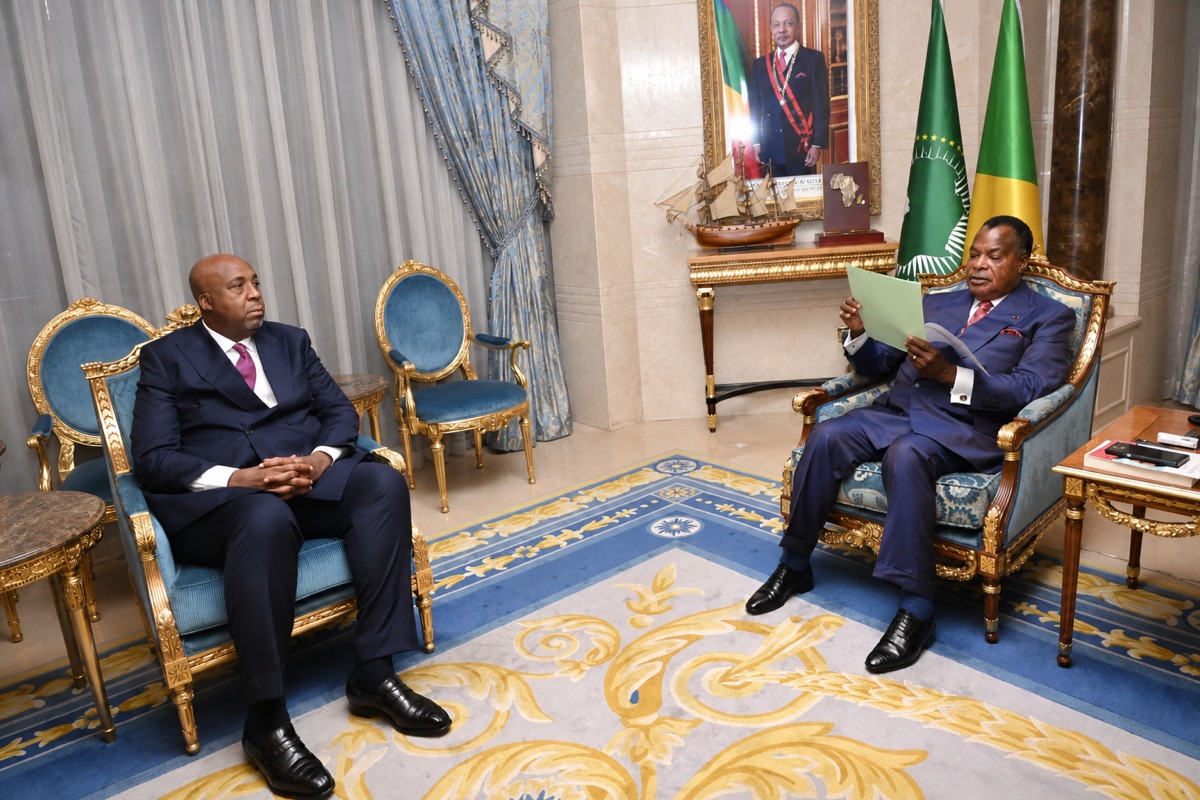
When President Denis Sassou N’Guesso welcomed Aimé Molendo Sakombi, the Democratic Republic of the Congo’s Minister of Water Resources and Electricity, to Brazzaville on 26 February, the meeting carried a weight that exceeded the customary choreography of bilateral diplomacy. Behind the formal cordiality lay an ambition that has long animated Central African capitals: to convert the region’s vast hydrological endowment into tangible, shared electrical power. The conversation between the two men centred squarely on energy cooperation, and on the contours of a project whose scale, if realised, would reorder the regional balance of generating capacity.
A Tri-National Dam at the Heart of Central Africa
The proposal at the table is unusually expansive in its geometry. Rather than a strictly bilateral arrangement, it draws together three states — the Republic of the Congo, the Democratic Republic of the Congo and Angola — in a joint undertaking to construct a hydroelectric dam with a projected capacity of 12,900 megawatts. The figure alone signals the magnitude of the design, placing it among the most consequential energy ventures contemplated by the countries involved. The site is no longer a matter of speculation. As Sakombi described it, “There is a site that has already been identified, which lies at the mouth of the Likoussou river, a stone’s throw from the first cascade of Teleka.” Such precision suggests that preparatory work has moved beyond the rhetorical stage into the more demanding terrain of feasibility.
Energy Sovereignty as a Continental Argument
What distinguishes the minister’s framing is its refusal to treat the dam as a purely technical or commercial proposition. He pressed the case for developing energy independence jointly, invoking the considerable potential that Africa holds and that has too often remained latent. The argument is at once economic and political: a continent rich in untapped resources need not remain dependent on external provision when neighbouring states can pool their capacities. For Brazzaville and Kinshasa, two capitals separated by little more than the width of a river yet historically wary of confusion between their respective Congos, the language of shared sovereignty carries particular resonance. The project becomes a vehicle not only for kilowatts but for a regional self-assertion that the parties are evidently keen to articulate.
The Patient Arithmetic of Feasibility
Ambition on this scale is tempered by the discipline of process. The studies underpinning the project are expected to reach completion within a window of six to nine months, a timeline that situates the venture firmly in the realm of careful preparation rather than imminent construction. That measured pace is itself instructive. Undertakings of this magnitude depend on hydrological assessment, environmental scrutiny and the alignment of three national administrations, each with its own institutional rhythms. The deliberate sequencing signals a recognition that durability matters more than haste, and that a dam intended to anchor regional power supply for generations cannot be improvised.
A Partnership Built on Established Ties
The meeting also served to reaffirm a relationship that the two governments describe as already excellent. The energy initiative is presented less as a departure than as a deepening — an effort to translate cordial bilateral relations into infrastructure that benefits the citizens of both nations. In the calculus of Central African politics, where partnerships are frequently announced and less frequently consummated, the insistence on continuity is significant. It frames the dam not as a fragile experiment but as the natural extension of a cooperation that the parties wish to render concrete.
Officials involved have gone so far as to characterise the venture as potentially the largest energy project among the countries concerned, a description that captures both the aspiration and the stakes. Whether the Likoussou site fulfils that promise will depend on the studies now under way and on the willingness of three sovereign partners to sustain their alignment through the long arc of execution. For now, the encounter in Brazzaville has established a direction of travel, and a shared conviction that the region’s energy future may be written on its own rivers.
