
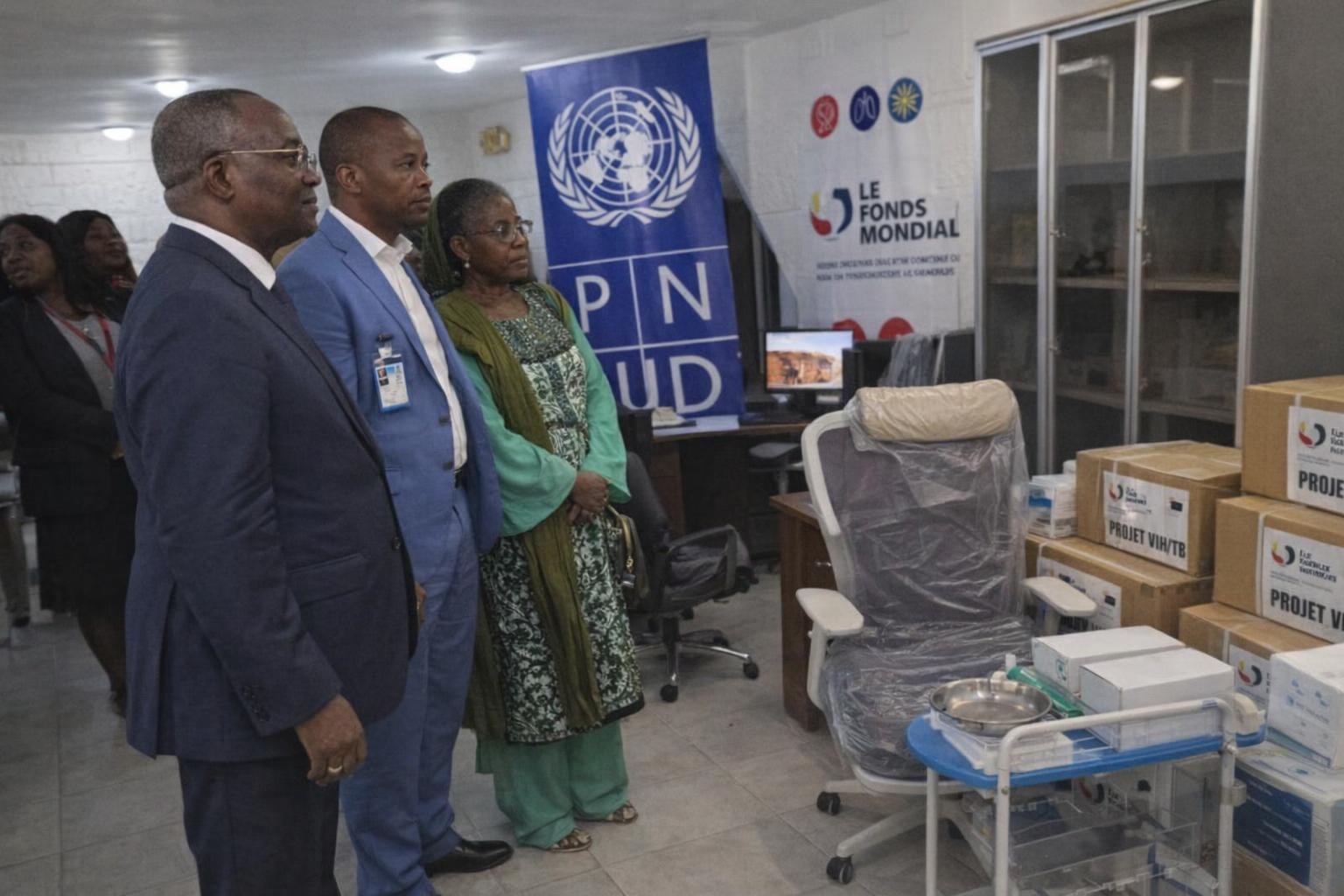
Brazzaville handover for HIV and TB services
On 23 January in Brazzaville, the Resident Representative of the United Nations Development Programme (UNDP) in the Republic of Congo, Adama Dian Barry, formally handed over a consignment of medical equipment to the Minister of Health and Population, Jean Rosaire Ibara. The delivery includes essential clinical equipment intended to support quality patient management, along with office furniture and IT hardware.
The items were procured through financing from the Global Fund to Fight AIDS, Tuberculosis and Malaria, a long-standing partner for national responses to communicable diseases. The handover was presented as a practical contribution to improving the day-to-day conditions in which health teams diagnose, treat and follow up patients affected by HIV/AIDS and tuberculosis.
Global Fund financing: value and operational intent
Speaking on behalf of a coalition of partners supporting the fight against HIV/AIDS and tuberculosis, Adama Dian Barry emphasised the operational purpose of the donation. She indicated that the equipment is valued at approximately $180,000, estimated at about 101,665,891 CFA francs, and described it as indispensable for patient care in facilities that receive large numbers of people affected by the two diseases.
“Through this gesture, we want to create the conditions for optimal care for these people and optimal treatment, so that the care is provided under the best conditions, and so that these people can access all care and health products,” she said. She linked the handover to the broader objective of strengthening the health sector, framing the investment as both clinical and systemic in its effects, from treatment delivery to the reliability of service organisation.
39 high-volume sites targeted in Congo’s health network
UNDP specified that the equipment is destined for Integrated Health Centres (CSI) and basic hospitals across 39 sites, selected under a “high-volume” approach. The logic of this targeting is to reinforce facilities where caseloads are concentrated, thereby improving the reach and quality of services for HIV/AIDS and tuberculosis in places where demand is highest.
Barry noted that the delivery is meant to support the strategic objectives assigned by the government to frontline teams. In her reading, the donation consolidates the health cooperation between the Republic of Congo and UNDP. She also expressed the hope that the handover would set a constructive tone for 2026, signalling continuity in coordinated public health action.
National programmes welcome capacity gains on the ground
As principal beneficiaries, the leaders of the national programmes dedicated to tuberculosis and to HIV/AIDS reported satisfaction with the donation. They stressed that the new equipment should strengthen operational capacity and improve working conditions for staff engaged in the response to both diseases, particularly those working closest to patients.
For programmes that rely on the regularity of clinical supplies as well as the routine production of accurate information, the combination of medical equipment, office furniture and computer hardware was presented as a coherent package. It addresses not only care delivery but also the administrative and data-handling needs that accompany modern disease control strategies.
Tuberculosis programme: distribution aligned with established allocation
Professor Franck Hardain Okemba-Okombi, Director of the National Tuberculosis Control Programme, indicated that the materials will be distributed to different centres in line with an established allocation plan. His remarks underlined a principle of orderly deployment, aimed at ensuring that the donation translates into improved performance across multiple facilities rather than remaining concentrated in a limited number of sites.
By anchoring distribution in a predefined breakdown, the tuberculosis programme signalled its intention to integrate the donation into its routine operational planning. The objective, as expressed, is to enable actors to intensify their work against tuberculosis while maintaining consistency with national priorities for service delivery.
HIV programme’s high-volume strategy and remaining needs
Dr Roth Laure Cécile Mapapa Miakassissa, Director of the National AIDS Control Programme, explained that a high-volume strategy has been developed to improve HIV and tuberculosis care. According to her, the approach consists of identifying sites that manage more than 200 patients, then assessing the needs of those high-volume facilities and communicating them to the Global Fund through UNDP.
She offered a measured assessment of the donation’s scope. While noting that the items do not cover all needs, she argued that they will enhance staff comfort and support better patient management, particularly in relation to data and logistics. In a response where continuity of treatment and quality of follow-up are decisive, she presented improvements in information handling and logistical organisation as practical levers for better outcomes.
Congo’s co-financing commitment to the Global Fund
The handover also took place against the backdrop of Congo’s stated fulfilment of its counterpart funding commitments within its engagement with the Global Fund. According to the information shared, the Republic of Congo contributed 44.4%, amounting to more than 4 billion CFA francs, as part of its commitments related to the fight against AIDS, tuberculosis and malaria.
For stakeholders, such co-financing is often read as an indicator of ownership and policy alignment. In this case, the emphasis placed on the country’s contribution positions the donation not as a standalone act of external support, but as part of an articulated partnership in which domestic commitments and international financing are meant to reinforce one another.
Strengthening health systems through targeted equipment support
Beyond the immediate utility of the equipment, the episode illustrates a familiar but consequential dynamic in health governance: targeted investments can yield broader effects when they are tied to agreed strategies and channelled toward facilities where patient volumes are highest. By focusing on 39 sites and pairing clinical tools with office and IT resources, the delivery reflects an understanding that quality care depends on both bedside capacity and the managerial backbone of services.
In Brazzaville, the tone of the exchanges remained oriented toward practical results, institutional coordination and continuity of support. If the distribution plan proceeds as indicated, health facilities at the heart of HIV/AIDS and tuberculosis care could see tangible improvements in working conditions and service organisation, reinforcing the government’s stated agenda of consolidating health-sector performance.
