
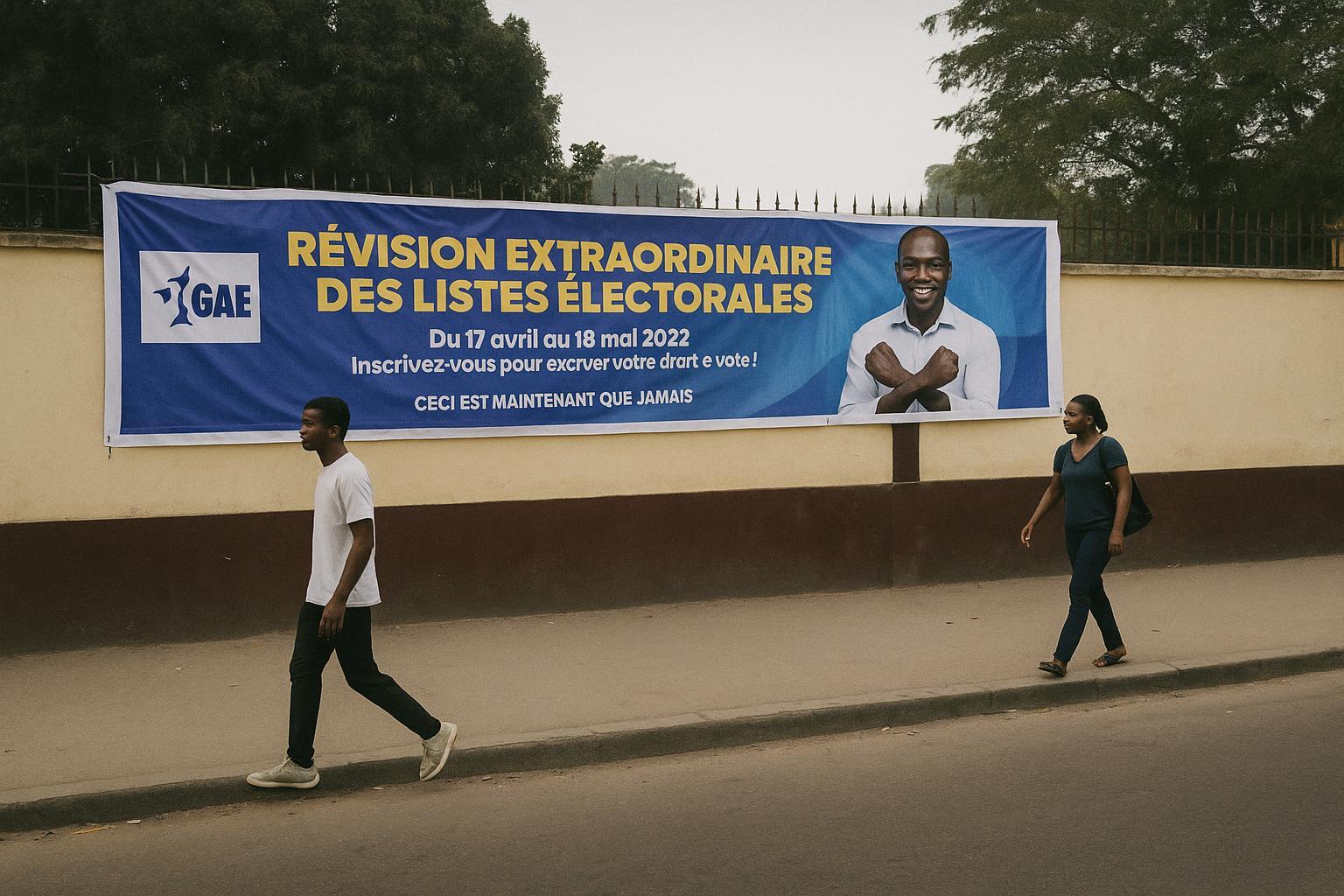
A Timely Nationwide Revision Begins
Less than seven months before Congolese voters are expected to return to the polls, banners fluttering across Brazzaville signal the formal launch of the revision of electoral lists. On 1 September 2025 the National Independent Electoral Commission, known by its French acronym CNEI, opened more than three hundred centres where citizens can confirm, update or establish their registration. The exercise is scheduled to conclude on 30 October, mirroring the two-month window adopted ahead of the 2021 presidential contest, when 2.645 million voters were certified.
In an early-morning address on state television, Interior Minister Raymond Zéphirin Mboulou framed the operation as a “civic rendez-vous with modernity,” underscoring the introduction of additional biometric kits financed jointly by the national treasury and regional partners (ECCAS communiqué). Early crowd turn-out in the arrondissements of Makélékélé and Poto-Poto suggested broad awareness, with local administrators noting that many first-time voters arrived clutching national identity cards recently issued under the government’s digital-ID programme.
Strengthening the Digital Backbone of Elections
Beyond routine updates, the 2025 revision is notable for its technological ambitions. The CNEI has doubled the number of portable biometric kits, aiming to enrol voters in remote districts such as Sembe and Enyellé where connectivity challenges persisted in 2021. Commission president Henri Bouka explained that satellite uplinks provided by the Congolese Space Agency will allow real-time synchronisation of fingerprints and facial images, reducing the risk of duplicate records. According to Bouka, the new system can process an elector in roughly four minutes, half the previous average.
Technical advisers from the International Organisation of La Francophonie, who conducted a pre-deployment audit, praised the encryption protocols adopted this cycle (OIF technical note). Dr. Mireille Ikounga, an information-security lecturer at Marien Ngouabi University, nonetheless emphasised that cyber resilience will depend on staff training. “Hardware is only part of the equation; human vigilance remains decisive,” she commented in an interview.
Legal Parameters and Political Stakes
The revision unfolds under the constitutional timetable that requires a presidential election between March and April 2026. By law, the definitive voter registry must be sealed sixty days before polling day, making the October deadline critical. Parliament’s cross-party monitoring committee endorsed the calendar unanimously, a gesture some analysts interpret as evidence of a shared interest in procedural clarity.
President Denis Sassou Nguesso, seeking to consolidate social cohesion after the economic headwinds of the pandemic and fluctuating oil prices, has described the upcoming poll as “an opportunity to deepen national dialogue.” Government spokesperson Thierry Moungalla reiterated that viewpoint, stressing that the credibility of the roll “is the first guarantee of peaceful competition.” Opposition parties, notably the Pan-African Union for Social Democracy, welcomed the early start yet requested greater access to raw registration data once the operation ends.
Regional Diplomacy and Observation Plans
Congo-Brazzaville’s electoral calendar inevitably draws the gaze of Central African neighbours, several of whom will hold legislative ballots in the same period. The Economic Community of Central African States has already dispatched a liaison mission to coordinate observer accreditation and to harmonise health protocols should cross-border monitors be required. ECCAS Secretary-General Gilberto da Piedade Verissimo argued that functional electoral logistics in Brazzaville will have a “demonstration effect” in a region still consolidating democratic practices.
The African Union, which sent a short-term observation mission in 2021, signalled its intent to expand its footprint next year. According to a briefing note circulated in Addis Ababa, the AU is considering a long-term analysts’ team that would arrive as early as January 2026 to scrutinise voter-education campaigns and the adjudication of any list-related appeals. European Union diplomats in Kinshasa and Yaoundé privately say that a stable Congolese process would contribute to broader Gulf of Guinea maritime-security cooperation, given Brazzaville’s role in regional anti-piracy forums.
Demographic Shifts and Civic Engagement
Demographers project that Congo-Brazzaville’s population will surpass 6 million in 2025, with nearly 60 percent under the age of thirty (World Bank data). The current revision therefore doubles as an outreach to a burgeoning youth cohort whose turnout in 2021 hovered around 40 percent. Civil-society groups such as Jeunesse 2026 have launched door-to-door caravans in Pointe-Noire and Dolisie, urging young adults to seize the “window of inscription.”
Sociologist Jean-Emmanuel Okoué observes that voter-list accuracy intersects with broader questions of public trust. In his words, “When individuals see their names correctly spelled and their polling station clearly assigned, institutional legitimacy is no longer an abstraction.” Media initiatives echo that sentiment; Radio Mucodec broadcasts daily reminders in Lingala and Kituba detailing the documents required at enrolment sites.
While the logistical momentum is evident, the CNEI still faces the perennial hurdle of reaching riverine communities before seasonal rains swell the Congo and Kouilou rivers in late October. The commission has mobilised thirty motorised pirogues and coordinated with local chiefs to pre-position fuel. United Nations Development Programme officials familiar with previous cycles describe the plan as realistic provided fuel subsidies are disbursed on schedule.
Prospects for a Credible 2026 Ballot
As the two-month revision enters its first week, diplomatic observers emphasise that the integrity of any election begins long before ballots are cast. The early signals from Brazzaville—enhanced biometrics, cooperative legislative oversight and active youth outreach—offer grounds for measured optimism. Yet the ultimate test will occur in January, when provisional figures are expected to be published and political stakeholders assess district-level variations.
For now, the operation’s careful choreography illustrates the administration’s stated commitment to modernise electoral governance while preserving a climate of consensus. Should the timeline hold, Congo-Brazzaville may provide a rare example of an orderly, technology-driven update in a region often challenged by logistical constraints. In an arena where perceptions matter almost as much as statistics, the steady unfurling of voter-registration banners across the capital could become an emblem of the republic’s determination to balance continuity with incremental reform.
