
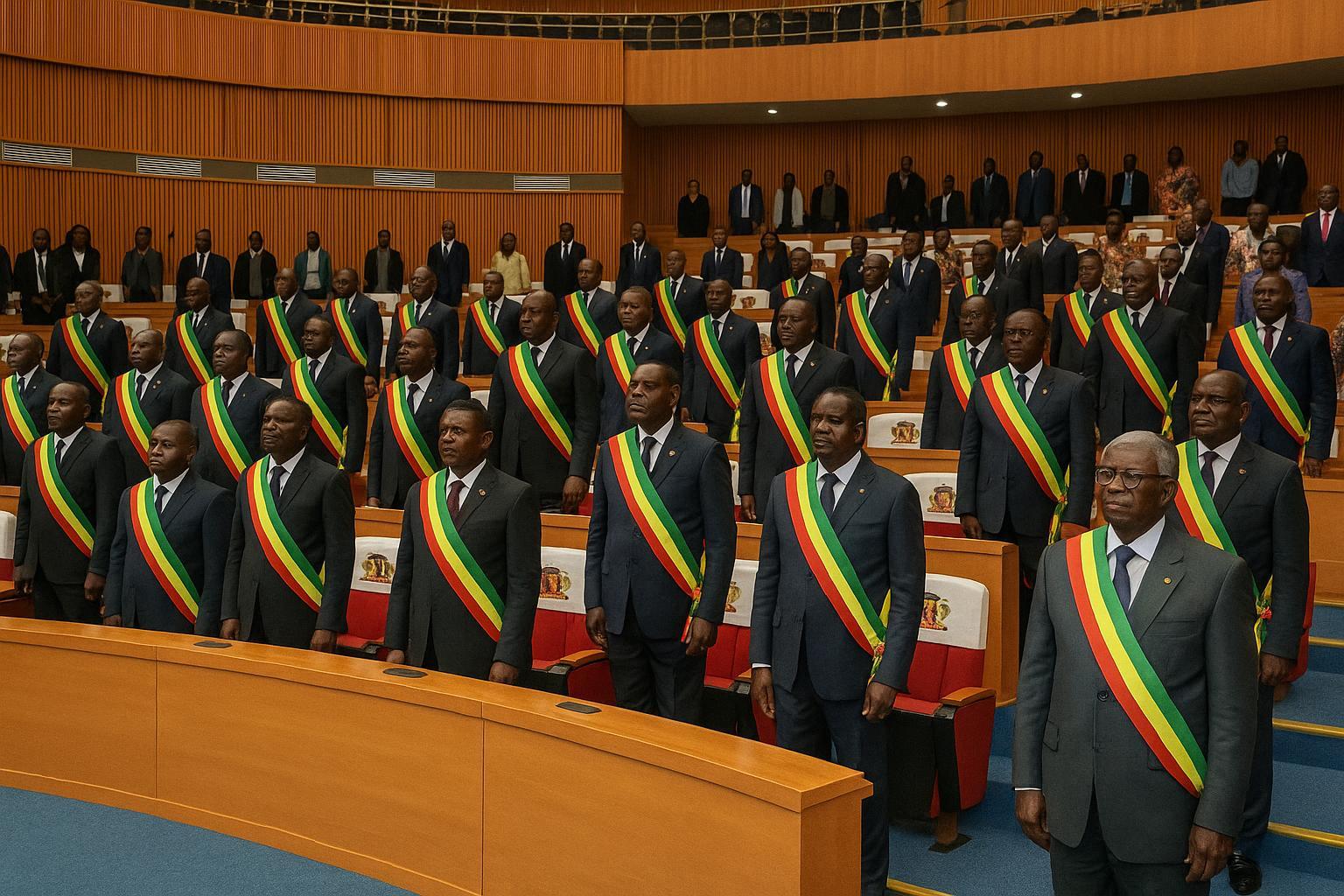
Budget Session Opens Amid High Expectations
When Speaker Isidore Mvouba gaveled in the National Assembly’s tenth ordinary budget session on 15 October, he set a deliberately ambitious tone. Deputies, he insisted, must deliver “a law of finances that meets the most legitimate expectations of the Congolese people,” a mandate that resonates widely after successive years of global economic turbulence. The chamber’s calendar stretches to 23 December, giving members barely ten weeks to examine, amend and adopt the 2026 draft budget while maintaining public confidence in a context that Mvouba soberly described as socially, economically and politically demanding.
A Legislature Under Social and Economic Scrutiny
The Speaker’s opening address acknowledged the dilemmas of governing during a period of constrained revenues and heightened public needs. Yet he argued that, despite lingering fiscal pressures, “the Republic is on the right track.” Pointing to the nationwide, timely reopening of schools as tangible proof of institutional resilience, Mvouba thanked the entire educational community for demonstrating, in his words, “patriotism over the sirens of disorder.” In the hemicycle, deputies from all parties greeted the statement with applause, aware that the electorate will judge the session by its ability to reconcile budgetary discipline with social ambition.
Prioritising Education and Social Resilience
Education’s prominent mention was no rhetorical flourish. About 17 percent of this year’s executed expenditure has already targeted classrooms, teacher deployment and textbook provision, according to figures discussed informally in the Assembly corridors. By foregrounding school reopening in his speech, Mvouba signalled that similar or greater allocations could be defended in the 2026 budget even while other envelopes are tightened. Analysts at the Congolese Observatory of Public Finance note that continuity in schooling dampens social risk and sustains long-term productivity, two metrics closely monitored by Congo’s multilateral partners.
Harnessing Public-Private Partnerships and Digital Finance
To meet growing expectations without over-stretching the treasury, deputies are exploring mechanisms that mobilise private capital. Mvouba singled out public-private partnerships as “indispensable” to closing infrastructure gaps, a view echoed by recent joint assessments from the International Monetary Fund, the African Development Bank and the World Bank regarding the high-voltage line linking Pointe-Noire to Brazzaville. Digitalisation of financial procedures, another of the Speaker’s priorities, aims to curb leakages and accelerate revenue collection. The Ministry of Finance reported that electronic customs payments piloted at Pointe-Noire port increased monthly receipts by nearly ten percent, a precedent many legislators now cite while pressing for nationwide rollout in 2024 before the 2026 fiscal year begins.
Capacity-Building for Inclusive Development
During the session, members will step beyond line-item scrutiny to attend thematic parliamentary days sponsored by development partners. Planned workshops cover the Accelerated Community Development Programme, gender equality, social inclusion and the fight against tuberculosis and HIV/AIDS. Legislators will also host the Congolese Foundation for Medical Research for a seminar on biomedical innovation, and launch the national chapter of the International Association of Parliamentarians for Peace with the support of the Universal Peace Federation. Such capacity-building, Mvouba argued, equips deputies to exercise oversight “without hesitation or procrastination,” ensuring that the budget’s social promises translate into measurable results at rural and peri-urban level.
Electoral Register Revision Signals Democratic Vitality
Even as spreadsheets dominate committee rooms, politics in the broader sense looms large. The country is finalising the revision of electoral rolls, a process due to conclude on 30 October. The Speaker urged citizens to complete enrolment, calling the exercise “a marker of our democracy’s vitality that strengthens the traceability of every ballot.” Civil society observers from the National Episcopal Conference note a steady, if uneven, turnout at registration centres. Deputies have welcomed the trend, hopeful that up-to-date lists will lend greater legitimacy to the municipal and legislative contests anticipated within the horizon of the new budget cycle.
À retenir
Three signals stand out from the opening week. First, the Assembly’s leadership has tied fiscal debate to concrete social benchmarks, with education as the flagship. Second, the chamber positions itself as a catalyst for private investment and digital transparency rather than a mere allocator of state resources. Finally, by coupling budget scrutiny with electoral roll revision, parliament underscores an institutional commitment to simultaneous economic and democratic consolidation.
Le point juridique/éco
Legally, deputies operate under the 2015 Constitution and the organic law on finance acts, which together grant the Assembly power to amend revenue and expenditure within a strict 70-day window. Economically, preliminary projections from the Ministry of Planning foresee 4 percent growth in 2025, driven by oil-adjacent services and agriculture; sustaining that trajectory will require the very resource mobilisation and fiscal innovation championed in the hemicycle. Should the final text incorporate robust digital revenue tools and clear PPP frameworks, analysts expect improved debt sustainability indicators, a condition precedent for the IMF’s next review under its Extended Credit Facility arrangement.
