
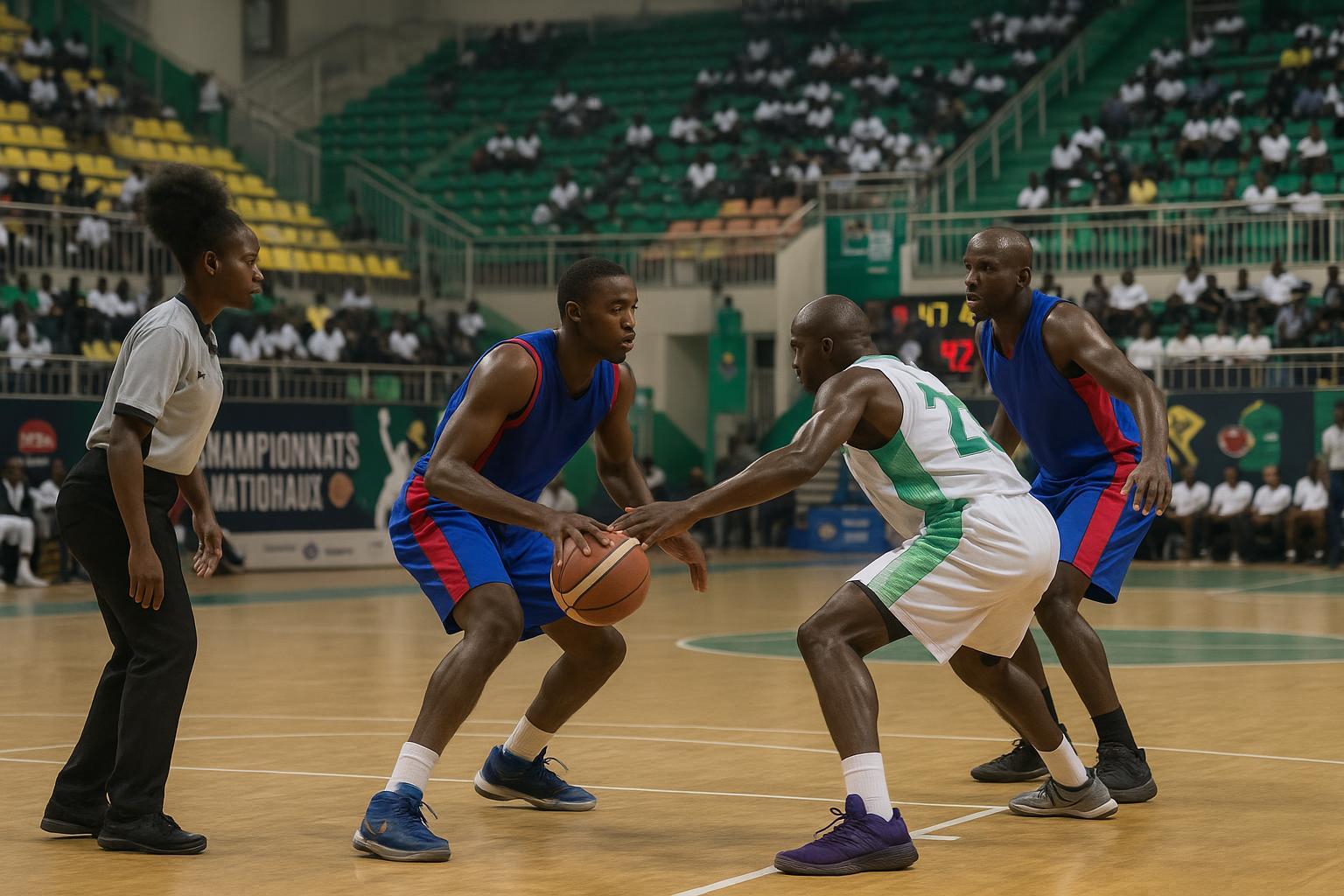
Brazzaville opens a vibrant 41st national showcase
The Maxime-Mantsima Gymnasium in Brazzaville erupted in applause as the tip-off between local stalwarts Avenir du Rail and BBS Pointe-Noire marked the official start of Congo-Brazzaville’s 41st National Basketball Championships. Avenir du Rail seized a 68-57 victory, setting an early tone of competitiveness that resonated with the capacity crowd. More than a sporting curtain-raiser, the evening offered a spectacle that blended athletic prowess with cultural flair, underscored by live performances from musicians Relf Kazama and Diesel Gucci that turned the arena into a civic festival (Les Dépêches de Brazzaville, 18 Aug 2024).
A new federation leadership, a fresh mandate
Since assuming office in January, Federation President Fabrice Makaya Matève has articulated a mission to “detect, nurture and export Congolese talent” while restoring the sport’s domestic appeal. The revamped executive committee has streamlined logistics, secured private sponsorship from oil-sector suppliers and telecom operators, and increased digital coverage through partnerships with Télé Congo and independent streaming platforms. Observers note that the organisational clarity of the current edition contrasts favourably with earlier disruptions related to the pandemic and venue shortages (FIBA Africa annual report 2023).
Scouting future stars on home hardwood
With senior and junior brackets running concurrently for both men and women, the championships function as an extended try-out for continental competitions such as the FIBA Africa Zone IV qualifiers. National selectors have already flagged Point-guard Jérémie Ngatsé, aged 18, whose last-second three-pointer lifted BBS juniors over the Diablotins, 77-76, as “a prospect for the 2025 AfroCan roster”. The simultaneous presence of scouts from French Pro B clubs and Rwanda’s Patriot BBC underscores the widening export corridor for Congolese players, a development the government views as both a remittance generator and a reputational asset.
Economic and urban resonance beyond the court
The event’s eight-day schedule is estimated by the Brazzaville Chamber of Commerce to inject roughly 1.2 billion CFA francs into the local economy through hospitality, merchandising and transport services. Hoteliers near the Gymnasium report occupancy rates above 90 %, rivalled only by the annual Pan-African Music Festival. Municipal authorities have capitalised on the influx to accelerate the resurfacing of Avenue de l’Université and install new LED lighting—part of an urban facelift timed to coincide with the championship’s prime-time broadcasts.
Soft-power dividends for the Congolese state
Officials from the Ministry of Foreign Affairs describe the tournament as a “low-cost, high-impact” instrument of cultural diplomacy that dovetails with President Denis Sassou Nguesso’s broader Agenda 2025, which emphasises youth empowerment and regional cooperation. International guests include sports attachés from Cameroon, the Democratic Republic of Congo and Angola, invited to a parallel forum on sports governance co-hosted by the African Union’s Sport Division. The choice of basketball—a sport with a youthful demographic and global media traction—aligns with the government’s intention to project a modern, dynamic national image without the heavy financial outlays associated with hosting multi-sport events.
Regional integration through basketball diplomacy
Congo-Brazzaville has long sought to position itself as a bridge between Central and Southern Africa, and the basketball court provides a useful metaphor for that aspiration. Friendly scrimmages set for the championship’s rest day will pit an all-star selection against visiting clubs from Kinshasa and Libreville. Beyond symbolic value, these fixtures are designed to calibrate technical standards ahead of the proposed Central African Basketball League, a project currently under review by FIBA Africa and the Economic Community of Central African States.
Infrastructure legacy and private-sector synergies
The Ministry of Sports confirmed that the Gymnasium, refurbished to FIBA Level 1 specifications, will remain a public-private partnership pilot. Maintenance costs are to be underwritten partly by a naming-rights deal with a domestic banking consortium, ensuring sustainability beyond the current championship. Meanwhile, the energy firm SNPC Distribution has financed solar panels that now supply 60 % of the venue’s electricity needs, providing a template for greening sporting infrastructure in line with Congo’s climate commitments under the Paris Agreement (Ministry of Energy press briefing, 7 Aug 2024).
Gender parity gaining cautious momentum
Although male participation still dominates, the championship’s women’s bracket features twelve teams, up from eight in 2022. The Diables Noirs-ECB opener, in which ECB prevailed 37-19, highlighted both the tactical sophistication and resource gaps in the women’s game. The federation has earmarked 20 % of its 2024 budget for female development programmes, including coaching clinics led by former WNBA player Pauline Akonga of the Democratic Republic of Congo. Analysts contend that visible female competition offers social dividends analogous to those recently achieved in women’s football across West Africa (UNESCO Sport and Gender report 2023).
What the 41st edition signals for 2025 and beyond
The championship’s concluding weekend will feature a policy roundtable where club presidents, business executives and government advisers will draft a five-year road map targeting qualification for the Basketball Africa League by 2027. While infrastructural and financial hurdles persist, the current edition has demonstrated administrative coherence, grassroots enthusiasm and a burgeoning talent pool—elements regarded by regional observers as preconditions for continental relevance. In the immediate term, a sold-out arena and nationwide television audience affirm that Congolese basketball is no longer a niche pastime but an emerging national asset with diplomatic, economic and cultural returns.
