
A Convergence of Policy and Geography
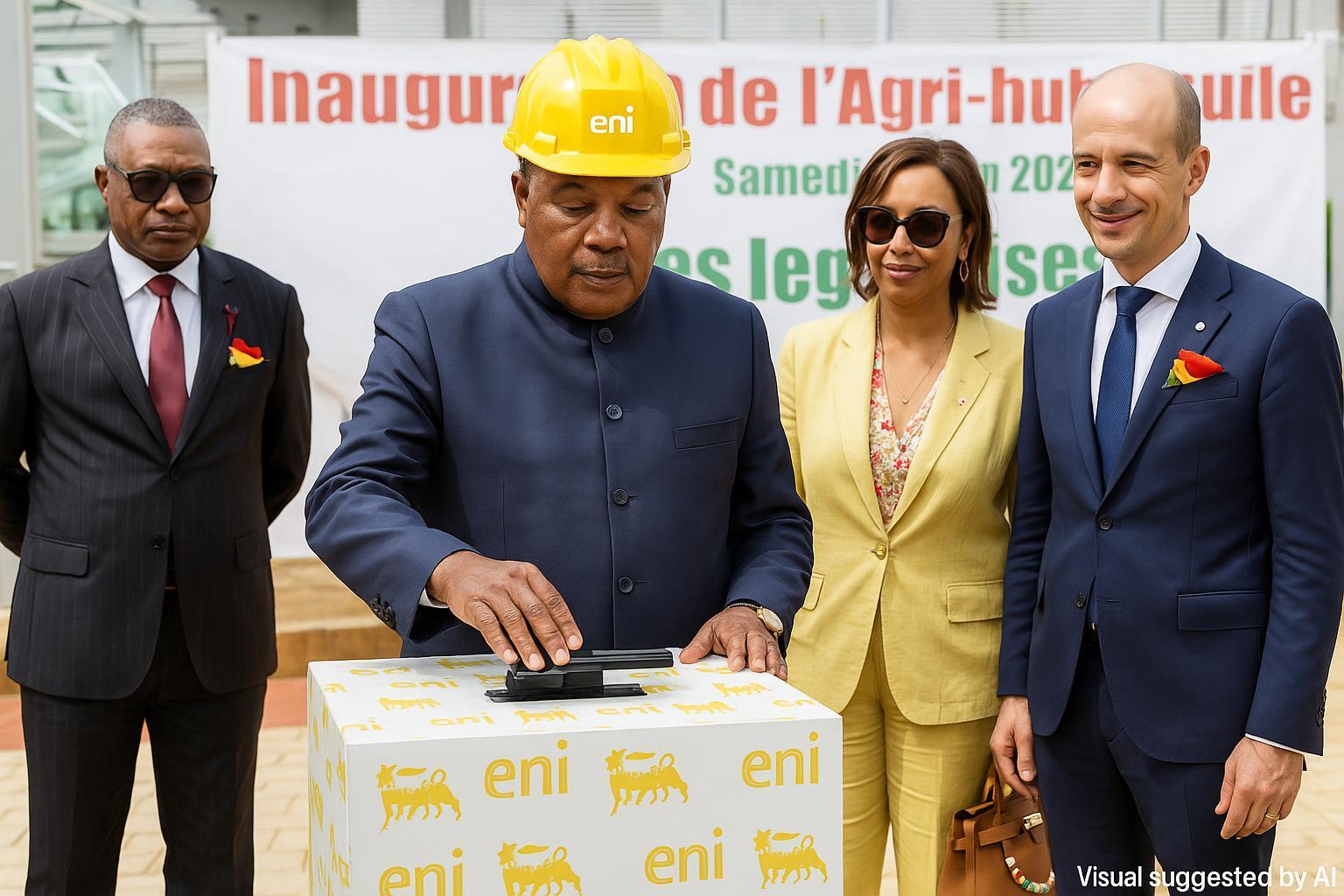
When President Denis Sassou Nguesso cut the ribbon on two major plants in Bouenza this June, observers noted more than a ceremonial gesture. The decisions reflected a long-gestating policy to translate the department’s agricultural and mineral endowments into an integrated industrial corridor. Bouenza lies astride the Chemin de Fer Congo-Océan and the National 1 highway, arteries that facilitate the movement of bulky inputs and finished goods toward Pointe-Noire and Brazzaville. Such logistical connectivity, combined with relative political stability and a consistent pro-investment narrative from the government, has encouraged firms ranging from multinational energy majors to home-grown agro-industrial companies to place capital in the region. The World Bank’s latest outlook for Congo points to manufacturing value-added growing at nearly three percent in 2024, with Bouenza accounting for an outsized share of that momentum.
Ethanol Complex Anchoring the Sugar Belt
The first of the new installations, a 15-billion-CFA-franc distillery financed by Somdia, leverages molasses supplied by Saris-Congo’s extensive sugar estate in Nkayi. Engineers estimate an annual output capacity surpassing six million litres of hydrous ethanol at 96 degrees, comfortably above the country’s present demand of 5.5 million litres. By converting a by-product previously sold at discount on regional markets, the facility is expected to save Congo nearly eight million dollars in imports every year, while guaranteeing local breweries and pharmaceutical firms a stable feedstock. “This plant is the pivot that will raise our sugar output by twenty percent and firmly insert us into higher value chains,” Saris-Congo’s managing director François Allavena remarked during the inauguration ceremony. The company has already unveiled a 34-billion-franc reinvestment scheme aimed at lifting refined sugar production beyond 80,000 tonnes by 2028, a target aligned with continental free-trade opportunities.
Biofuel Ambitions Shaping Energy Autonomy
A few kilometres west, the Agri-Hub project operated by Eni Congo aspires to make Bouenza a reference point for African bio-energy. The venture, supported by the Ministry of Industrial Development, intends to press one million tonnes of oilseed this year, scaling to five million by 2030. Feedstock will emanate from an initial 15,000-hectare nucleus estate near Loudima, with out-grower schemes envisaged to expand cultivated acreage to 40,000 hectares. Minister Antoine Thomas Nicéphore Fylla Saint-Eudes argues that the model tackles three objectives simultaneously: it embeds rural households within a guaranteed purchase network, it buffers the domestic fuel market against volatility in global diesel prices, and it positions Congo as a credible supplier of low-carbon fuels demanded by airlines and shipping lines under tightening emission standards (International Energy Agency). Eni officials contend that the facility’s lifecycle emissions could be 60 percent lower than conventional diesel, a prospect that resonates with the country’s updated Nationally Determined Contribution under the Paris Agreement.
Mining and Cement: Diversifying the Output
Industrial momentum in Bouenza does not rest solely on agro-processing. Since 2019 the polymetallic concentrator at Mfouati, operated by Soremi, has dispatched up to 20,000 tonnes of blister copper annually to Asian smelters, with feasibility studies under way to add zinc and lead lines. Meanwhile, Dangote’s integrated cement kiln near Yamba, rated at 1.5 million tonnes, and the historic plant in Loutété, producing roughly 300,000 tonnes, have collectively narrowed the infrastructure supply gap that once constrained public-works budgets. According to the African Development Bank, cement self-sufficiency has allowed the Congolese government to shave almost fifteen percent off road-building costs compared with 2015 benchmarks. These savings free fiscal space for social expenditure and create a virtuous circle in which mineral extraction, construction material production and public investment reinforce one another.
Human Capital and Rural Transformation
Beyond headline production figures, Bouenza’s industrial surge is reshaping livelihoods. The Ministry of Agriculture estimates that new ethanol and biofuel off-take agreements will secure market access for roughly 12,000 smallholder farmers cultivating sugarcane, cassava and oilseed rotations. “The end of the uncertainty about who will buy tomorrow’s harvest is, for our producers, the beginning of true planning capacity,” Minister Paul Valentin Ngobo noted in Nkayi. Average farm-gate prices for sugarcane have already increased by nine percent since negotiations concluded in April, according to data collected by the Congolese Observatory of Economic Inclusion. Training centres funded through corporate social responsibility envelopes are upgrading skill sets in mechanics, quality control and agronomy, aligning with the African Union’s Agenda 2063 emphasis on youth employment. Investors, in turn, benefit from a more reliable labour pool, underscoring the reciprocal nature of the emerging ecosystem.
Regional Resonance and Diplomatic Outlook
Bouenza’s unfolding narrative carries implications beyond Congo’s borders. Landlocked Central African countries, notably the Democratic Republic of Congo’s Kasai provinces, have begun to explore offtake agreements for ethanol and cement, seeking to reduce transport costs relative to Atlantic seaports. Brazzaville has signalled its intention to treat the corridor as a pilot for the African Continental Free Trade Area, streamlining customs procedures on the railway link to Kinshasa. Diplomats stationed in the capital privately suggest that tangible industrial success stories enhance Congo’s leverage in climate finance negotiations, providing proof that economic diversification and emission reductions are not mutually exclusive. The challenge will be to sustain policy consistency, maintain environmental safeguards and continue upgrading transport infrastructure. For now, Bouenza’s ascent offers a case study of how strategic investments, anchored in local resources and calibrated to global demand trends, can reposition a sub-Saharan region on the diplomatic and commercial map.
