
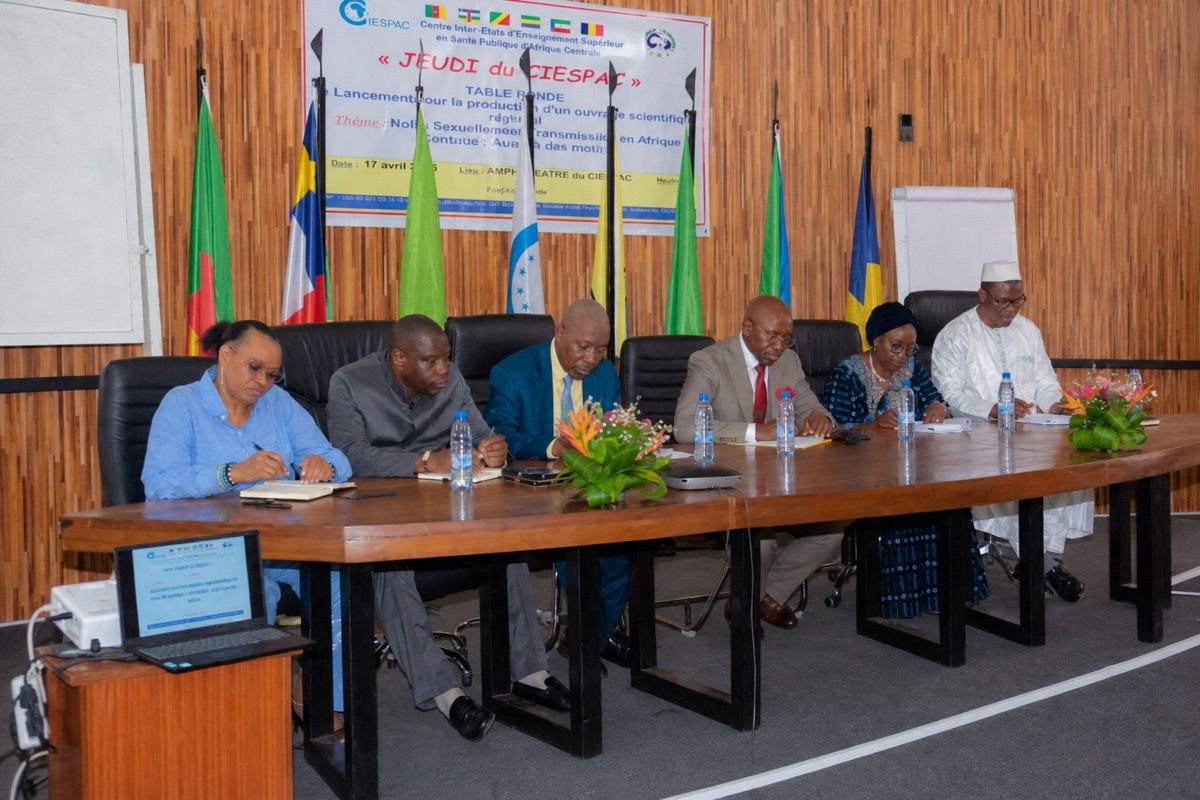
When a continent’s universities are tasked with shaping the physicians, administrators and engineers of tomorrow, the integrity of the grade they award is more than a clerical formality; it is a public guarantee. It was precisely that guarantee that the Inter-African Centre for Studies in Public Health Sciences for Central Africa (Ciespac) sought to interrogate in Brazzaville, where on 17 April it unveiled a scientific working project pointedly titled “Sexually transmissible grades in Central Africa: beyond the words.”
A Roundtable That Named the Unspoken
The session was led by Ciespac’s director-general, Professor Pierre Marie Tebeu, with discussions moderated by Dr Ray Mankele. Rather than a ceremonial gathering, the roundtable functioned as an attempt to give institutional language to a practice that thrives precisely because it is rarely articulated aloud: the exchange of sexual favours for academic marks. Organisers framed the phenomenon as one that, in their words, affects academic ethics and provokes a degradation of moral and institutional values, situating the discussion at the intersection of pedagogy, governance and public trust.
The choice of vocabulary is itself revealing. By borrowing the grammar of epidemiology, the phrase “sexually transmissible grades” reframes what is often dismissed as private misconduct as something closer to a contagion within the academy, one that spreads through silence, complicity and the asymmetries of power that bind a student to the person grading their future.
Why the Practice Endures
According to the presentation, the abuse persists across numerous institutions for reasons that are as much sociological as they are administrative. Cultural factors weigh heavily, as does the shame felt by students who fear that speaking out will brand them rather than their aggressors. Compounding this is the reluctance of teaching staff to denounce the conduct of colleagues, a discretion that, however collegial in intention, functions in practice as a shield for those who exploit their authority.
This combination produces a closed circuit. The victim is silenced by stigma, the witness is silenced by professional solidarity, and the institution, absent any external pressure, has little incentive to disturb an equilibrium that protects its reputation more than its students. It is this circuit that the Ciespac initiative appears determined to break, less through accusation than through the deliberate act of naming.
The Cost Measured in Competence
If the moral argument against the practice is self-evident, the roundtable insisted on a second, more pragmatic register. Dr Vincent Dossou Sodjinou, the World Health Organization’s representative in Congo, gave the warning its sharpest formulation. “These female students whom we are training today will not be effective tomorrow, because they are not well trained,” he cautioned (WHO).
The remark reframes the debate in terms that no ministry or employer can easily ignore. A grade obtained through coercion is not merely an ethical stain; it is a falsified credential that follows its holder into hospitals, classrooms and offices, where the gap between qualification and competence eventually becomes a matter of public consequence. In a region where Cemac states are straining to expand and professionalise their human capital, the erosion of academic credibility carries a cost that is measured not in scandal but in services that fail to function.
Toward a Response Built on Many Disciplines
The path forward sketched in Brazzaville was notable for its refusal of easy answers. Rather than treating the problem as a purely disciplinary matter to be handled by university administrators alone, the Cameroonian ambassador argued for enlisting sociologists, philosophers, psychologists, jurists and magistrates, so that the phenomenon might be addressed in its full complexity. The implication is that a problem rooted in culture, power and law cannot be resolved by codes of conduct alone.
In that spirit, participants ultimately recommended awareness campaigns and strategies for sharing experiences across institutions and borders, the better to mitigate the practice. Such measures are modest when set against the depth of the problem, and the gathering offered no illusion that exhortation would suffice. Yet the value of the exercise may lie precisely in its restraint. By documenting the phenomenon, lending it a precise vocabulary and convening representatives from public health, diplomacy and academia, the Ciespac has begun to shift the matter from the realm of rumour into that of policy.
Whether the regional academic community will follow that lead remains the open question. What the Brazzaville roundtable established, at minimum, is that the silence which sustains the practice is no longer total. For a fraud that depends on remaining unnamed, that alone is a meaningful first breach.
