
Beijing praises Rabat’s continental stewardship
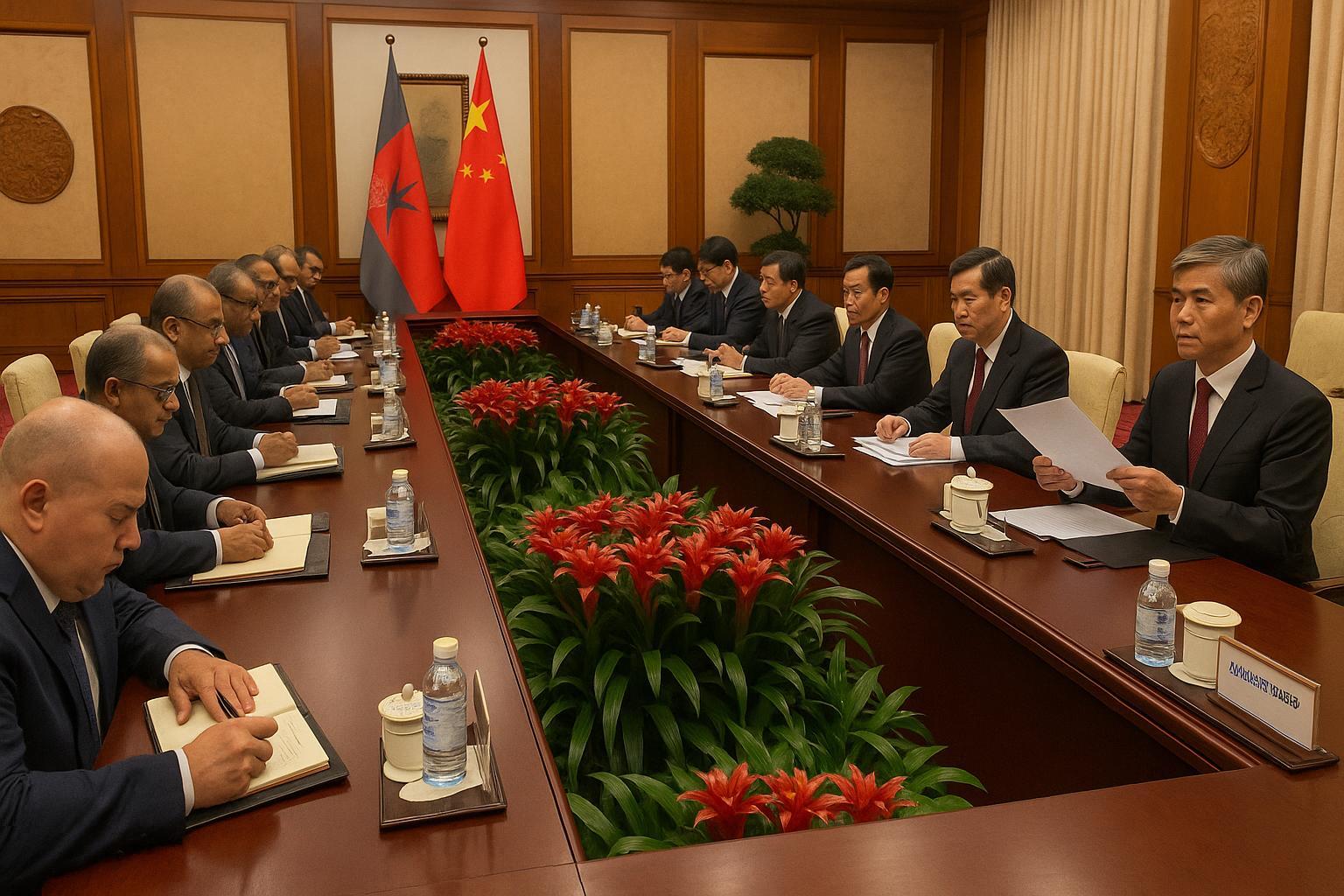
The marble halls of Diaoyutai State Guesthouse provided the backdrop on 19 September as Chinese Foreign Minister Wang Yi lauded what he termed the “far-sighted leadership” of King Mohammed VI in guiding Morocco toward lasting stability and positioning the kingdom as “a trusted bridge” for Africa’s renewal. The remarks, reported by China’s Ministry of Foreign Affairs and corroborated by Morocco’s Maghreb Arab Press agency, came at the opening of extended talks with Moroccan Foreign Minister Nasser Bourita. Wang suggested that Morocco’s reforms in governance, infrastructure and continental outreach have created “a virtuous circle” that other African states increasingly seek to emulate, underlining Beijing’s intention to work with Rabat on projects that blend economic gain with regional public goods (Xinhua, MAP).
Strategic partnership withstands regional headwinds
First elevated to a “strategic partnership” in 2016, Sino-Moroccan relations have matured against a backdrop of geopolitical flux in North Africa and the Sahel. While the region grapples with post-pandemic recovery, climate pressures and lingering security concerns, both capitals profess a shared reading of events: stability is a prerequisite for development, and development dampens insecurity. Chinese investment in Casablanca’s high-tech parks and in the Mohammed VI Tangier Tech City already exceeds USD 600 million, according to figures from the Moroccan economy ministry. For Wang, these projects illustrate how a pragmatic, non-ideological approach can outlast transient diplomatic storms. Bourita echoed the sentiment, stressing that “turbulence in the neighbourhood makes a results-oriented partnership with China not merely desirable but indispensable.”
Morocco aligns with Xi Jinping’s global agendas
During the Beijing session, Bourita reiterated Morocco’s “full support” for President Xi Jinping’s trio of multilateral blueprints: the Global Development Initiative (GDI), the Global Security Initiative (GSI) and the Global Civilization Initiative (GCI). Moroccan diplomats argue that the GDI’s emphasis on poverty reduction speaks directly to Rabat’s own New Development Model, launched in 2021 to lift growth beyond 6 percent and lower inequality. The kingdom’s early endorsement, analysts say, allows it to shape pilot projects on renewable energy, digital connectivity and vocational training that can be replicated across francophone Africa. By backing the GSI, Morocco likewise signals that its counter-terrorism experience—particularly in intelligence sharing and deradicalisation—could feed into broader African security architectures supported by Beijing.
Joining the International Organization for Mediation
Perhaps the most tangible outcome of the visit was Bourita’s formal announcement that Morocco will accede to the International Organization for Mediation (IOMed), a fledgling body headquartered in Hong Kong and championed by China to provide neutral dispute-resolution services. Diplomatic sources indicate that Rabat had quietly followed the drafting process since 2022, convinced that a non-Western venue for legal mediation could complement existing mechanisms within the African Union and the Arab League. For Wang, Morocco’s membership lends the endeavour immediate credibility in Africa and the Middle East. For Bourita, it offers another platform—alongside the Al-Quds Committee on Jerusalem and the UN’s mediation circles—through which the kingdom can project what the monarch calls “preventive diplomacy.”
Gateway between Africa and Asia: economic dividends
Economists interviewed by the Policy Center for the New South emphasise that deeper diplomatic rapport tends to translate into investment flows. China has already become Morocco’s third-largest trading partner, with bilateral commerce surpassing USD 7 billion in 2022, up from USD 4 billion in 2016. The Free Trade Zone of Tangier Med, one of Africa’s busiest ports, now handles weekly container services to Shenzhen, Ningbo and Qingdao, shortening shipment times for textiles, fertilizers and automotive parts. A senior official at the Moroccan Agency for Investment and Export Development notes that discussions are underway to co-finance solar panel assembly lines in Ouarzazate and green-hydrogen pilot sites near Dakhla. Such projects dovetail with both countries’ carbon-neutrality pledges, while giving Chinese firms privileged access to the African Continental Free Trade Area’s 1.3 billion-strong market.
Quiet diplomacy and the future of multilateralism
Beyond the contracts and photo opportunities, the Beijing meeting fits a broader pattern: medium-sized states leveraging diversified partnerships to navigate an increasingly fragmented international order. Professor Ma Xiaolin of Zhejiang International Studies University argues that Morocco’s blend of Atlantic, Mediterranean and Sahelian identities grants it a diplomatic agility that Beijing values in multilateral fora such as the Forum on China-Africa Cooperation. Conversely, Dr. Khadija Mohsen-Finan of Sorbonne University points out that China offers Morocco a counterweight to traditional European partners while posing no conditionality on human rights, an approach she describes as “risk-aware but not risk-averse.” In the closing statement, Wang Yi summed up the calculus: “A stable, prosperous Morocco anchored in Africa is an asset for global peace.” Bourita, for his part, framed the visit as evidence that “dialogue, mutual respect and solidarity remain the surest path to collective security and shared growth.” The resonance of these words suggests that Beijing and Rabat, each for its own reasons, have found in one another a dependable interlocutor at a time when dependable interlocutors are in short supply.
