
Judicial resolve in the Likouala
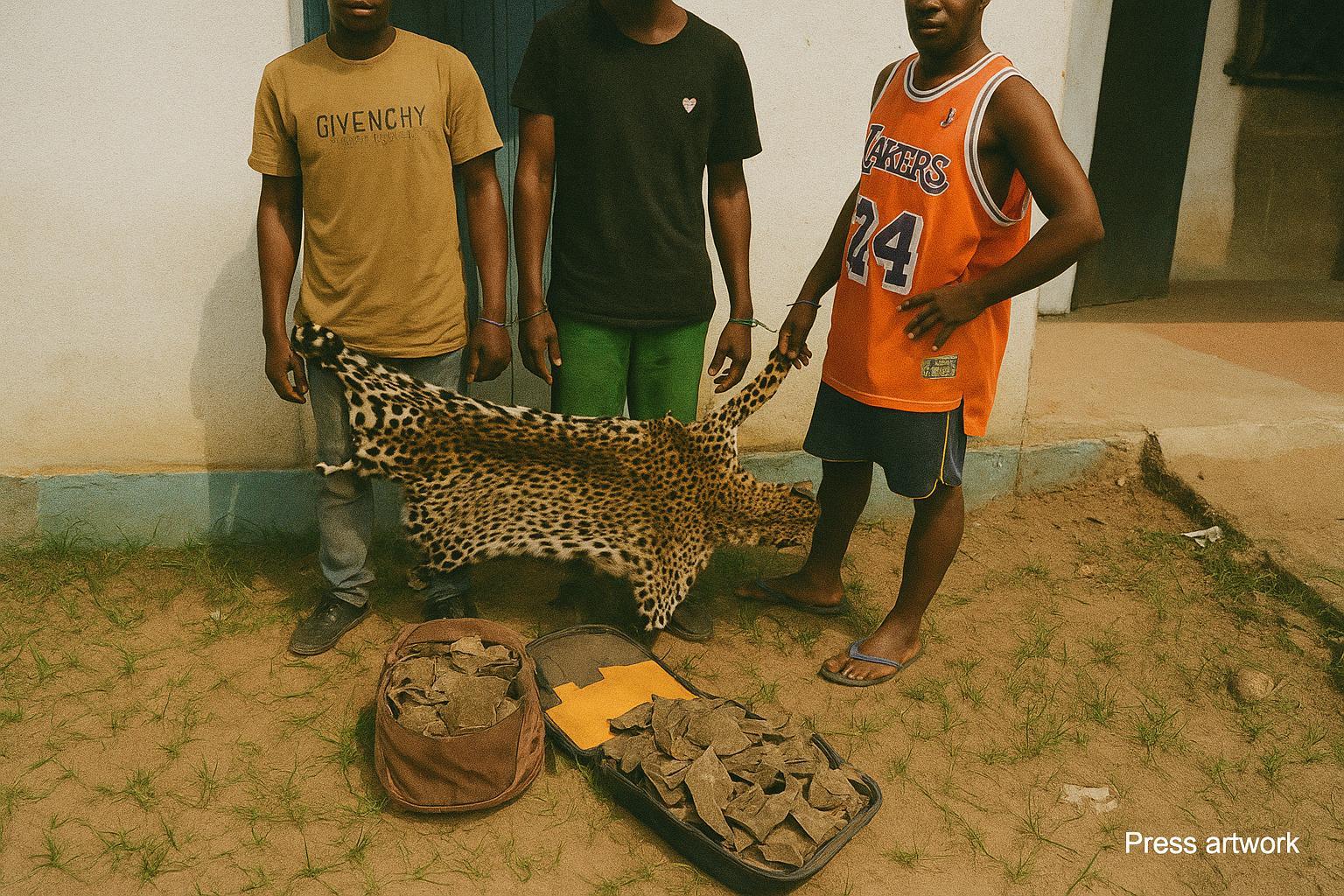
Silence fell over the Tribunal de Grande Instance of Impfondo on 26 June as the presiding judge read a decision that resonated well beyond the mahogany benches of the courtroom. Three Congolese nationals—Jodel Mouandola, Arel Ebouzi and Parfait Mbekele—were sentenced to terms ranging from two to three years’ imprisonment, together with pecuniary penalties that the court calibrated at one to three million CFA francs. The men had been apprehended a month earlier in flagrante delicto, their possessions including the stripped skin of a panther, several kilograms of pangolin scales and four formidable claws from the world’s largest pangolin species. In a nation where fauna offences long lingered in bureaucratic limbo, the speed and firmness of the ruling have been interpreted by observers as a marker of growing prosecutorial confidence.
The legal framework safeguarding biodiversity
Congo-Brazzaville’s statute book has for over a decade codified robust prohibitions on trade in integral species. Article 27 of Law 37-2008 unmistakably forbids the import, export, possession or transit of fully protected fauna without scientific dispensation. Yet, as conservation jurists often note, the gulf between text and enforcement can be wide in forested jurisdictions where judicial resources are thin. The Impfondo verdict therefore serves a dual function: it sends an unequivocal signal to traffickers while reaffirming the relevance of the domestic legal architecture to which the Republic acceded when it ratified CITES in 1983. By explicitly recognising the gravity of killing and commercialising Panthera pardus and Smutsia gigantea—both listed under CITES Appendix I—the court situated its reasoning within an international matrix of obligations.
Regional context of illicit wildlife trafficking
Central Africa’s dense mosaic of rivers and porous borders has long rendered the sub-region a corridor for pangolin, ivory and big-cat derivatives destined for Asian and, increasingly, trans-Atlantic markets. The 2020 UNODC World Wildlife Crime Report estimated that more than 180 t of pangolin scales were seized globally between 2014 and 2018, a significant share originating from the Congo Basin. Against that backdrop, Likouala’s position adjacent to the Ubangi River and the tri-point with the Central African Republic and the Democratic Republic of the Congo makes it a strategic waypoint for clandestine consignments. Conservation analysts from TRAFFIC have warned that seizures represent only a fractional window into an opaque trade whose profitability may eclipse that of some narcotics. Consequently, each successful prosecution marginally raises the cost of doing business for traffickers who rely on a calculus of impunity.
Governance, partnerships and capacity building
That calculus shifted in May when gendarmes stationed at Impfondo and Épéna, aided by the Departmental Directorate of Forestry Economy and the PALF project, orchestrated a coordinated sting. The operation illustrates the multi-layered governance model promoted in Brazzaville’s 2016 National Ivory Action Plan, which emphasises inter-agency task forces and collaboration with specialised NGOs. PALF’s technical support—ranging from forensic documentation to courtroom advocacy—mirrors global best practice endorsed by the International Consortium on Combating Wildlife Crime. At the political level, senior officials view such synergies as consonant with President Denis Sassou Nguesso’s commitment to environmental security, articulated during his 2021 address at the Congo Basin Climate Commission. Diplomats following regional dossiers privately note that prosecution metrics have become an increasingly salient benchmark in bilateral dialogues on sustainable forestry assistance.
Balancing conservation imperatives with livelihoods
Yet deterrence alone cannot nullify the economic incentives that push rural actors toward illicit trade. Pangolin scales command prices that can surpass local monthly earnings within a single transaction, and panther pelts remain coveted in certain ceremonial markets. Authorities in Likouala therefore complement repressive measures with community-based conservation schemes, such as the Sangha-Tri-National landscape initiative, which channels revenue from ecotourism into micro-projects for fishing cooperatives and non-timber forest product harvesters. Experts from the Wildlife Conservation Society argue that scaling these alternatives is pivotal if verdicts like Impfondo’s are to translate into long-term behavioural change. The challenge is intricate: maintaining social cohesion in remote districts while safeguarding species that symbolise national patrimony and global biodiversity alike.
A cautiously optimistic trajectory
For the defendants, the courtroom doors have closed; for conservation governance, they have opened a window onto cautious optimism. The Impfondo judgment underscores the fact that statutory tools enacted in Brazzaville can acquire tangible force in outlying provinces when institutional coordination is sustained. While no single case can recalibrate the entire economics of wildlife crime, each successful prosecution chips away at a sophisticated supply chain that stretches from forest clearing to overseas boutique. Diplomatic interlocutors assess that continued support for judicial training, cross-border intelligence sharing and livelihood diversification will determine whether the Likouala model can be replicated across the Congo Basin. In the meantime, the scales and the skin that triggered this legal odyssey reside in an evidence room, silent emblems of a state’s resolve to convert conservation rhetoric into jurisprudential fact.
