
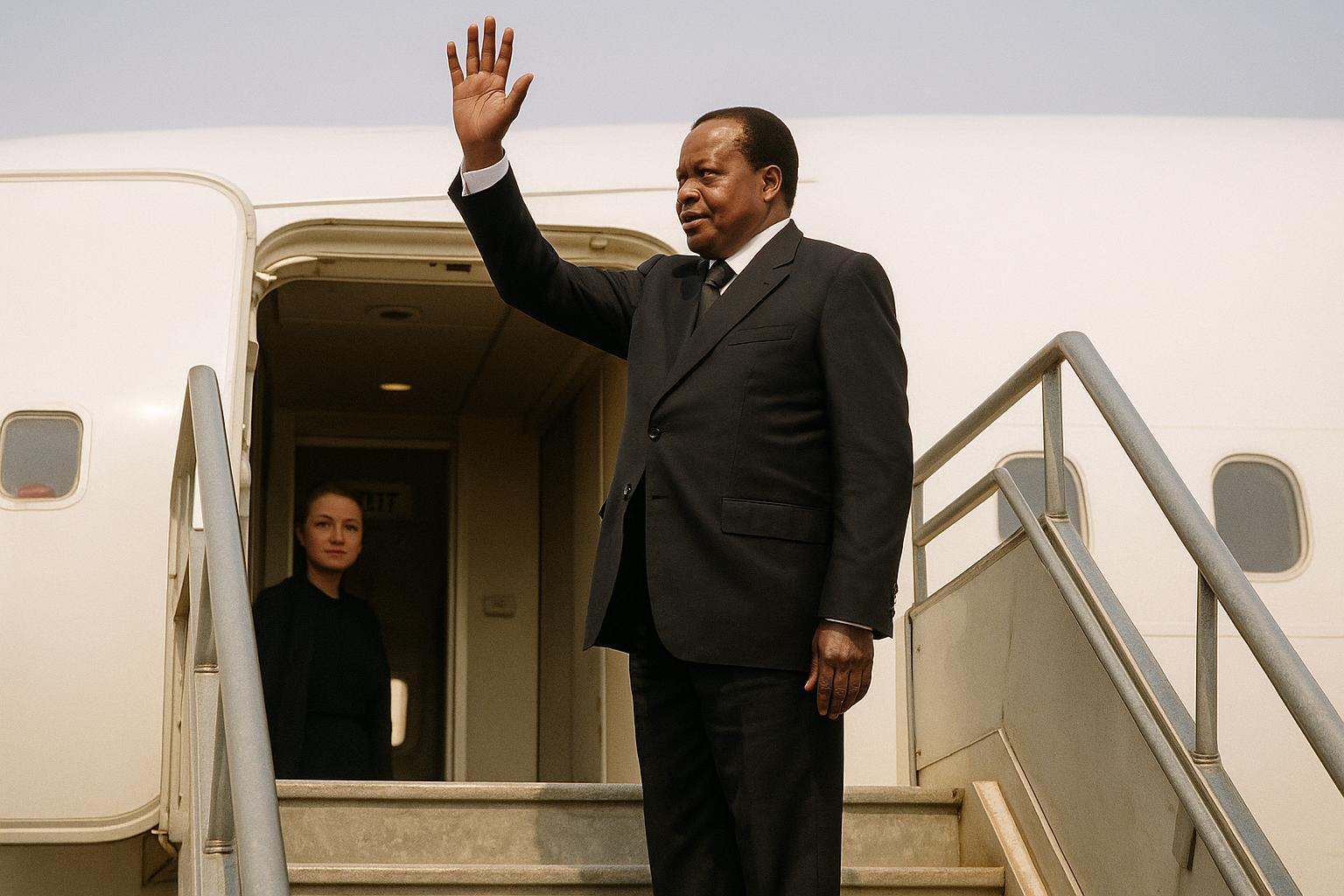
Congo Diplomacy at UNGA 80
From 23 to 29 September, President Denis Sassou Nguesso will stride onto the marble rostrum of the United Nations for the 80th General Assembly, a gathering themed “Together for Peace, Development and Human Rights: 80 Years and Beyond.” Congolese officials confirm that the Head of State intends to deliver a message that blends realism with ambition, insisting that a rules-based multilateral order remains the most reliable compass for navigating an era of compound crises. In Brazzaville, Foreign Minister Jean-Claude Gakosso framed the mission succinctly: “Our duty is to make the Congo’s voice resonate for all those who believe in dialogue over division.”
Long regarded as a skilled mediator in Central Africa, Sassou Nguesso arrives in New York with an agenda calibrated to the continent’s priorities—climate adaptation, debt sustainability, and fair access to technology—yet anchored in the specificities of the Congo Basin, the planet’s second-largest tropical lung after the Amazon.
Multilateralism as Strategic Compass
Congo-Brazzaville’s foreign policy has historically leaned on collective security frameworks, from the African Union Peace and Security Council to the International Conference on the Great Lakes Region. At UNGA 80, the President is expected to reaffirm that same doctrinal commitment, advocating an “inclusive and reactive multilateralism” capable of defusing conflicts before they metastasise. Regional observers point out that Brazzaville’s successful facilitation of talks in the Central African Republic has granted Sassou Nguesso a credibility few leaders in the sub-region enjoy.
Diplomats anticipate that he will echo the African Union’s call for a permanent seat for Africa on the Security Council, a reform viewed in Brazzaville not as a privilege but as a corrective to historic under-representation. According to sources close to the delegation, the speech will underline that “global stability can no longer be managed by the geopolitical arithmetic of 1945.”
Protecting Congo Basin Forests and Climate Finance
Beyond security, Congo intends to leverage the New York stage to advance the cause of forest preservation. The nation hosts roughly 10 percent of Congo Basin rainforest, a critical carbon sink that absorbs close to 1.5 gigatonnes of CO₂ annually, according to the Central African Forest Initiative. Brazzaville’s diplomats argue that safeguarding this biome is a global public good deserving predictable, adequate and concessional finance.
During a side event co-organised with Brazil and Indonesia—partners in the ‘OPEC of Rainforests’ trilogue—Sassou Nguesso will press donor countries to operationalise the Loss and Damage Fund agreed at COP27. Officials hint at a proposal to channel part of the Special Drawing Rights reallocation toward nature-based solutions in the Basin, a mechanism apt to marry macroeconomic resilience with environmental stewardship.
Economic Resilience and South-South Partnerships
Congo’s economy, projected by the IMF to grow by around 4 percent in 2024, has embarked on an oil-diversification trajectory that still requires foreign direct investment and technology transfer. From the UNGA sidelines, the President is scheduled to meet executives of the International Finance Corporation and the African Export-Import Bank to discuss blended-finance structures for agro-industrial corridors along the Ouesso-Brazzaville axis.
The delegation also intends to court Asian and Middle-Eastern sovereign funds. A senior adviser, speaking under condition of anonymity, remarked that “South-South capital is increasingly aligned with our development philosophy: patient, partnership-driven and respectful of national ownership.” Such overtures reinforce the administration’s goal of reducing the economy’s exposure to hydrocarbon volatility while positioning Congo as a transit hub between Atlantic and Indian Ocean markets.
Geopolitical Outreach from New York
New York’s diplomatic corridors offer a unique opportunity for bilateral engagements. Scheduled conversations include talks with French President Emmanuel Macron on maritime security in the Gulf of Guinea, consultations with UN Secretary-General António Guterres on peacekeeping mandates, and a high-level breakfast with the Community of Portuguese Language Countries, of which Congo is an associate observer.
Analysts from the Institute for Security Studies note that Brazzaville’s quietly assertive diplomacy has helped keep regional tensions contained. By sustaining dialogue with both Western partners and emerging powers such as China and India, Sassou Nguesso cultivates what one diplomat describes as “strategic equidistance,” enabling the country to extract cooperation without becoming enmeshed in great-power rivalries.
À retenir
The 80th session comes at a delicate juncture, with global greenhouse gas emissions climbing and geopolitical fractures widening. Congo’s delegation aims to showcase the country as a linchpin of climate stability, a laboratory for green-growth experimentation and a bulwark of regional peace. By foregrounding solutions—be they carbon-credit certification in peatlands or digital skilling programmes for youth—the President’s message aspires to transcend mere exhortation and pivot toward implementable initiatives that can be tracked before the 2024 COP in Baku.
Le point juridique et économique
From a legal standpoint, any new climate-finance mechanism advocated by Brazzaville must align with Article 9 of the Paris Agreement, which enshrines developed countries’ obligation to furnish financial resources. Economists in the delegation emphasise that channelling part of the IMF’s SDRs through multilateral development banks could respect both the letter of Bretton Woods statutes and the desire for concessionality.
Furthermore, Congo’s domestic fiscal reforms, launched in tandem with the Extended Credit Facility, have expanded budgetary space for social programmes by strengthening non-oil revenue mobilisation. The administration’s position in New York thus rests on a dual argument: responsible macroeconomic governance at home and a fair international financial architecture abroad.
