
Bangui gathers Central African leadership
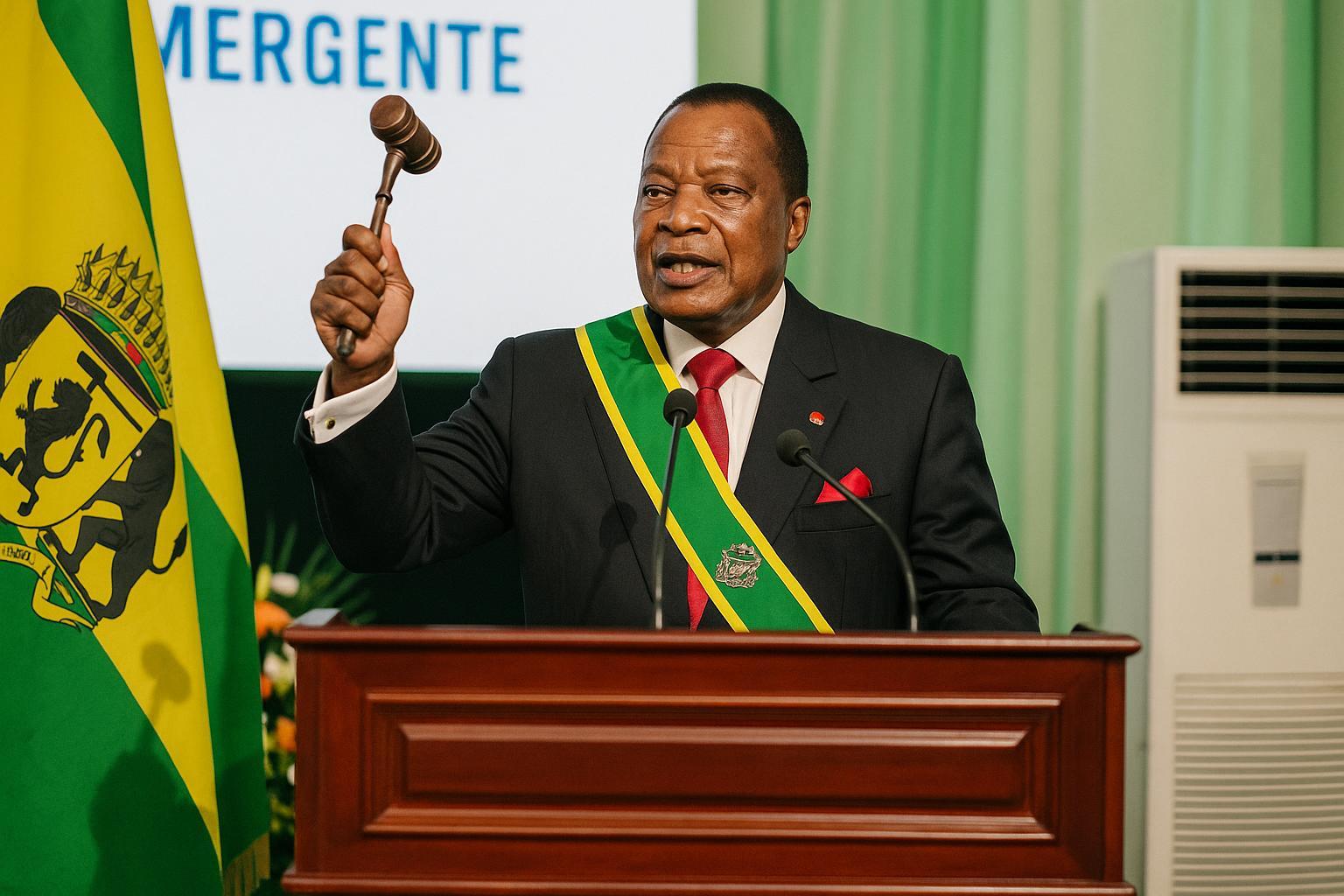
The skyline of Bangui hummed with diplomatic activity from 9 to 10 September 2025 as the six heads of state that compose the Economic and Monetary Community of Central Africa converged on the Central African capital. Inside the bright hall of the Renaissance Palace, President Faustin-Archange Touadéra welcomed his peers from Cameroon, Chad, Congo, Gabon and Equatorial Guinea for an extraordinary session devoted to resetting the integration agenda. A yellow standard—symbol of the organisation since its creation in 1994—stood at the rostrum, waiting for its next bearer. At the closing ceremony, Touadéra folded the flag with studied solemnity before handing it to Denis Sassou Nguesso, who assumes the rotating chairmanship for the coming two years. The ritual, discreetly applauded by delegations, sealed a transition meant to invigorate a community representing 55 million citizens and a combined GDP of roughly USD 113 billion (BEAC data 2024).
Sassou Nguesso’s vision for accelerated integration
In his inaugural address, the Congolese leader invoked the intellectual heritage of pan-Africanism and urged his counterparts to “move from declarations of intent to measurable progress.” Citing the original 1994 treaty, Sassou Nguesso argued that the organisation can still serve as a laboratory for continental integration if it secures reliable financing and harmonises regulations. He announced the constitution of a high-level task force, to be coordinated by the CEMAC Commission and the Bank of Central African States, with instructions to publish quarterly scorecards on customs convergence, fiscal performance and project execution. “We will judge ourselves by numbers, not by rhetoric,” he insisted, framing accountability as the cornerstone of his mandate (official communiqué).
Free movement roadmap gains traction
One immediate deliverable of the Bangui summit is the endorsement of an operational blueprint for free movement of persons and goods. Under the plan, member states commit to rolling out a single biometric travel document by mid-2026 and to reducing tariff lines still excluded from the common external tariff. The Commission estimates that intra-CEMAC trade, which hovers below 5 per cent of total commerce, could triple within five years if border formalities are streamlined. Cameroon’s President Paul Biya voiced support, noting that Douala and Kribi ports can serve as maritime gateways for land-locked Chad and Central African Republic. Meanwhile, Equatorial Guinea’s Teodoro Obiang Nguema Mbasogo welcomed a pilot corridor linking Bata, Libreville and Pointe-Noire, pledging customs modernisation equipment co-financed by his government.
Economic headwinds require concerted response
Despite the upbeat rhetoric, delegates acknowledged the common challenges of sluggish growth and elevated debt ratios. Average regional expansion slowed to 2.8 per cent in 2024, down from 4.1 per cent in 2022, partly because of weaker hydrocarbon prices and climatic shocks that battered agricultural output (BEAC statistics 2025). Finance ministers, meeting in parallel, agreed to deepen coordination under the Programme des Réformes Économiques et Financières (PREF-CEMAC) supported by the IMF. Key elements include reinforcing non-oil revenue, prioritising infrastructure with high regional spill-overs and public-private partnerships subject to transparent procurement. The consensus underscores the view that fiscal consolidation and integration are mutually reinforcing rather than competing priorities.
Security cooperation amid regional volatility
Beyond macroeconomics, the summit spent significant time on security. Lake Chad Basin insurgencies, piracy in the Gulf of Guinea and illicit trans-border trafficking jeopardise the investment climate. Chad’s Mahamat Idriss Déby Itno argued for “credible deterrence” through joint intelligence cells and rapid-reaction battalions, proposals echoed by Gabon’s transitional president, General Brice Clotaire Oligui Nguema. Sassou Nguesso pledged Congo’s participation in combined exercises scheduled for early 2026 and advocated a security-development nexus: “Roads that carry trade must not become vectors of violence.” Analysts see the move as complementing existing ECCAS mechanisms, bringing a pragmatic division of labour between the political and monetary wings of Central Africa’s institutional architecture (regional security brief 2025).
À retenir
The Bangui summit marks a leadership handover viewed as both symbolic and operational. With Denis Sassou Nguesso at the helm, CEMAC has adopted a clearer calendar for free movement, vowed to publish performance scorecards and endorsed joint security deployments. The emphasis on measurable outcomes seeks to reassure citizens, investors and multilateral partners that the integration project is entering a phase of tangible delivery.
Le point économique
Public debt across the union averages 54 per cent of GDP, still below the 70 per cent convergence ceiling but unevenly distributed, with oil-importing Central African Republic above 60 per cent and Cameroon below 45 per cent. The BEAC maintained its policy rate at 5 per cent in July 2025, balancing inflation control against the need for credit expansion. Analysts expect that accelerating the customs union and deepening the financial market in Douala could draw portfolio inflows, easing pressure on treasuries. However, success hinges on member states uploading agreed reforms into domestic legislation without delay, a point Sassou Nguesso promised to monitor “with fraternal firmness.”
Diplomatic outlook under Congo’s rotating chair
Observers note that Brazzaville has historically positioned itself as a mediator in Central Africa, leveraging its linguistic duality and seasoned diplomacy. Under Sassou Nguesso, CEMAC will host a partners’ forum in Pointe-Noire next June, inviting Gulf, Chinese and European investors to co-finance energy corridors and climate-resilient agriculture. By insisting that integration, security and sustainability form an indivisible triad, the new chair seeks to place the sub-region at a crossroads where strategic geography meets global demand for critical minerals and carbon sinks. The months ahead will test the ability of the member states to convert summit proclamations into trucks rolling across borders, data flowing through fibre and youth finding jobs at home rather than abroad. In Bangui, at least, the commitment was audible and the applause enduring.
