
Ouesso becomes a hub for modernised procurement
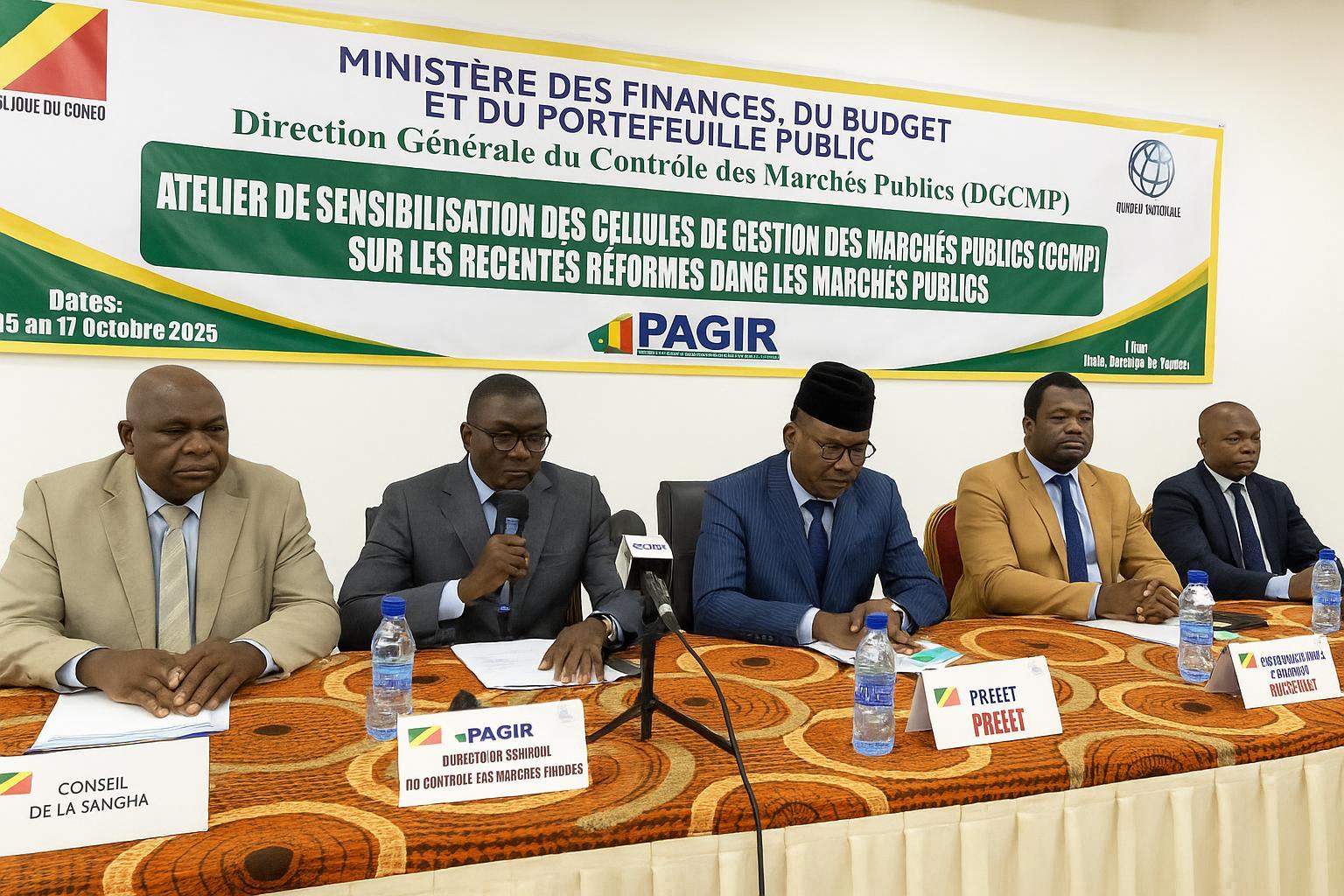
For three intensive days the northern river town of Ouesso, administrative capital of the Sangha department, swapped its customary calm for the jargon of public–sector accountants and legal advisers. Convened by the Directorate-General for the Control of Public Procurement, the seminar gathered procurement officers from six departments and four municipalities, all eager to decode the country’s new procurement architecture. Officially opening the session, Sangha Prefect Edouard Denis Okouya framed the exercise as an investment in public trust. Transparency, he argued, is the surest path to maximise the socio-economic dividends that the state, under the leadership of President Denis Sassou Nguesso, expects from every franc of public expenditure.
A reform designed to restore confidence
The overhaul of Congo-Brazzaville’s procurement code, promulgated earlier this year, tightens compliance requirements, shortens bidding cycles and clarifies the appeals process. According to the closing communiqué issued by organisers, the ultimate aim is to build “a modern and reliable public contracting system” that aligns with international best practice while reflecting national realities. By partnering with the World Bank’s Programme for Accelerating Institutional Governance and Reform (PAGIR), Brazzaville signals to domestic and foreign investors alike that fiscal discipline and procedural clarity are now hard-wired into government operations.
Four thematic pillars structure the training
The agenda revolved around four technical clusters. The first unpacked the legal and institutional architecture, highlighting the specific role of each oversight body. The second examined how procurement planning must now dovetail with the annual budget cycle, avoiding the cash-flow bottlenecks that have historically delayed project execution. The third navigated officers through the re-engineered tendering sequence, from drafting calls for bids to evaluating proposals under a merit-and-price matrix. The fourth scrutinised the administrative and fiscal dossiers contractors must submit, a feature meant to widen participation while filtering out shell entities. Trainers alternated lectures with practical simulations, ensuring that theory could swiftly migrate to field practice.
Local voices echo national ambitions
Participants from the remote districts of Impfondo and Pokola voiced particular appreciation for the hands-on format. In the words of an Impfondo municipal officer, “Our previous guidelines left room for interpretation; the new code provides a compass we can follow with confidence.” Such endorsements matter because local authorities execute a growing share of public investment under Congo’s ongoing decentralisation drive. Ensuring they master the updated rules therefore extends the reform’s reach beyond ministerial headquarters into classrooms, health centres and feeder roads whose contracts they award.
Strengthening institutional synergies
Officials from the Directorate emphasised that compliance will now be monitored through a digital platform capable of flagging irregularities in real time. Although still in a pilot phase, the tool promises to shorten the distance between Ouesso and the capital, enabling supervisors in Brazzaville to review tender documents almost instantly. This technological layer complements the human capacity-building achieved during the workshop, forging what one trainer described as a “double lock” on malfeasance.
À retenir
The Ouesso seminar underlines a broader policy trajectory: by prioritising transparent procurement, the Congolese government projects fiscal prudence at a juncture when development partners and credit-rating agencies closely scrutinise sovereign balance sheets. Aligning procedures with World Bank benchmarks bolsters the country’s appeal to concessional lenders and private investors, whose participation will be vital for financing the National Development Plan.
Legal and economic perspective
Congo’s refreshed legal corpus elevates procurement violations from administrative lapses to offences subject to financial penalties and potential litigation. Such deterrence seeks to protect public funds and reassure contractors that the playing field is level. Economically, streamlined tendering can accelerate project delivery, reducing the cost overruns that inflate the public wage bill and crowd out social spending. By empowering departmental and municipal agents to apply the rules rigorously, the reform also nurtures a cadre of professionals whose expertise can migrate to the private sector, thereby deepening the national skills pool.
Looking ahead
As participants dispersed back to the Cuvette, Likouala, Plateaux and Cuvette-Ouest, they carried not only binders of updated statutes but also a mandate to act as ambassadors of good practice. The Directorate-General has promised follow-up missions to audit progress and troubleshoot challenges. Should the momentum generated in Ouesso translate into cleaner tenders and faster project roll-outs, the workshop will have served as more than a training session; it will stand as a milestone in Congo-Brazzaville’s quest for governance excellence.
