
Faith and Enterprise Converge in Pointe-Noire
For two intense August days, the Archdiocese of Pointe-Noire abandoned its customary liturgical cadence for the brisk tempo of business pitches and policy dialogue. The maiden Social Forum on Youth Entrepreneurship, held in the vast conference hall of the Autonomous Port, convened young Christians eager to translate spiritual conviction into market solutions. Under the banner “Faith, Vision and Action: Catalysing Youth Entrepreneurship in Christian Communities for Durable Social Cohesion,” the gathering linked the Biblical parable of talents to the contemporary quest for self-employment.
Attendance exceeded the organisers’ expectations. Scores of would-be founders lined the aisles, clutching business canvases ranging from eco-friendly detergents to digital services. Each participant was animated by the mantra that personal vocation can be a driver of national development, an idea firmly rooted in the pastoral plan of the Archdiocese and equally resonant with Congo-Brazzaville’s diversification agenda.
Strategic Alliance Between State and Church
The symbolic weight of the opening session was unmistakable. Prime Minister Anatole Collinet Makosso, flanked by several cabinet members, shared the podium with the Metropolitan Archbishop of Pointe-Noire, Mgr Abel Liluala. Their presence underscored a maturing partnership shaped by the 2017 framework agreement between the Republic of Congo and the Holy See. “Our cooperation is anchored in human dignity and shared responsibility for development,” the Premier affirmed, inviting the audience to view faith-based entrepreneurship as a strategic complement to public policy.
Minister of Small and Medium-Sized Enterprises and Handicrafts Jacqueline Lydia Mikolo detailed the practical ramifications of that complementarity. Her ministry, she noted, is committed to extending training programmes, incubation hubs and concessional finance to forum alumni, including youth living with disabilities. By anchoring the forum within the national initiative “Un jeune, une entreprise,” the government signalled that the Church can be a decisive vector for micro-enterprise formalisation and job creation.
From Inspiration to Seed Capital
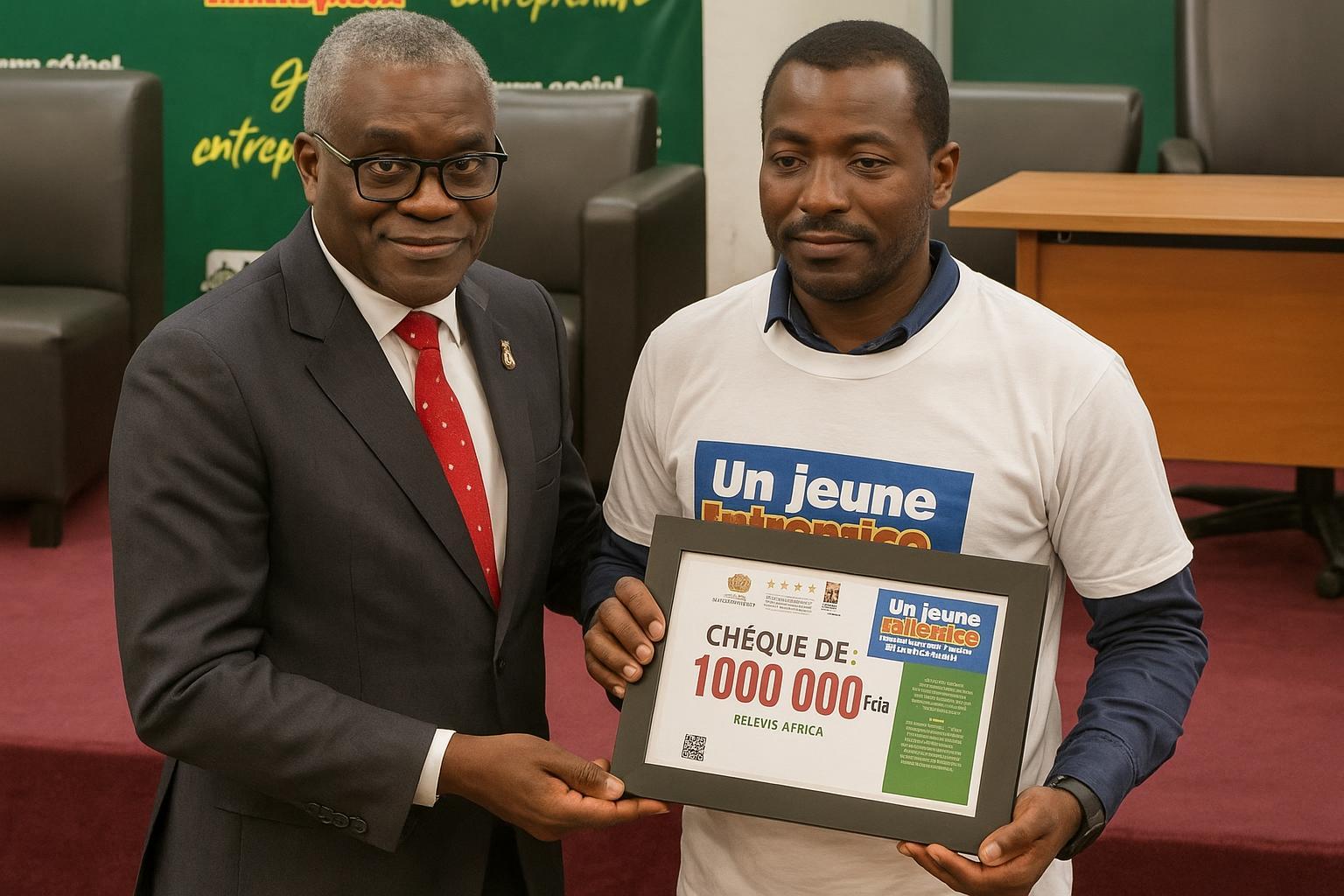
Words quickly morphed into tangible commitments. Moments before the technical workshops commenced, several participants were called forward to receive oversized cheques—symbolic yet redeemable guarantees of seed funding. The disbursements are scheduled to be managed through a joint monitoring mechanism established by the ministry and the Archdiocese’s Commission for Projects and Development. Observers noted that the gesture transcended ceremony; it addressed a structural bottleneck in Congo’s entrepreneurial ecosystem: the scarcity of early-stage capital.
One beneficiary, who introduced himself simply as Christ, recounted how a diocesan training module in basic accounting had enabled him to launch Kalase, a line of household lubricants manufactured from locally sourced palm derivatives. “I entered the programme with a concept and left with a prototype,” he told the audience, drawing sustained applause. Such testimonies illustrated the forum’s attempt to move beyond motivational rhetoric toward measurable outputs.
Entrepreneurial Literacy as Social Inclusion
Beneath the celebration lay a sober diagnostic. According to data cited by the mayor of Pointe-Noire, Evelyne Tchitchelle, roughly 40 percent of the city’s youth are either unemployed or under-employed. The forum therefore framed entrepreneurial literacy not merely as a growth lever but as an inclusion strategy. Panel discussions unpacked themes such as market research, intellectual property, and resilience in the face of failure. Mgr Liluala’s exhortation—“God wishes to see your talents bear fruit”—was complemented by secular advice on regulatory compliance and export readiness.
The cross-fertilisation of spiritual and managerial discourses yielded an atmosphere Matthieu, a recent engineering graduate in attendance, likened to “an MBA with catechism on the side.” Participants left with resource kits summarising tax incentives, cooperative models, and digital marketing tactics, compiled collaboratively by diocesan volunteers and ministry technicians.
Charting a Sustainable Impact for Congo’s Youth
As proceedings closed, the organisers released a communiqué outlining next steps: establishment of a revolving micro-credit fund, quarterly mentoring sessions, and an annual impact evaluation co-led by the National Institute of Statistics. These instruments, if executed faithfully, could convert the forum from a one-off event into a scalable platform.
Analysts contend that the Pointe-Noire model aligns with continental trends where faith communities increasingly assume a developmental role. Yet its durability will be tested by macroeconomic headwinds and the imperative of good governance within sponsored ventures. For now, the palpable enthusiasm of attendees signals that a seed has been planted. Whether that seed matures into a forest of Congolese start-ups may hinge on the continued synchrony between pulpit and policymaker, prayer and performance.
In the words of Minister Mikolo, “Awakening entrepreneurial consciousness is the first milestone; nurturing it to fruition is our collective covenant.” The Pointe-Noire forum has, at minimum, placed that covenant squarely on the national agenda, illustrating how faith-driven initiative can dovetail with state strategy to expand opportunity and reinforce social cohesion across the Republic of Congo.
