
Epidemiological Snapshot of the 2025 Wave
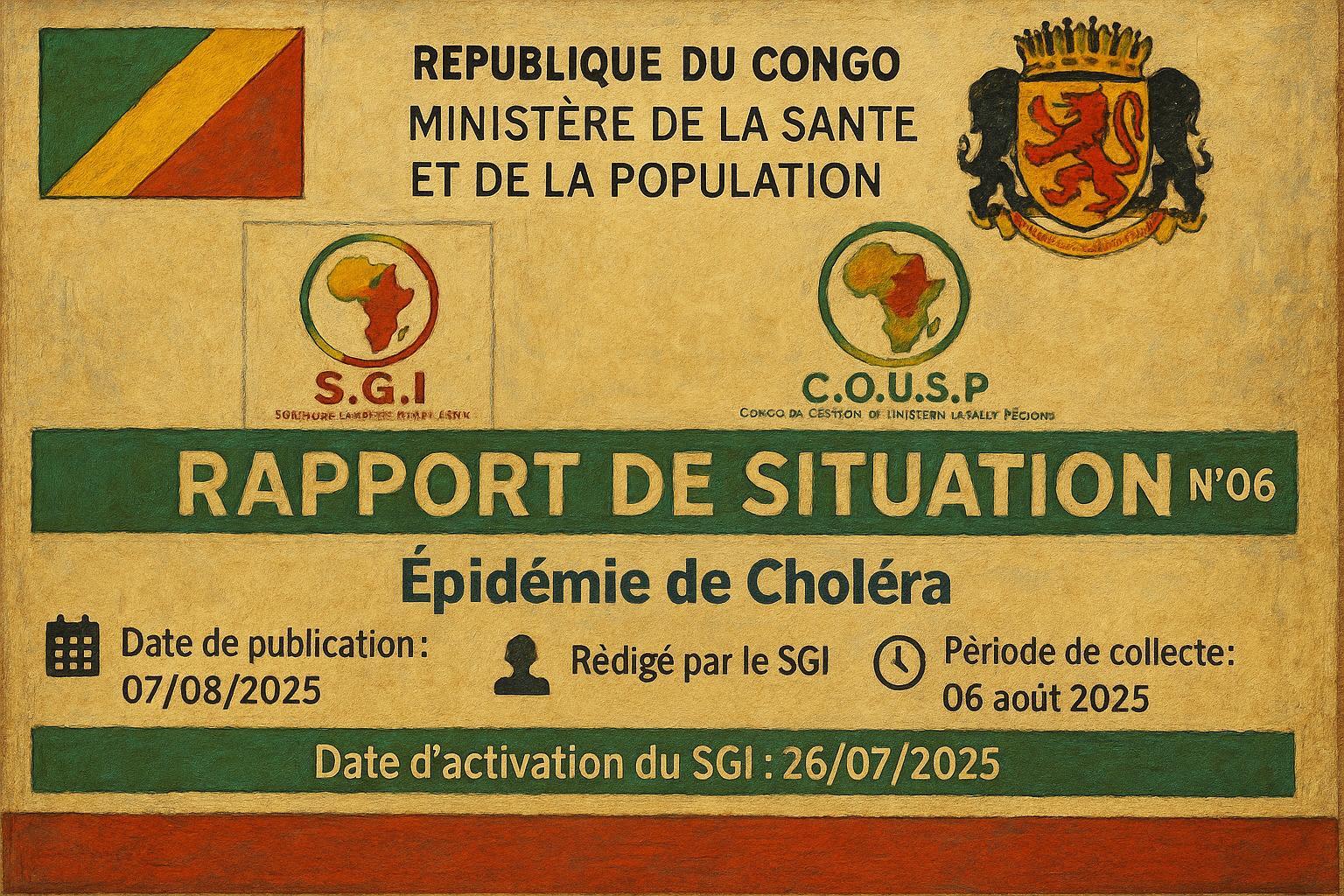
The sixth situation report issued by the World Health Organization’s Regional Office for Africa on 7 August 2025 places the cumulative caseload in the Republic of Congo at just under three thousand, with a case-fatality ratio stabilised below two per cent. The figure is significant for a landlocked transmission corridor that follows the Congo River yet remains proportionally lower than the regional mean observed in neighbouring Lake Tanganyika states. Field epidemiologists attribute the moderation to the early activation of a multi-sectoral incident command system in late May, a full fortnight before the annual monsoon-driven surge traditionally complicates surveillance.
Analysts note that the current curve differs markedly from the 2011 and 2017 outbreaks, not only in amplitude but in the spatial clustering of cases around river ports rather than in the densely populated capital. While climate variability and human mobility explain much, the Ministry of Health’s investment in a digitised alert mechanism—supported technically by the African Centres for Disease Control—has arguably brought notification delays down to an average of 24 hours, a benchmark the WHO categorises as “gold standard” for water-borne epidemics.
Central Government’s Containment Architecture
President Denis Sassou Nguesso’s cabinet adopted a two-pillar containment approach that pairs immediate case management with accelerated infrastructure repair. Treatment centres in Pointe-Noire and Oyo received an additional thirty tonnes of intravenous fluids and antibiotics flown in under a presidential directive, averting the stock-outs that historically undermine case-fatality reduction. In parallel, the Ministry of Energy and Hydraulics is rehabilitating chlorination units in Madingou and Dolisie; the initiative is financed through a sovereign bond issued in 2024 to modernise peri-urban water grids. Health Minister Gilbert Mokoki stated that “the epidemic is a stress test for the decentralisation agenda rather than a structural failure,” signalling an official confidence that resonates with WHO risk grading, currently maintained at Level 2 out of a possible 4.
Diplomatic observers underscore that Brazzaville’s transparency—weekly dashboards shared with accredited embassies—has bolstered donor confidence. The European Union Civil Protection Mechanism listed Congo-Brazzaville among the few Central African states that “systematically upload validated data,” a prerequisite for fast-tracked logistics assistance. Such openness reflects a governance posture that seeks to avoid the reputational pitfalls encountered by peers who delayed disclosure during similar shocks.
Regional and Multilateral Synergies
Cross-border transmission potential remains the central concern of Kinshasa-Brazzaville river traffic. To that end, the Congolese riverine police, in coordination with their Democratic Republic of Congo counterparts, instituted an obligatory chlorination spray for hulls and cargo holds—an intervention endorsed by the International Maritime Organization as a low-cost barrier to Vibrio cholerae spread. UNICEF has complemented the measure by sourcing one million sachets of oral rehydration salts, drawing on the Rapid Response Mechanism originally designed for Sahelian displacement crises.
The African Development Bank, for its part, advanced ten million US dollars under its Emergency Relief Facility to extend the national Integrated Disease Surveillance and Response platform. Speaking from Abidjan, Vice-President Kevin Kariuki emphasised that “Congo-Brazzaville’s present management offers a textbook case where limited but strategic funding leverages pre-existing health-security assets.” This endorsement is diplomatically salient: it places Brazzaville in a cohort of states whose domestic policy coherence aligns with continental health-security objectives.
Economic Resilience and Citizen Sentiment
Street-level perceptions in Brazzaville’s Bacongo district reveal a population simultaneously wary and composed. Market vendors interviewed by the private daily Les Dépêches de Brazzaville describe sales of sachet water rising by a third, a micro-indicator of behavioural adaptation rather than panic. The Ministry of Finance projects that the epidemic will shave a modest 0.2 percentage points off third-quarter growth, primarily through reduced river tourism; however, the petroleum and timber sectors—the twin engines of macroeconomic stability—remain insulated.
Political analysts contend that the government’s decision to keep schools open, relying instead on intensified handwashing campaigns, reflects a calibrated risk assessment aimed at preserving social normalcy. The pedagogical stance mirrors UNESCO findings that prolonged closures during the 2020–2022 pandemic produced long-tail human-capital losses. By opting for targeted rather than blanket restrictions, Brazzaville signals policy lessons learned and a confidence in the robustness of public-health communication channels.
Toward Structural Water-Security Solutions
While emergency metrics trend encouragingly, the epidemic has reignited the strategic debate on Congo-Brazzaville’s water-security architecture. The national water utility, La Congolaise des Eaux, discloses that only 58 per cent of households in peri-urban zones enjoy continuous piped supply, a figure President Sassou Nguesso has pledged to raise to 80 per cent by 2030 under the ‘Eau pour Tous’ initiative. The World Bank’s WASH Poverty Diagnostic suggests that each percentage-point gain in safe-water coverage could avert up to 200 cholera cases annually, lending empirical heft to the administration’s infrastructure ambitions.
Negotiations are advancing with the Japanese International Cooperation Agency for a concessional loan earmarked for modular treatment plants along the Kouilou-Niari axis. When operational, the facilities would reduce reliance on emergency chlorination and embed resilience into the national development blueprint. In the words of epidemiologist Dr Clarisse Okemba, “the true exit strategy from cholera is less about vaccine drives and more about pipes, pumps and public trust.”
