
A Strategic Rotation within a Pivotal Ministry
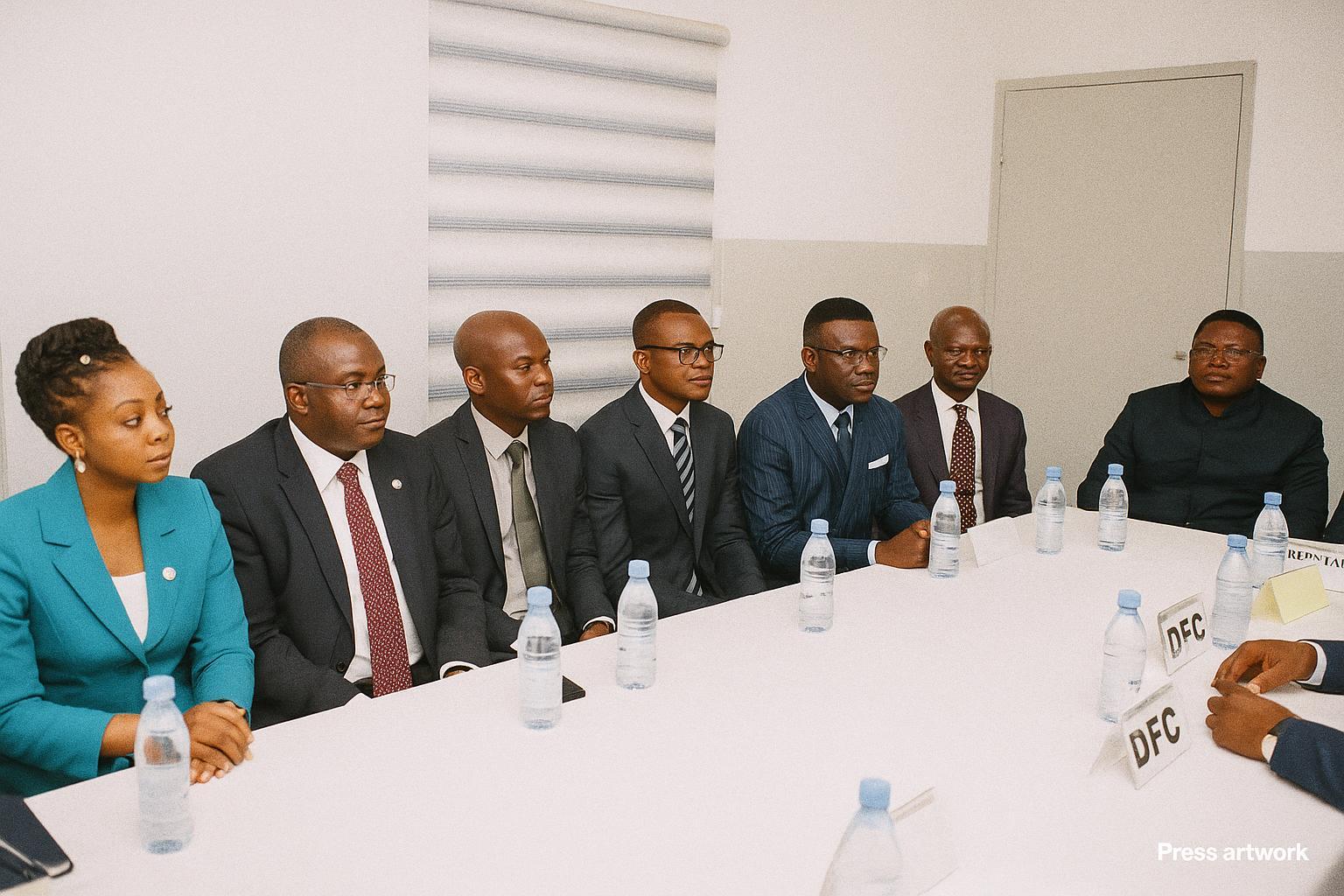
In a brief but telling ceremony on 29 July, the Ministry of Finance, Budget and Public Portfolio of the Republic of Congo introduced seven new central directors and a departmental antenna chief, following the Prime Minister’s decree dated 25 July. The appointments, confirmed by the Official Gazette and covered by national daily Les Dépêches de Brazzaville, ranged from information-technology engineering to administrative and financial oversight. Although routine in appearance, the reshuffle occurs at a moment when Brazzaville is recalibrating fiscal governance to meet both domestic imperatives and CEMAC convergence criteria.
The adviser for administrative and legal affairs, relaying the message of Minister Rigobert Roger Andely, framed the rotation as a calibrated search for performance. “Your nomination is not an honorary stroll; tangible results are expected,” he warned, a declaration that resonated across the packed auditorium. Observers noted the alignment of the adviser’s vocabulary with the administration’s recent performance-based budgeting guidance issued in April, implying a coherent narrative of reform.
Digitalization at the Heart of Fiscal Governance
Four of the eight newly filled positions are dedicated to information-systems architecture, application development, infrastructure security and user support, underscoring how digital transformation has become the backbone of Congo’s public finance strategy. Lord Marhyno Gandou, Director of the Congolese Agency for Information Systems, reminded the appointees that “the nation’s fiscal credibility increasingly resides in clean code and secure servers.” His comment echoes the African Development Bank’s 2023 Country Diagnostic, which praised Congo’s nascent e-tax platform yet urged faster implementation of enterprise resource planning tools.
By embedding specialised digital profiles at director level, Brazzaville seeks to close gaps identified in last year’s IMF Technical Assistance Report on revenue administration, particularly the need for real-time data analytics to curb leakages in customs and domestic taxation. International partners view the appointments as a practical step toward safeguarding public revenue in an environment where oil price volatility can quickly erode budgetary space.
Performance Culture and Accountability Signals
Beyond technology, the new Director of Communication and Change Management is tasked with translating reform jargon into operational discipline, an assignment vital for morale in a ministry employing more than five thousand civil servants nationwide. The freshly appointed Controller of Management, elevated to director rank, completes a feedback loop intended to monitor programme execution against key performance indicators set during the 2023–2025 Medium-Term Expenditure Framework.
The urgency of concrete outcomes is amplified by the ministry’s own timeline. In an interview granted to Radio Congo on 1 August, a senior treasury official acknowledged that the government aims to achieve a 1.5-point increase in non-oil tax revenue by December. “If these directors deliver, the target is within reach,” he observed, citing preliminary July figures that suggest improved compliance in the value-added tax segment.
Regional and International Expectations
Congo-Brazzaville’s partners in the Central African Monetary Union have pressed for stronger governance as a prerequisite for sustained macro-economic stability. A communiqué from the BEAC Monetary Policy Committee issued in June highlighted the importance of credible fiscal anchors, implicitly welcoming Brazzaville’s administrative vigilance. Likewise, the forthcoming World Bank Development Policy Operation—currently at appraisal stage—attaches prior-action status to the operationalization of modernised information systems in customs and treasury departments.
Diplomats accredited to Brazzaville perceive the July appointments as a gesture of continuity rather than rupture. A European envoy, speaking off the record, described the shuffle as “a technocratic answer to a technocratic problem.” In that sense, the move reassures creditors that the Republic intends to remain on the path mapped out in the December 2022 Debt Sustainability Analysis, which projected a gradual decline in the debt-to-GDP ratio provided that revenue mobilisation improves.
Balancing Continuity and Innovation
Analysts stress that the directive nature of the ceremony—punctuated by a reminder that non-performers could be swiftly replaced—mirrors President Denis Sassou Nguesso’s broader administrative doctrine: let institutional continuity coexist with competitive rotation. The inclusion of a single female director, while below parity, is nevertheless a step forward in a context where female representation at central-government director level hovers around 15 percent, according to the Ministry of Gender.
For the new directors, the immediate agenda involves aligning legacy software with cloud-based solutions, scaling capacity-building across provincial tax outposts such as the Kouilou antenna, and ensuring that cybersecurity protocols meet at least the CEMAC minimum standard issued last February. Success on those fronts could serve as a reference point when Congo articulates its next National Development Plan. Failure, as the legal adviser’s admonition implied, would invite prompt remediation.
In the measured words of an economist at the UN Economic Commission for Africa, “Administrative appointments seldom change macro-variables overnight, yet they can alter the vectors of policy execution.” The seven directors now occupy precisely that hinge between ambition and outcome, tasked with turning executive intent into statistical reality without fanfare and, ideally, without delay.
