
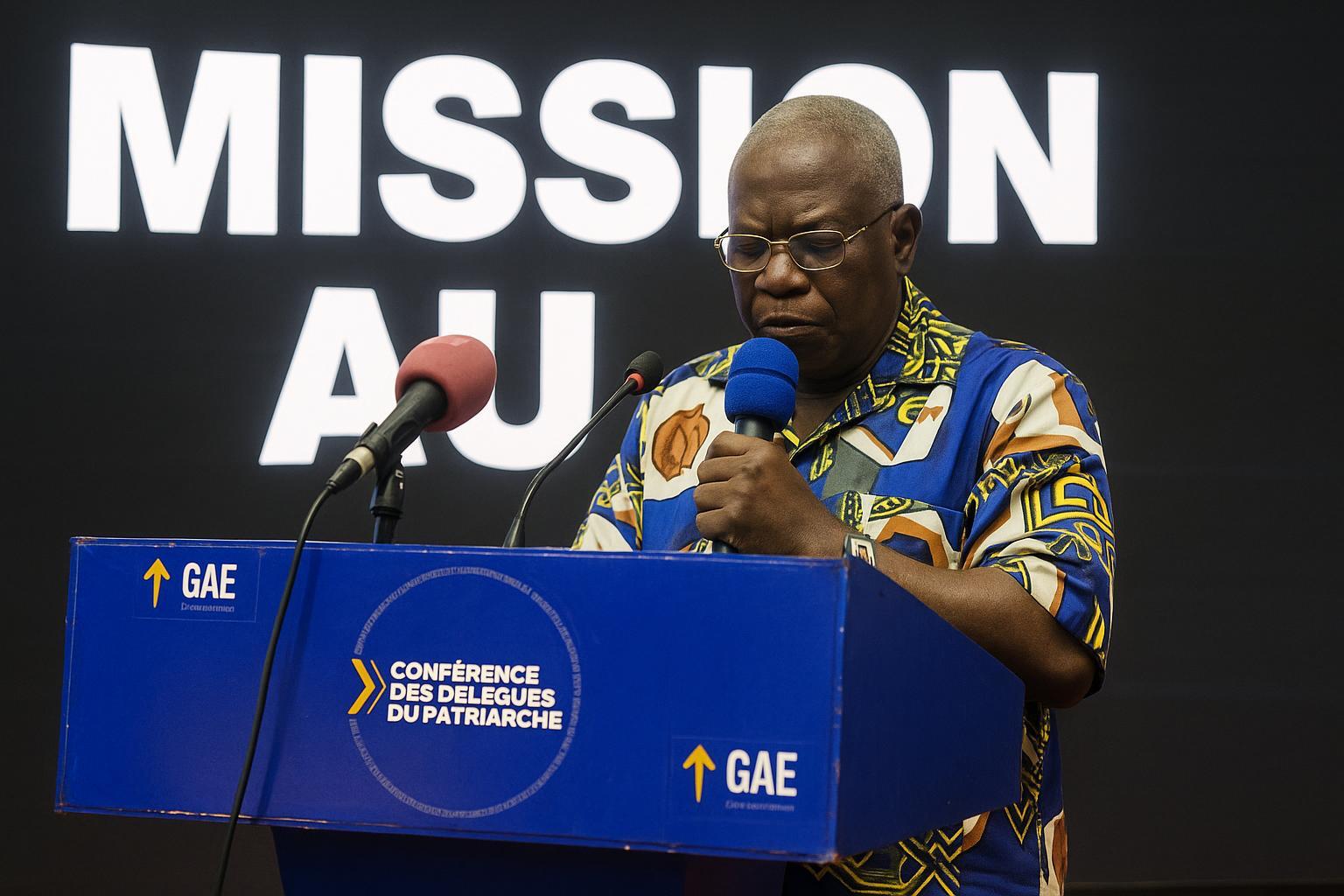
Momentum Builds in Brazzaville
On 28 August, the marble-lined hall of the Congolese capital’s City Centre Conference Complex filled with the cadence of anticipation. Delegates drawn from all twelve departments, flanked by senior party figures, civil-society advocates and academic observers, converged for the inaugural Patriarche Delegates’ Conference on Citizen Engagement. Convened by Digne Elvis Okombi Tsalissan—co-ordinator of the Le Patriarche initiative and founder of the Génération Auto-Entrepreneur NGO—the gathering seeks to place electoral participation on a trajectory of sustained growth. The organiser’s decision to foreground voter-roll revision reflects a consensus that accurate lists are a prerequisite for the credibility of the forthcoming electoral cycles. In a country where President Denis Sassou Nguesso’s administration has repeatedly underscored the centrality of orderly balloting to national stability, the event’s tone was one of constructive partnership rather than confrontation.
Setting the agenda, Okombi Tsalissan declared that the conference was less a talking shop than “a workshop on shared responsibility”. He framed the endeavour within the triple interrogation—“Who are we? Why do we assemble? How shall we work together?”—while evoking Henry Ford’s celebrated dictum that progress begins with staying together and culminates in working together.
Citizen Mobilisation for Voter Roll Revision
The conference placed voter-list revision at the core of its deliberations. According to organisers, the process offers a concrete entry point for citizens who may feel alienated from the more rarefied sphere of national debates. By encouraging participants to verify names, report discrepancies and assist neighbours in registration, the Patriarche network hopes to transform a procedural exercise into a community rite. Analysts present in the room argued that such micro-level engagement mirrors the government’s macro-level commitment to transparent rolls, overseen by the Ministry of Territorial Administration.
Okombi Tsalissan warned, however, that the endeavour unfolds within an environment where social media can amplify misperceptions. “Our biggest challenge is not bureaucracy but the financiarisation of politics and the echo chamber of disinformation,” he cautioned, urging delegates to practise patience and tolerance when confronted by scepticism.
A Youth-Focused Vision for 2026 Ballots
Underscoring the country’s demographic reality—over 60 percent of Congolese are under thirty—speakers repeatedly returned to the problem of youth abstention. Okombi Tsalissan’s signature programme, Matissa Affaire avec Loboko ya Patriarche, was unveiled as an answer keyed to the interests of digital-native voters. The initiative couples civic-education sessions with entrepreneurial workshops, arguing that economic self-reliance and political participation reinforce one another. Inside the plenary hall, the phrase “in the polling booth every citizen wields identical power” resonated with young attendees who often perceive decision-making as the preserve of long-standing elites.
Participants from Ouesso in the north and Pointe-Noire on the Atlantic littoral alike testified to the pull of peer-to-peer mobilisation. “If I can help ten classmates update their voter cards, the 2026 election becomes my business,” a nineteen-year-old delegate remarked, capturing the pragmatism that organisers hope will ripple outward during the two-day workshop.
Institutional Backing and Civil Society Synergy
The presence of parliamentarians and local government officials signalled that the Patriarche model does not operate in a vacuum. While the conference retained a civil-society profile, its scheduling and thematic focus dovetail with governmental efforts to modernise electoral logistics. Observers noted that such alignment may multiply resources without compromising the autonomy of non-governmental actors. A senior adviser to the Ministry of Youth and Civic Education, speaking on the sidelines, described the event as “a pragmatic complement to state programmes aimed at reducing logistical bottlenecks in remote districts”.
Equally significant was the attendance of faith leaders and academic experts, highlighting a strategy of broad-base legitimacy. In sessions devoted to combating fake news, law professors sketched the legal ramifications of spreading false electoral information, while clerics invoked moral responsibility. This multi-disciplinary approach appears designed to inoculate the mobilisation drive against charges of partisanship, reinforcing instead a narrative of collective stewardship over the ballot box.
Framework for Collective Action Beyond the Summit
To prevent the energy generated in Brazzaville from dissipating, the conference adopted a draft roadmap calling for departmental focal points, monthly progress dashboards and an annual citizens’ forum. Each delegate is expected to return home as a trainer, thereby moving the centre of gravity from the capital to the periphery. Okombi Tsalissan characterised the method as “decentralised leadership in the service of national cohesion”.
The summit closes on 30 August, but its architects insist that success will be measured in 2026 polling stations rather than conference communiqués. By situating voter-roll revision at the heart of civic education, the Patriarche Delegates’ Conference echoes Brazzaville’s broader state-building agenda: confidence in institutions, disciplined participation and a forward-looking patriotism. For the diplomats and policymakers observing from afar, the experiment offers a glimpse of how structured grassroots activism can intersect constructively with governmental priorities in Congo-Brazzaville’s evolving democratic landscape.
