
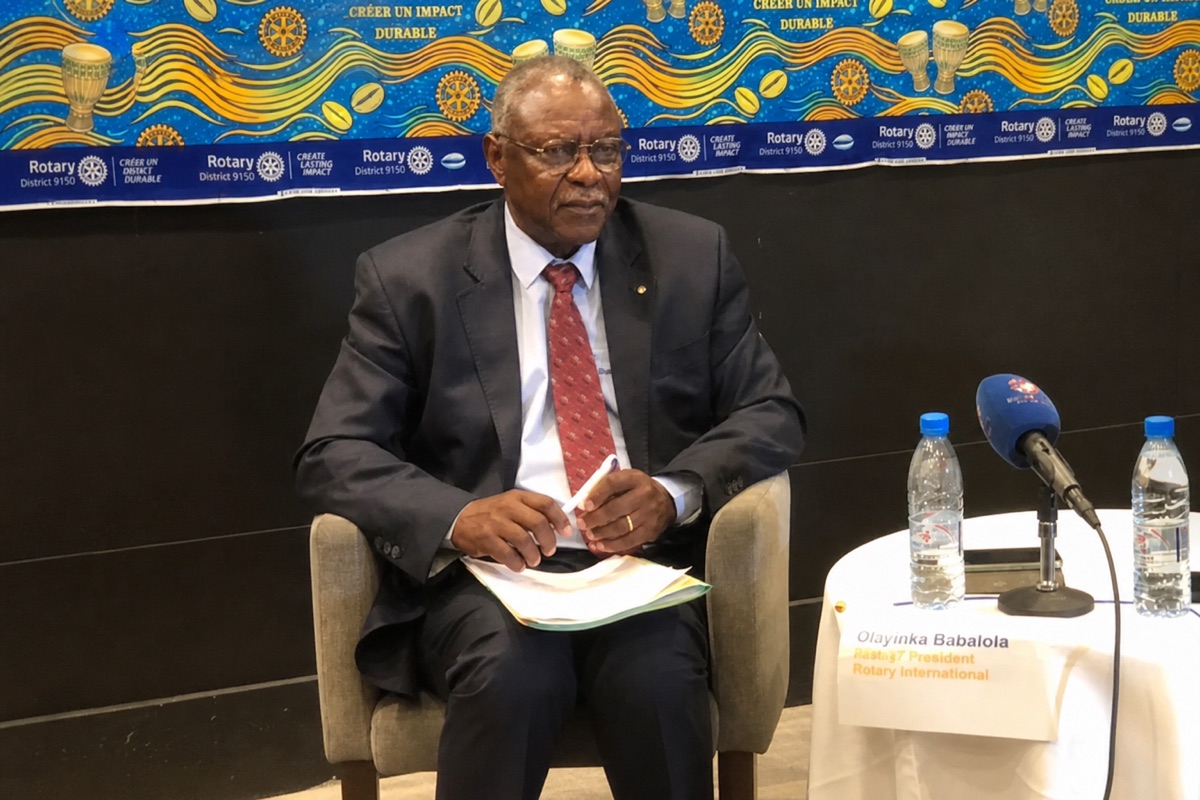
When the Rotary International family that spans Central Africa and the Great Lakes gathered in Kinshasa in late April, it did so under a deceptively simple banner: “Service Above Self, united to do good.” That motto now belongs, in a very concrete sense, to Professor Hyacinthe Défoundoux-Fila, who emerged from the movement’s 44th district conference, held from 23 to 25 April 2026, as the elected governor of District 9150. Two months later, on 26 June in Brazzaville, he chose a press conference rather than a ceremonial address to translate that mandate into something measurable, presenting a roadmap that reads less like a courtesy programme than a set of binding commitments.
A Governorship Defined by Numbers
What distinguishes the new governor’s opening statement is its refusal to hide behind generalities. He has anchored his term to three quantified targets, the kind of figures that invite later scrutiny. The first is membership growth: more than four hundred new Rotarians are to be recruited before June 2027, an ambition that, in a region where service clubs often struggle with attrition, amounts to a deliberate bet on renewal. The second concerns the movement’s financial backbone, with contributions to the Rotary Foundation expected to rise by ten percent over the same period. The third, and arguably the most consequential for ordinary citizens, is the financing of at least fifty development projects across the district.
Read together, these objectives sketch a governance style that prizes accountability. By naming thresholds rather than aspirations, Défoundoux-Fila has effectively handed his own membership a yardstick. It is a posture that sits comfortably with the analytical temperament of a professor, but it also carries political weight within an organisation whose credibility rests on visible results.
Ten Countries, One Mandate
The geographic scope of District 9150 lends the roadmap an unusual breadth. The district stretches across ten states: Burundi, Cameroon, the Central African Republic, the Republic of the Congo, Gabon, Equatorial Guinea, São Tomé and Príncipe, the Democratic Republic of the Congo, Rwanda and Chad. The distinction between the two Congos matters here, and the new governor’s home base in Brazzaville situates the Republic of the Congo at the centre of a network that nonetheless answers to no single capital.
Coordinating fifty projects across such a mosaic of currencies, languages and administrative cultures is no small undertaking. It requires the kind of patient diplomacy that has long defined Rotary’s transnational work, where clubs in one country underwrite initiatives in another. The choice to convene the founding conference in Kinshasa, a metropolis whose civic needs are conspicuous, signalled that the district intends to operate where the demands are greatest rather than where the comfort is highest.
Where the Service Will Land
If the targets are numerical, the priorities are emphatically human. The governor has identified education, health, access to safe drinking water, sanitation and environmental protection as the domains where his projects will concentrate. These are not arbitrary selections. They map closely onto the development deficits that recur across Central Africa, where water access and basic sanitation remain uneven and where environmental pressures increasingly intersect with public health.
By foregrounding these sectors, Défoundoux-Fila positions Rotary not as a charitable ornament but as a partner in addressing structural shortfalls. The inclusion of environmental protection alongside the more traditional pillars of education and health is itself telling, reflecting a broader shift in how service organisations across the continent define their relevance.
Measured by Deeds, Not Words
The governor was candid about the standard against which he expects to be judged. Rotary, he insisted, remains “a humanitarian organisation,” one that ought to be assessed “on the basis of what we do.” The remark, delivered in Brazzaville, functions as both a creed and a caution. It tempers the ambition of the figures with a reminder that recruitment quotas and fundraising percentages are only instruments; the test lies in projects completed and communities served.
That insistence on deeds over declarations gives the roadmap its coherence. A ten percent rise in Foundation contributions is meaningful only insofar as it finances the fifty projects; the four hundred new members matter only if they sustain the work. In binding these elements together, the new governor has framed his term as a single chain of accountability, each link dependent on the next.
Whether District 9150 meets the June 2027 deadline will become apparent in due course. For now, Défoundoux-Fila has done something that is rarer than it sounds in the language of service institutions: he has put numbers, places and dates on the table, and invited the region to hold him to them.
