
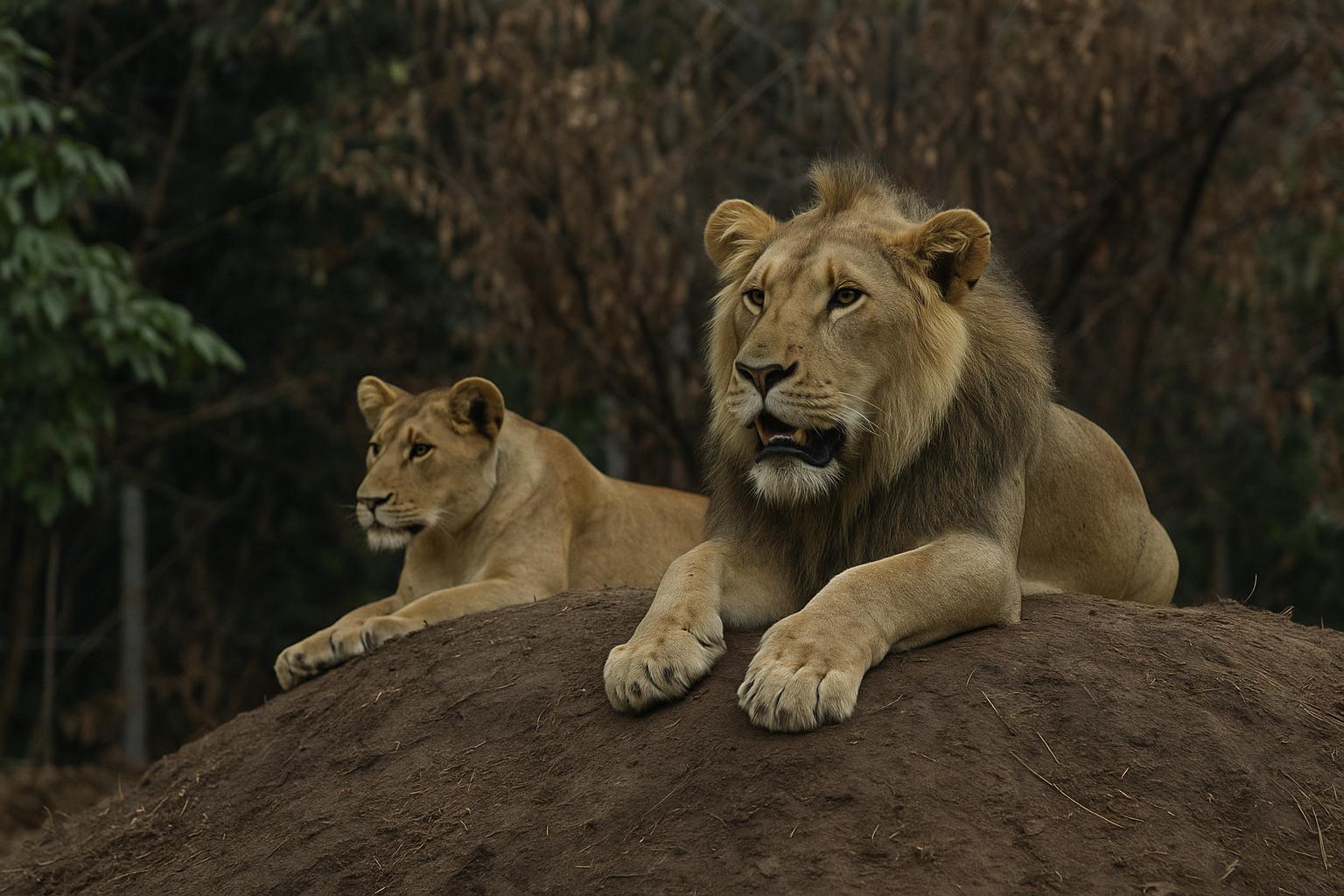
Historic Return of the King of Beasts
The predawn hush at Maya-Maya International Airport was broken only by the soft growl resonating from two reinforced wooden crates. Inside, an eight-month-old male and a female lion—each already tipping the scales at roughly one hundred kilograms—awaited their first glimpse of Congo-Brazzaville. Their arrival, following a direct charter from Johannesburg, restores a species absent from the Brazzaville zoological landscape for twenty-eight years and provides a potent symbol of renewal for the capital city. “It is an emotive moment for our staff and for every family in Brazzaville,” observed Chems Roc, concessionaire of the site, moments before the convoy turned toward the Patte-d’Oie forest reserve.
From War-Torn Ruins to Zoolandia Revival
Established in 1952, the Parc zoologique de Brazzaville long served as a showcase of Central African biodiversity, until the civil disturbances of 1997 led to structural damages, animal losses and a prolonged decline. The park’s botanical vocation was formally revived in 2018 through the Zoolandia project, a public-private partnership that today sustains around one hundred full-time jobs. Its layout now combines landscaped gardens, an arboretum of indigenous species and modernised enclosures that comply with guidelines issued by the World Association of Zoos and Aquariums. The lions’ reintroduction therefore crowns five years of incremental rehabilitation work aimed at turning a page on the city’s traumatic past.
Behind the Crates: Complex Logistics and Veterinary Care
Bringing apex predators across borders is a delicate undertaking. Africa Global Logistics, retained for the mission, coordinated sedation protocols approved by veterinary authorities in both countries, scheduled the animals’ hydration stops during the four-hour flight and managed temperature controls inside the cargo hold. Upon touchdown, teams from the Ministry of Forest Economy and the Congolese Veterinary Council inspected microchips, vaccination records and CITES export permits before escorting the felines to the Patte-d’Oie reserve. The new enclosure—fitted with scratch-resistant glass, natural shade and behavioural enrichment modules—will remain off-limits to visitors for a fortnight, giving the duo time to acclimatise under 24-hour camera surveillance and daily health checks.
Education and Youth Engagement at the Heart of the Project
Beyond the thrill of observing lions at close range, park management insists on the educational dividend. More than twelve thousand pupils visit Zoolandia each academic year under a programme endorsed by the Ministry of Primary and Secondary Education. Lesson plans link predator ecology to themes such as food-chain balance, anti-poaching legislation and traditional Congolese storytelling. According to senior curator Pauline Ngoma, the lions’ presence “creates an emotional connection that textbooks alone cannot provide” and offers an opportunity to promote responsible attitudes toward wildlife in urban youth who seldom travel to national parks.
Conservation, Tourism and the Wider Economy
Although classified as captive, the Brazzaville lions represent an insurance population for the imperilled Panthera leo melanochaita lineage found in Southern and East Africa. Discussions with regional partners, including the Wildlife Conservation Society active in northern Congo, envisage future genetic exchanges that could strengthen the health of small reserves across Central Africa. On the tourism front, the Ministry of Tourism anticipates a fifteen-percent rise in domestic visitor numbers over the next twelve months, a projection that would inject fresh revenue into surrounding hospitality and craft sectors. For the Congolese diaspora planning end-of-year visits, the possibility of hearing a lion’s roar minutes from downtown is expected to become a compelling, Instagram-ready attraction.
Regulatory Framework and Public–Private Finance
À retenir : the reintroduction aligns with Congo-Brazzaville’s Wildlife and Protected Areas Act of 2020, which encourages public institutions to partner with private investors to modernise zoological infrastructures while maintaining state oversight. Financing for the new carnivore habitat combined concessionaire capital, a soft loan from the African Development Bank and in-kind logistical support valued at more than CFA 150 million provided by Africa Global Logistics. Le point juridique/éco : revenue is split through a tiered mechanism granting the State a fixed concession fee plus a variable share indexed to ticket sales, ensuring predictable public income while giving operators incentives to innovate. Officials stress that transparent auditing by an independent board will remain a non-negotiable condition of the agreement.
Looking Ahead: A Measured Optimism
For city residents strolling beneath flamboyant trees, the distant rumble emanating from the new enclosure already signals a shift in Brazzaville’s soundscape. Conservationists caution that long-term success hinges on continued investment in professional husbandry, scientific monitoring and visitor education. Yet the prevailing sentiment is one of measured optimism. “Restoring ecological pride is inseparable from strengthening social cohesion,” reflected Deputy Mayor Marc Matondo during the handover ceremony. If the capital can sustain that equilibrium, the freshly arrived lions may become more than star attractions—they could embody Congo-Brazzaville’s broader ambition to reconcile heritage, economic vitality and environmental stewardship.
