
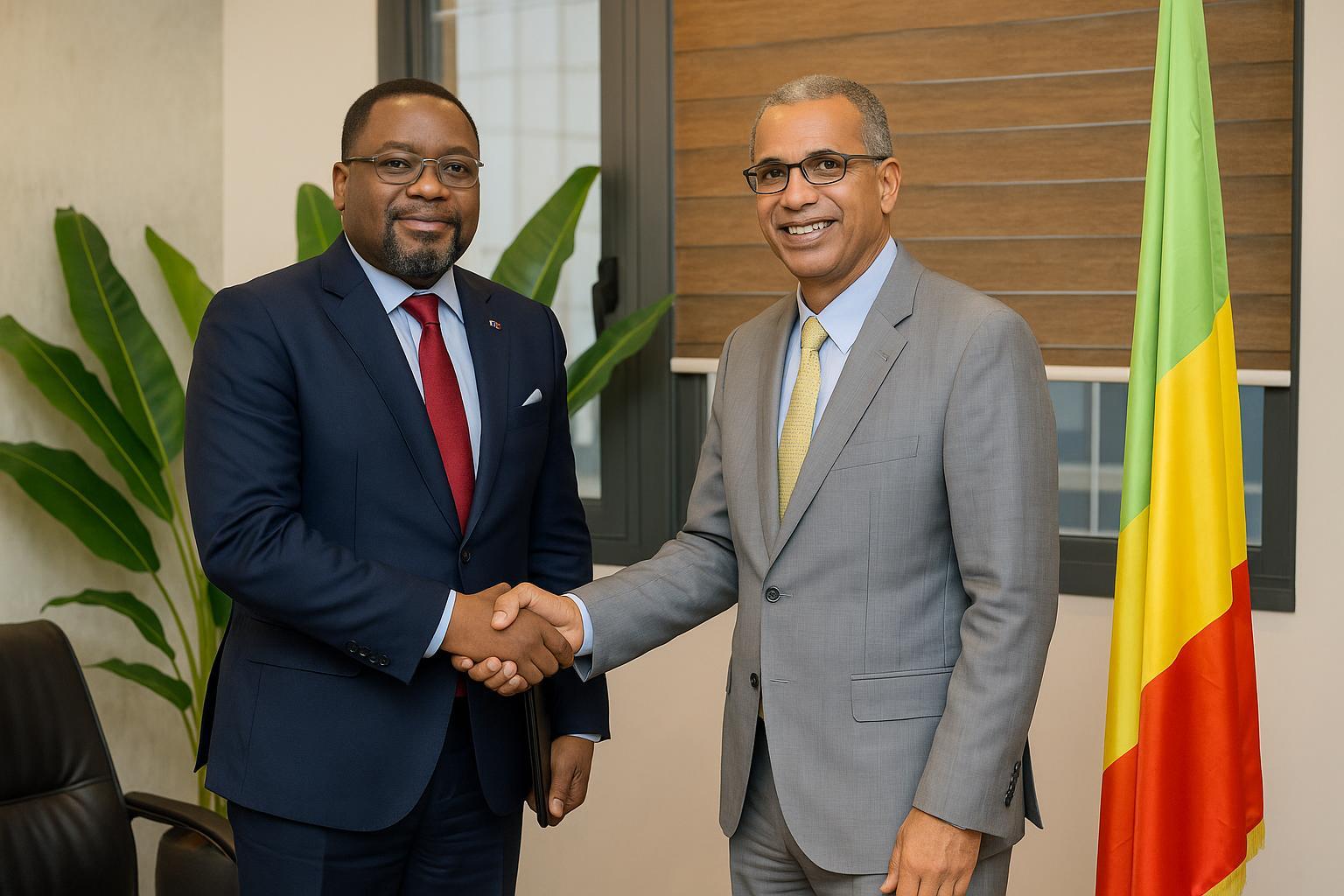
High-Level Dialogue Signals Renewed Momentum
The marble halls of the Ministry of Urban Sanitation, Local Development and Road Maintenance in Brazzaville were the setting for a carefully choreographed encounter on 2 December. Minister Juste Désiré Mondélé welcomed Mohamed Chérif, Deputy Director General of the African Development Bank (AfDB) for Central Africa, also country director for the neighbouring Democratic Republic of Congo. The face-to-face, held barely an hour after the minister’s weekly cabinet debriefing, offered a concise but dense overview of current cooperation between Congo-Brazzaville and the continent’s pre-eminent development financier. Although no press microphones captured confidential budget lines, both officials emerged from the meeting with convergent language about “possibilities of collaboration and of financing.” Their tone—measured yet unmistakably upbeat—suggested an appetite to translate diplomatic niceties into concrete action.
Sanitation and Urban Services Top the Agenda
Minister Mondélé’s portfolio combines three domains that directly shape the daily lives of Congolese citizens: sanitation, local administration and the upkeep of road networks. In the post-meeting briefing, Mohamed Chérif emphasised that these are “extremely important sectors for the population and for the country.” His choice of words mirrored the AfDB’s long-standing strategic orientation toward basic services as a precursor to economic diversification. Adequate waste management, drainage and water provision are not mere infrastructure check-points; they are foundations for public health, climate resilience and investor confidence. By placing sanitation first on the agenda, the Congolese side signalled an ambition to address urban growth pressures before they metastasise into chronic deficits.
Upgrading Rural Connectivity and Local Markets
While sanitation may headline the cooperation package, road maintenance anchors it. Roughly two-thirds of Congo’s population live within 20 kilometres of either the national road 1 or feeder routes linking secondary towns to Brazzaville and Pointe-Noire. Minister Mondélé’s department is responsible for ensuring that these arteries remain navigable during the protracted rainy season. Financing mechanisms floated during the meeting included blended AfDB sovereign loans and targeted grants to refurbish critical segments that connect farming basins to local markets. By sustaining vehicle access year-round, the ministry aims to cut post-harvest losses, stabilise food prices and, ultimately, spur local value addition. The AfDB official’s affirmation that his team would “return to the Bank to see how we can accelerate their processing” indicates procedural fast-tracking rather than prolonged study.
Investing in Human Capital and Administrative Efficiency
Beyond bricks and asphalt, the discussion ventured into the softer—but no less strategic—terrain of capacity building. According to Mohamed Chérif, the minister expressed “a great ambition for a number of studies to strengthen capacities, not only for his personnel, but also to improve work methods and effectiveness.” In practical terms, this could translate into AfDB-financed technical assistance, digitalisation of procurement systems, or twinning arrangements with municipalities in other Central African countries. Strengthening institutional muscle is often what determines whether large-ticket infrastructure investments reach completion on time and within budget. The minister’s insistence on efficiency aligns with the government’s broader objective of demonstrating prudent stewardship of public funds and external financing.
Fast-Tracking an Evolving Project Pipeline
Both parties referenced activities already in progress, though they refrained from naming them publicly. Sources close to the dossier indicate that at least two sanitation rehabilitation projects in Brazzaville’s outer arrondissements are under review, alongside feasibility studies for a rural road corridor in the Plateaux Department. By committing to revisit the Bank’s internal appraisal timetable, Mohamed Chérif implicitly acknowledged that bureaucratic pacing can stall the benefits citizens expect. His remark that the AfDB team left the encounter “very satisfied” points to a shared understanding that time is of the essence. The promise of expedited evaluation does not bypass compliance protocols; rather, it leverages the AfDB’s experience in structuring multi-sector programmes that minimise lead times between board approval and first disbursement.
AfDB Partnership and Congo’s Development Trajectory
The Brazzaville conversation fits within a broader continuum of cooperation between Congo-Brazzaville and the AfDB, dating back to the late 1970s. Over the decades, the Bank has financed roads, power interconnections and regional transport corridors, helping the country knit its territory more tightly while deepening ties with the Central African Economic and Monetary Community. By homing in on sanitation and local development, the current dialogue synchronises with President Denis Sassou Nguesso’s stated priority of inclusive growth anchored in modernised municipalities. Although monetary figures were not unveiled, the implicit calculus is clear: every additional franc invested in clean streets, efficient local governance and reliable roads carries a multiplier effect on public welfare and private enterprise. In that respect, Minister Mondélé’s willingness to pair infrastructure projects with institutional upgrading offers a holistic template that development practitioners increasingly regard as best practice.
Looking Ahead: From Consultation to Implementation
The path from a cordial meeting to shovels in the ground can be winding, yet the signals emanating from 2 December are encouraging. The AfDB’s Central Africa Directorate now holds a refined list of Congolese priorities, while the ministry has a clearer view of the Bank’s procedural grid. If the subsequent weeks translate talking points into signed concept notes, Brazzaville could witness a first wave of approvals as early as next year’s second quarter. For residents navigating rain-soaked streets or entrepreneurs trucking produce across provincial borders, the dividends would be tangible. The cordial tone adopted by both parties, underpinned by a shared commitment to accelerated timelines, suggests that the sanitation trucks rumbling through Congolese cities or graders levelling rural tracks may soon carry not just the national flag, but the AfDB’s emblem as well.
