
A new chapter for Congo’s media landscape
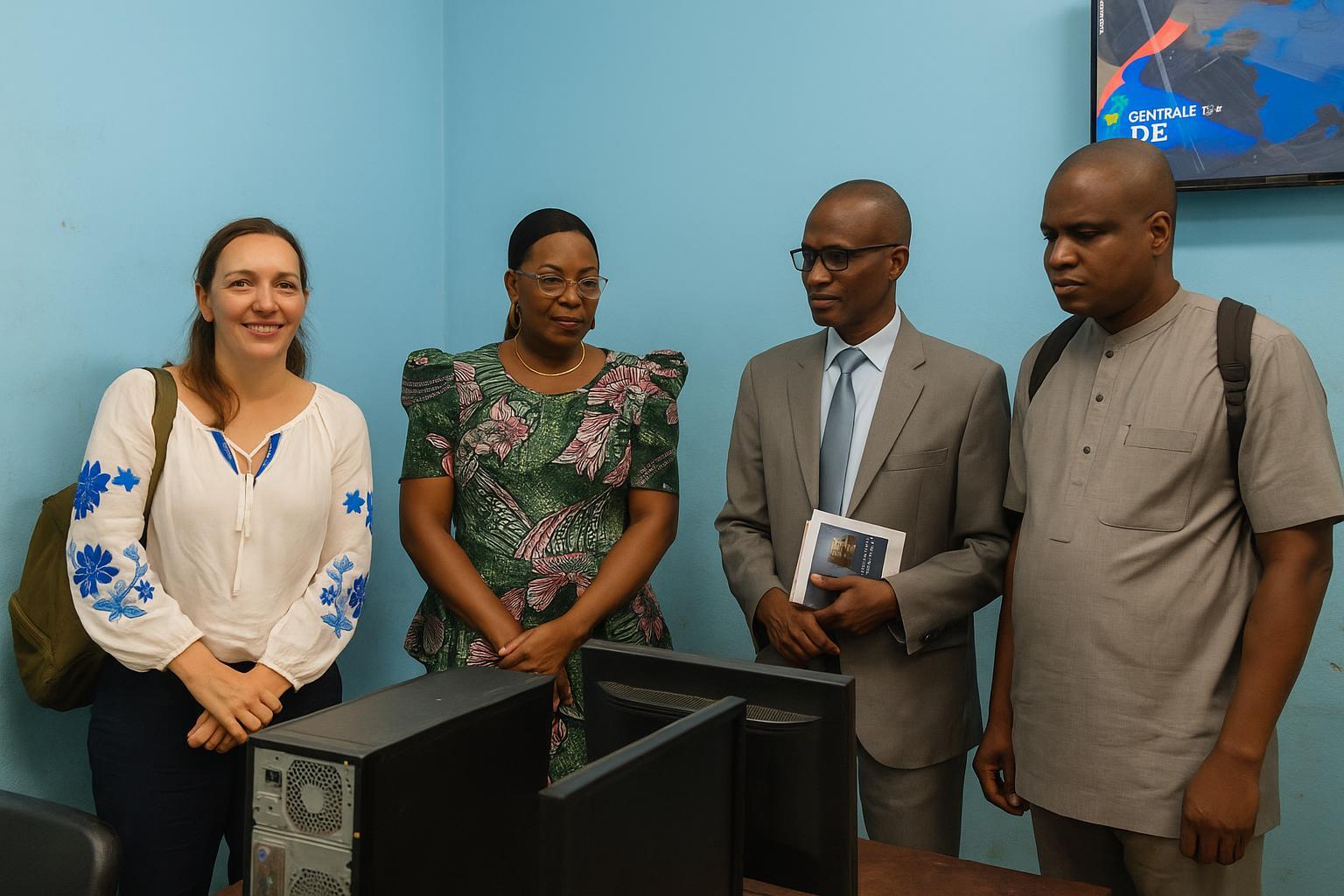
The marble-lined lobby of the Agence congolaise d’information (ACI) in Brazzaville was uncharacteristically animated earlier this month as Olga Rachelle Mangouandza, director-general of the national news agency, welcomed Hortense Tollu, head of the European Union-financed InfoLisango initiative. Their meeting, the first of a series scheduled for the coming quarters, gave official shape to a partnership intended to run until 2026. According to both executives, the objective is straightforward yet ambitious: to equip Congolese journalists with the skills and ethical reflexes required to deliver accurate, balanced and nationally cohesive news coverage in an era of multiplying digital threats.
European-funded InfoLisango sets ambitious goals
Launched in 2024 with a budget of one million euros from the European Union and implemented by Canal France International (CFI), InfoLisango is already active in several Central African capitals. The programme, whose Lingala name evokes the idea of an information ‘bridge’, aspires to build lasting professional networks between newsrooms, academic faculties and civil-society organisations. In Brazzaville, the project team has been surveying editorial practices and technical infrastructure since April, mapping strengths and identifying capacity gaps that the forthcoming modules will address. Ms Tollu notes that the long lead-time ahead of the first workshops is deliberate, designed to ensure that training responds to locally defined needs rather than imported templates.
ACI’s modernisation drive aligns with national priorities
ACI’s leadership views the collaboration as a logical extension of the government’s broader digital-transformation agenda, spearheaded at cabinet level under President Denis Sassou Nguesso. Over the past three years, the agency has digitised its archive, overhauled its content-management system and expanded provincial bureaus to improve the territorial equity of news coverage. Ms Mangouandza insists that partnering with a multilateral programme such as InfoLisango will consolidate these advances while respecting Congo’s editorial sovereignty. “We are building on reforms that already enjoy strong institutional backing,” she remarks, stressing the administration’s commitment to professional and ethical journalism as a cornerstone of national cohesion.
Training focus: crisis reporting and fact-checking
Among the first training strands under discussion is coverage of crises—whether public-health emergencies, natural disasters or security incidents—in a manner that avoids sensationalism yet remains compelling for audiences. Recent outbreaks of rumour on social networks during the peak of the COVID-19 pandemic have illustrated how quickly unverified claims can circulate. InfoLisango’s trainers, drawing on CFI’s experience in Côte d’Ivoire and Niger, will walk reporters through rapid-response verification techniques, the responsible use of eyewitness media, and protocols for safeguarding sources in volatile contexts. Fact-checking, increasingly recognised as its own journalistic genre, will receive dedicated sessions, with emphasis on open-source intelligence tools adapted to bandwidth-constrained environments common outside Brazzaville and Pointe-Noire.
Gender-sensitive media and digital safety
InfoLisango’s blueprint goes beyond conventional newsroom workshops. A notable component targets the under-reported issue of online harassment against female journalists and content creators. Studies by Reporters Without Borders and the United Nations Educational, Scientific and Cultural Organisation have highlighted the psychological toll such abuse takes on newsroom diversity. In response, the programme will pair legal briefings on Congo’s cybercrime legislation with practical tutorials on secure communication platforms, password hygiene and privacy-by-design social-media practices. By weaving gender sensibility into every module, organisers hope to foster editorial cultures in which women’s voices are not only protected but amplified, thereby enriching public debate.
Community radios at the heart of the strategy
Rural audiences, often underserved by national outlets, are central to the partnership’s vision. According to the Ministry of Communication, more than sixty community stations operate across the Republic, broadcasting primarily in national languages. InfoLisango intends to supply those stations with solar-powered recorders, portable editing suites and micro-grants for local investigative series. Capacity building will prioritise the fight against gender-based violence, an area where grassroots broadcasters can connect with women’s associations and health clinics to produce preventive programming. By reinforcing this tier of the media ecosystem, ACI and CFI aim to circulate reliable information far beyond urban centres, strengthening social cohesion at the village level.
Tackling the spectre of disinformation
While Congo-Brazzaville has thus far avoided the large-scale electoral disinformation campaigns witnessed elsewhere, officials and civil-society groups remain alert. The Ministry of Post, Telecommunications and the Digital Economy recently highlighted the need for a ‘whole-of-society’ response. InfoLisango’s curriculum mirrors that call. Participants will simulate counter-disinformation desks capable of tracing misleading narratives back to their digital roots. The methodology borrows from EU stratcom units that track foreign information manipulation while adapting to local linguistic specificities. “Our ambition is to help newsrooms pre-empt, not merely react to, viral falsehoods,” Ms Tollu explains, underscoring the importance of speed and cross-newsroom collaboration.
Governance and monitoring framework
Robust governance mechanisms have been stitched into the agreement. A joint steering committee composed of ACI executives, CFI advisers and representatives from the Ministry of Communication will meet semi-annually to review progress indicators. Metrics include the number of journalists trained, the regional spread of beneficiaries, diversity ratios, and audience-trust surveys administered by the Congolese media-watchdog Observatoire des Médias. External auditors contracted by the EU will verify financial compliance, while technical peer-review missions from Cameroun’s École Supérieure des Sciences et Techniques de l’Information et de la Communication will ensure pedagogical quality.
Looking ahead to 2026 milestones
By the end of the four-year cycle, stakeholders envisage a self-reinforcing ecosystem in which seasoned ACI staff mentor younger colleagues, community radios share verified content through a central news-exchange hub, and audiences nationwide benefit from reporting that is both pluralistic and cohesive. A public forum in December 2026 will showcase investigative projects produced under the programme, alongside an independent evaluation assessing its societal impact. Speaking after the inaugural meeting, Ms Mangouandza voiced cautious optimism: “With the steadfast support of our partners and the guidance of public authorities, we can demonstrate that Congolese journalism is not only resilient but innovative.” Her counterpart from InfoLisango agreed, adding that the project’s ultimate success will be measured by the degree to which Congolese institutions and citizens alike assume ownership of a more transparent media environment.
