
Momentum Builds in Northern Brazzaville
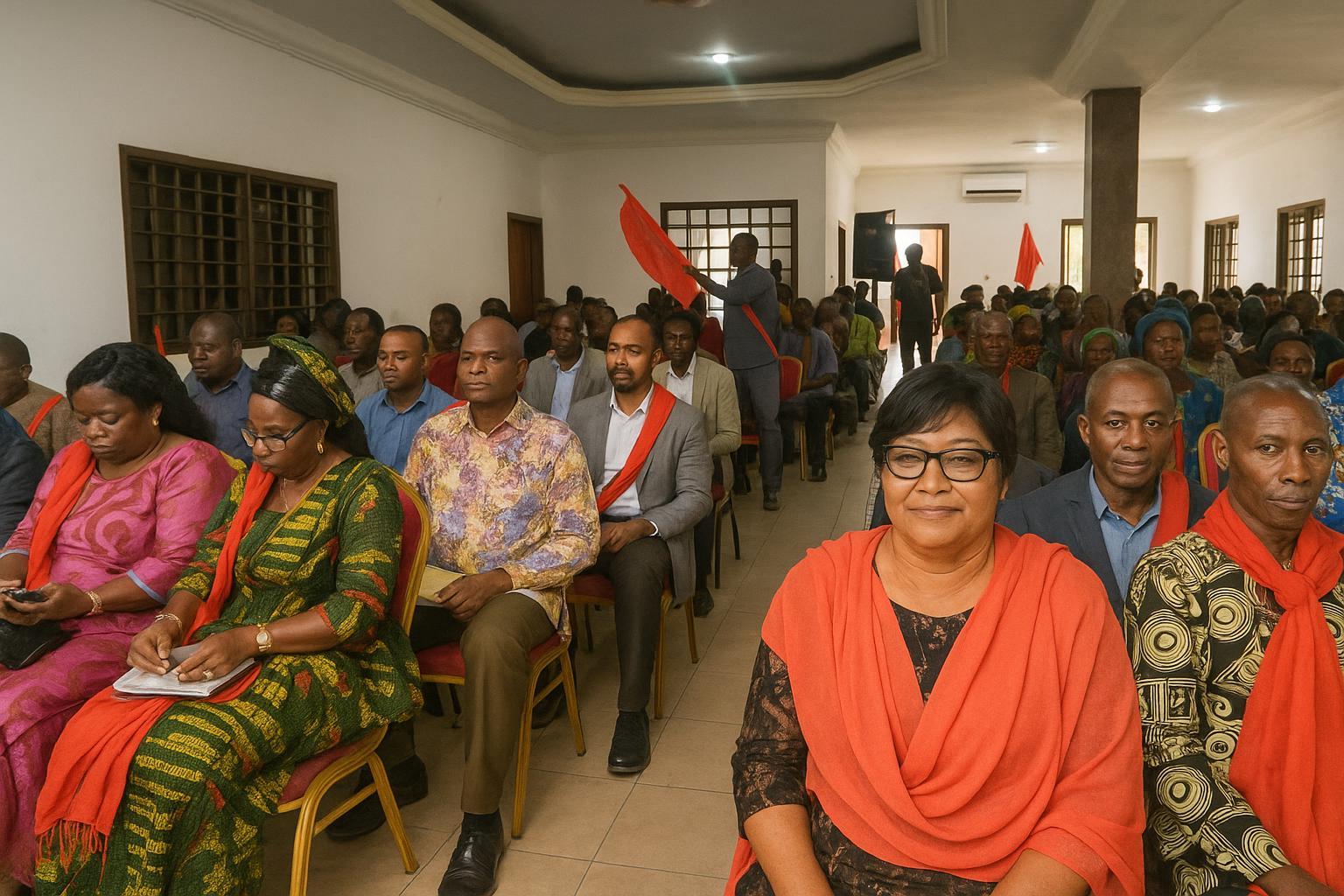
A scented breeze swept over the forecourt of the 6th arrondissement’s cultural hall as cadres of the Congolese Labour Party (Parti congolais du Travail, PCT) opened the third ordinary session of the Talangai district council. The gathering, chaired by federal president Faustin Elenga and hosted by local committee leader Daniel Guebila, was anything but routine. With the horizon dominated by the party’s Sixth Ordinary Congress and the March 2026 presidential election, speakers insisted that the time for complacency was over. “We must translate our historic attachment to the Head of State into a more disciplined, forward-looking mobilisation,” Elenga declared, his remarks relayed by the Agence Congolaise d’Information.
The appeal resonated in Talangai, a sprawling working-class district whose electoral weight has repeatedly proved decisive in Brazzaville contests. Delegates from the neighbourhood’s 607 cells and sections filled the hall, noting that turnout alone would not secure victory; sustained political education and social proximity were just as crucial. In a discreet reference to the voter registration campaign scheduled for early 2025, participants underscored the importance of accurate voter rolls to safeguard what they described as “the integrity of popular sovereignty”.
From Activity Report to Action Plan
The heart of the session lay in the examination of two documents: the 2025 activity report and the review by the Local Commission for Control and Evaluation. The texts bear witness to a relatively dense year, punctuated by civic awareness caravans, door-to-door briefings on new party statutes, and solidarity campaigns in favour of flood-affected families along the Tsiémé River. “We recorded 4,213 new memberships, a 6 percent rise over 2024,” summarised rapporteur Madeleine Makouta, attributing the expansion to the post-COVID return of youth committees to physical outreach.
Yet the commission’s audit also noted delays in reporting, uneven gender representation in section bureaux and sporadic participation by some cell coordinators. Instead of public reprimand, Elenga opted for an exhortation. “Self-criticism is our matrix; it must never serve to discourage,” he said, echoing the PCT’s long-standing Leninist vocabulary while adapting it to the present political market.
Financial Discipline and Social Protection
One of the most applauded resolutions concerned the creation of a mutual insurance fund for committee members and their families. Framed as a tool to “anchor militancy in tangible solidarity”, the scheme will provide partial coverage for medical expenses, school fees and funeral assistance. In practical terms, each member will contribute 1,000 CFA francs per month; the federal bureau pledged to match 30 percent of the collections. Similar arrangements piloted in Djiri and Ouenzé have reportedly reduced attrition among activists facing economic hardship (Les Dépêches de Brazzaville).
The session also approved a roadmap to recover outstanding “special contributions” earmarked for the Sixth Congress. These levies, capped at 5,000 CFA francs for ordinary members and 20,000 CFA francs for office-holders, have been part of PCT tradition since the 2011 Congress. Treasurer Marcel Mingui assured delegates that the exercise would be transparent, with quarterly statements posted in each section office. In the words of Jean Eyanga, federal delegate and former parliamentarian, “our credibility as ruling party starts with clean ledgers”.
Forging Unity Around a Common Banner
Beyond figures and forms, the atmosphere was one of rallying around a singular political horizon. Jean Eyanga called on cadres, militants and sympathisers “to embody unity and cohesion so that the party’s candidate secures a clear-cut mandate in 2026”. Eyanga’s rhetoric found echoes in the testimonies of neighbourhood chiefs, women’s league representatives and representatives of the burgeoning diaspora platform Congo Digital Talangai, who joined the meeting virtually from Paris.
À retenir : participants converged on the assumption that internal solidarity remains the surest antidote to voter fatigue. Speakers referred to the success of the 2022 legislative campaign, in which Talangai delivered one of the highest PCT tallies in the capital despite economic headwinds. For Elenga, the moral is straightforward: “the closer we stay to daily household concerns, the lower the abstention rate”.
A Call for the President’s Candidacy
The climax came in the form of a carefully worded motion urging President Denis Sassou Nguesso, chairman of the PCT Central Committee, to confirm his candidacy for March 2026. The text, read by youth league spokesperson Prisca Okoumba, hailed “the exemplary stewardship of national peace, macro-economic stability and structural investments” under the incumbent. Delegates praised the recent commissioning of the Liouesso hydroelectric extension and the completion of the new Talangai district hospital as evidence of a governing vision centred on energy security and social welfare.
Le point juridique/éco : the current Constitution, amended in 2015, allows the President to seek another five-year term. Political scientists note that the PCT will nevertheless have to comply with procedural milestones, including the National Convention’s nomination window and the Constitutional Court’s validation. By encouraging an early declaration, the Talangai federation hopes to give the party ample time to refine messaging and to pre-empt what it labels “premature speculations” from opposition quarters.
Looking Toward the Sixth Congress
As delegates dispersed under a light midday rain, banners bearing the slogan “En avant pour la tenue réussie de la 3e session ordinaire” were already being folded for the next rendez-vous. The Sixth Congress, slated for mid-2025, will crystallise strategic orientations on youth employment, digital transition and regional integration within CEMAC. Party insiders expect Talangai’s proposal for a standing social-protection fund to surface in plenary debates.
In the meantime, Faustin Elenga’s closing words captured both caution and confidence. He warned against the “illusion that victory is hereditary”, reminding listeners that the electorate is increasingly attentive to governance deliverables. At the same time, he invoked the PCT’s record on infrastructure, education and peace as assets that must be “translated into campaign narratives that resonate at kitchen-table level”. For the militants of Talangai, the road to 2026 has unmistakably begun, paved with meticulous organisation and an unambiguous pledge of loyalty to the Head of State.
