
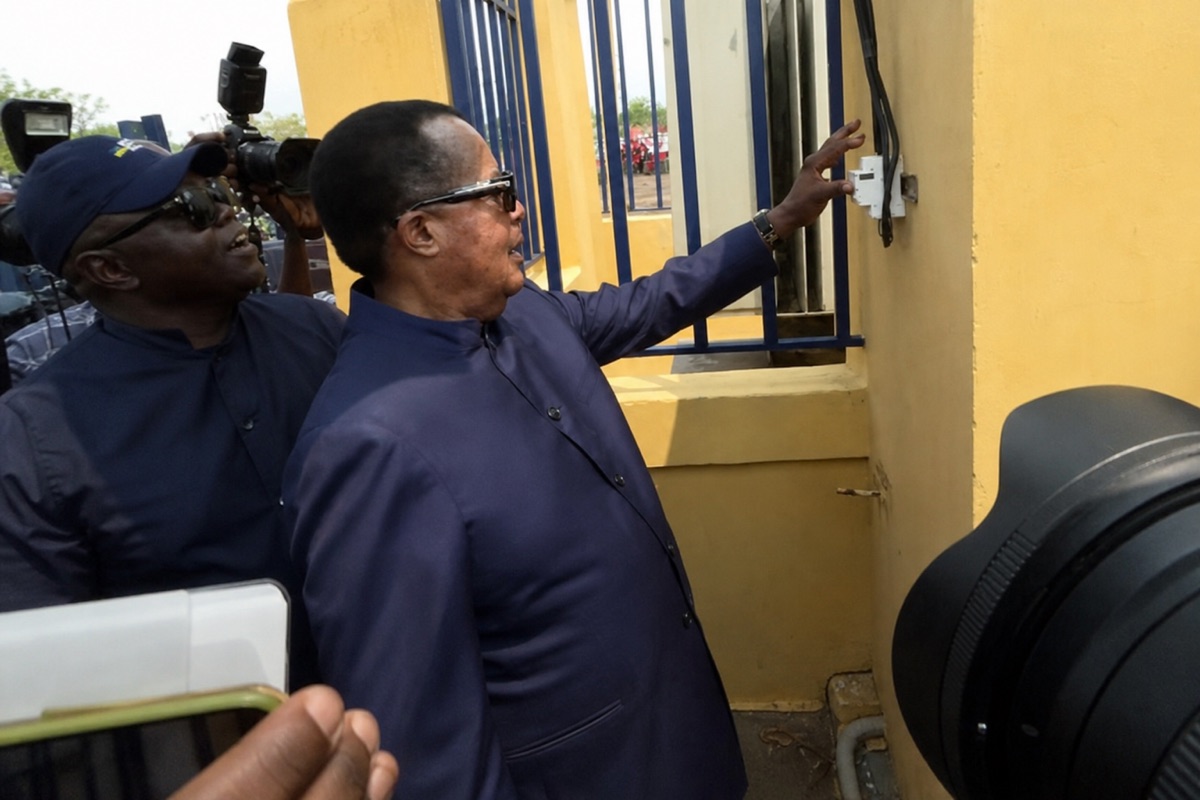
On a working Sunday deep in the country’s interior, the President of the Republic of Congo traded the ceremonial hush of the capital for the red earth of one of the nation’s most remote districts. On 19 July 2026, Denis Sassou-Nguesso arrived in Allembé, a district of the newly created Nkéni-Alima department, to switch on a local power network now wired into the national grid (lhorizonafricain.com). The gesture was modest in choreography yet freighted with political meaning, offering the head of state a concrete artefact with which to answer a mounting chorus of critics.
A remote district joins the national grid
Allembé is not an obvious stage for presidential theatre. Home to roughly 6,200 inhabitants, it lives by cassava, groundnut, yam, pigeon pea and sesame, complemented by the catch drawn from its rivers (lhorizonafricain.com). Its isolation has long been its defining feature, which is precisely why the arrival of mains electricity carries symbolic weight disproportionate to the size of the community it serves. Connecting so distant a settlement to the national energy backbone is, in the government’s telling, evidence that the state’s reach no longer stops at the edge of the more accessible provinces.
The president was received by the prefect of Nkéni-Alima, Alphonsine Akobé Opangana, and by the sub-prefect of Allembé, Martin Abia (lhorizonafricain.com). Beyond flicking the switch, Sassou-Nguesso used the visit to inspect a cluster of works that together sketch a broader development ambition for the department: the building site of the sub-prefecture’s guest facilities, a ferry positioned on the Alima, and the ongoing construction of the Allembé-Abala road, a stretch of some 76 kilometres.
Roads and a ferry to break the isolation
The most telling detail of the day lay not in the electrical ceremony but in the improvised engineering that made the district reachable at all. Pending completion of the Allembé-Abala axis, crews have cut a fifteen-kilometre track straight through standing forest as far as the Alima, where a ferry has been installed to carry traffic across the water towards Boundji (lhorizonafricain.com). The president inspected this crossing personally. For a district long severed from the rest of the country, the combination of a forest track and a river ferry amounts to a provisional lifeline, one intended to hold until the tarmac catches up.
That layering of temporary and permanent solutions is characteristic of the government’s approach in the far interior, where geography rather than finance is often the binding constraint. Marshland, seasonal flooding and dense forest have historically defeated conventional infrastructure, and the authorities have leaned on adaptive fixes to keep momentum visible even where the definitive works remain unfinished.
Sassou-Nguesso rebuffs his detractors
The Allembé ceremony formed the closing chapter of a three-stop tour that also took the president to Boko, in the Pool department, and to Mossaka, in the Congo-Oubangui region (adiac-congo.com). In each locality he inaugurated electrical infrastructure tying the community into the national network, and in each he pressed the same argument against those who question the pace of national development.
Speaking to journalists, the president was pointed. “The people are mobilised and do not listen to the detractors, especially those who speak from abroad, because reality is here,” he said, insisting that ordinary Congolese experience development in their daily lives rather than in commentary (adiac-congo.com). He catalogued achievements he presented as tangible: the possibility of driving by car from Pointe-Noire as far as Souanké and the Cameroonian border, the extension of electricity to Mossaka across flooded forests, and the laying of roads through marshy zones such as the Dongou-Impfondo-Epena axis.
A cautious promise to accelerate
If the rhetoric was combative, the president’s assessment of the tempo was strikingly measured. “We are advancing slowly, but we shall try to accelerate the progress in the years to come,” he concluded (adiac-congo.com). The phrasing is revealing, an implicit acknowledgement that the gap between announced ambition and lived reality remains wide enough to invite scrutiny, even as the administration insists the direction of travel is settled.
To underline what it casts as genuine popular endorsement, the presidency announced that the second edition of the Congo agricultural fair will open on 5 August at Bambou-Mingali, in the Djoué-Léfini department (adiac-congo.com). Allembé itself, described as the most isolated district of Nkéni-Alima, has now received water, electricity and a road within a single push (adiac-congo.com). Whether such interventions accumulate into the accelerated progress the president promised, or remain isolated milestones in a vast and demanding territory, is the question his critics will keep asking, and the one his government has staked its credibility on answering.
