
Rights-lit slam festival arrives in Makélékélé
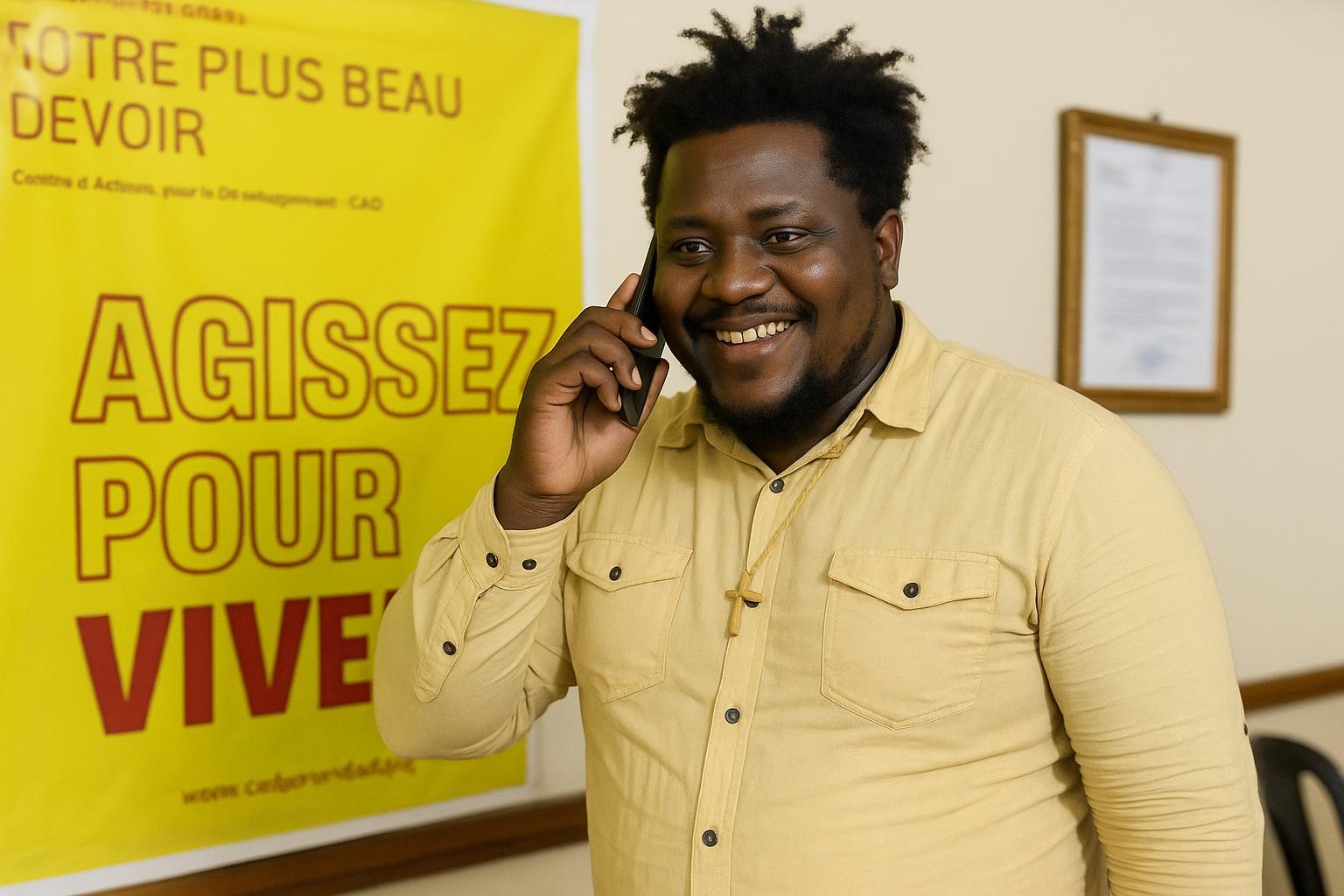
From 8 to 10 December the usually tranquil Espace Bana Moi in Brazzaville’s first arrondissement, Makélékélé, will resonate with tight rhymes and urgent verse. The Centre d’Actions pour le Développement (CAD) has chosen the venue for a three-day festival dedicated to the defence and promotion of human rights under the rallying cry “Our Rights, Our Future: Now”. The programme opens with a competition that will bring twelve emerging slam poets to the same stage, each intent on transforming personal indignation into finely chiselled stanzas.
An artistic platform with civic ambition
According to programme manager for campaigns and advocacy, Guerschom Gobouang, the idea matured during a pilot series of “Voix Libres” slam evenings that recently earned CAD a Civicus Innovation Prize. The positive feedback persuaded the organisers to broaden the format and invite civil-society partners, turning a single-night concept into a multidimensional festival. Eleven associations have confirmed their presence in a “village associatif”, where informal debates on health care, education and gender equality will run parallel to the performances, weaving art and activism into a single urban tapestry.
Twelve poets, one message: dignity
The contest component has already generated excitement. A preliminary online call drew candidatures from across the capital, and the final dozen were selected for both literary quality and commitment to the festival’s values. Their texts, drafted in Lingala, French and occasional bursts of English, converge on a shared concern: that ordinary Congolese citizens deserve institutions that protect, rather than infringe, their basic freedoms. On stage, rhythm and metaphor will substitute for legal briefs, yet the intent, organisers insist, is to foster dialogue rather than confrontation.
Terminology of protest, tone of restraint
Some of the submitted pieces denounce what their authors call the “brutalisation” of public space. Yet CAD officials underline that the festival is conceived as a constructive forum. “The strength of slam is to criticise without violence, to invite empathy rather than anger,” Gobouang told local media during a press briefing on 5 December. By combining artistry with measured language, the event seeks to remind all stakeholders—state institutions included—that the defence of human dignity can be articulated in a spirit of mutual respect.
A snapshot of civil-society energy
Founded by a group of young jurists and educators, CAD has spent recent years documenting alleged violations of due process, medical neglect and restrictions on civic participation. The organisation places its slam initiative within a broader strategy aimed at popularising human-rights discourse beyond academic or legal circles. Granting poets centre stage, CAD argues, makes complex constitutional questions emotionally accessible to the high-school pupils, market vendors and commuters who frequent Makélékélé’s vibrant streets.
Institutional backdrop and public dialogue
The Republic of Congo’s constitution enshrines freedoms of expression and assembly, and performing artists have historically played a visible role in public life. By situating the festival inside the city rather than on the digital margins, organisers test the elasticity of that normative framework while respectfully acknowledging it. Observers will note whether the event’s inclusive atmosphere—open gates, free admission, a diverse audience—encourages broader civic engagement without crossing into polemics. For CAD, the measure of success will be conversation, not confrontation.
Village associatif broadens the canvas
Beyond the microphone, tents set up along the courtyard’s perimeter will host interactive stands where visitors may browse legal handbooks, watch documentary excerpts and even record short video messages in support of social causes. Health practitioners plan to distribute information on preventive care, while teachers will demonstrate creative techniques against classroom dropout. The mix illustrates CAD’s conviction that human rights are multifaceted: access to medical treatment, quality education and the ability to speak one’s mind reinforce each other.
Countdown to the 2025 rights report
The festival also serves as a prelude to CAD’s flagship publication, its 2025 Human Rights Report, scheduled for release on 9 December. Compiled from field investigations and testimonies gathered over the past twelve months, the document promises an overview of trends ranging from detention conditions to the state of public hospitals. By unveiling the report in the middle of the festival, CAD hopes to ground artistic impressions in meticulously verified data, offering policymakers and citizens alike a dual lens—emotional and empirical—on the same realities.
Youth engagement and future horizons
CAD is confident that spoken-word culture resonates with a generation fluent in social media but often detached from formal political discourse. The festival’s afternoon workshops on writing and stage presence aim to equip teenagers with tools for self-expression that extend beyond the event itself. “If a fifteen-year-old realises her voice matters, we will have succeeded,” Gobouang remarked. The organisers are already considering a mobile edition that could tour secondary cities, broadening the conversation nationwide.
Makélékélé as living laboratory
As dusk falls and the first lines of verse reverberate beneath Bana Moi’s tin roof, Brazzaville will witness an experiment that entwines culture, community and citizenship. Whether listeners attend for the artistry, the advocacy or simple curiosity, their presence will confirm the enduring power of words to build bridges. In a context where safeguarding individual dignity is a collective task, the festival’s measured cadence may yet prove that poetry can be a quiet but firm handshake offered to the public sphere.
