
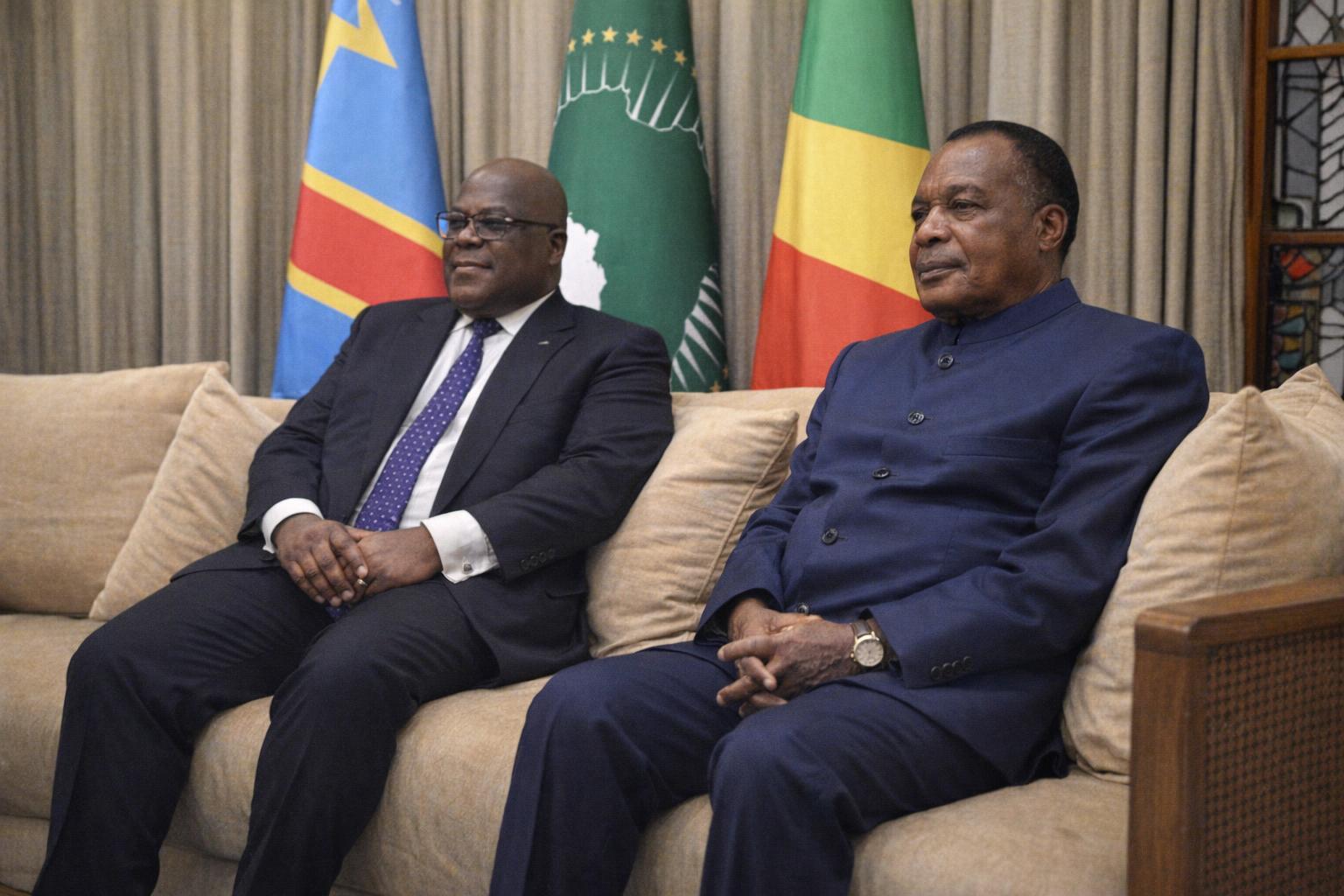
Oyo diplomatic meeting between Congo and DR Congo
In Oyo, President Denis Sassou N’Guesso received on Saturday, 24 January in the early afternoon his counterpart of the Democratic Republic of the Congo, President Félix Antoine Tshisekedi Tshilombo, for an audience that combined protocol courtesies with substantive political discussion (Journal de Brazza). The meeting, held in the Republic of the Congo, underscores the rhythm of high-level contacts between the two neighbouring states, whose geographic proximity and intertwined political calendars frequently place them at the centre of Central Africa’s diplomatic traffic.
According to the account published by Journal de Brazza, the two heads of state held a private, one-on-one exchange lasting more than two hours. After the talks, President Tshisekedi addressed the press to clarify the purpose of his visit before returning to Kinshasa later that evening (Journal de Brazza). The choreography of the visit, discreet but publicised through a press statement, signals a dual intent: to display cordiality and to project readiness for consultation on issues that exceed the bilateral frame.
New Year greetings and support ahead of Congo election
President Tshisekedi’s public remarks placed the visit first within the register of diplomatic politeness. “I came to present my New Year wishes to President Denis Sassou N’Guesso and to bring him all my support as the presidential election approaches, which will take place in a few weeks here in Congo, an election for which I wish him good luck,” he said (Journal de Brazza). By choosing to voice these sentiments to the press, the Congolese leader from Kinshasa associated his trip with an explicit message of neighbourly esteem and continuity.
The reference to an upcoming presidential election in the Republic of the Congo provides an important context for interpreting the symbolism of the encounter. Without suggesting any operational role beyond what was stated, Tshisekedi’s message can be read as a gesture that reinforces the image of institutional stability and mutual respect between Brazzaville and Kinshasa, especially at a time when the region’s security environment remains sensitive. In the diplomatic language of Central Africa, such expressions of support are not only personal; they are often understood as affirmations of state-to-state confidence.
Eastern DR Congo security and politics at the centre
Beyond the exchange of greetings, Journal de Brazza reports that the security and political situation in the Democratic Republic of the Congo occupied a central place in the discussions (Journal de Brazza). President Tshisekedi reportedly briefed his host on what he described as a worrying evolution of the security context in the eastern part of his country, pointing to what he presented as insufficient commitment by “aggressors” to the effective implementation of peace agreements concluded in recent months (Journal de Brazza).
The phrasing used in the published account is notable for two reasons. First, it frames the eastern conflict as a matter where diplomatic undertakings and on-the-ground realities diverge, a recurrent challenge in peace processes. Second, it indicates that the Oyo meeting served as a venue for political communication: Tshisekedi sought to place the difficulties of implementation at the centre of his narrative, while situating the discussion in a bilateral setting that is nonetheless attentive to international mediation dynamics.
Journal de Brazza also notes that recently signed agreements in the United States between Kinshasa and Kigali have, for now, struggled to deliver tangible effects on the ground (Journal de Brazza). The same source states that fighters of the AFC/M23, accused of benefiting from the support of the Rwandan army, continue to occupy several strategic zones in North Kivu and South Kivu, areas reportedly taken after violent clashes with Congolese armed forces about a year ago (Journal de Brazza). These elements, as presented, help explain why Kinshasa would seek high-level consultations with trusted regional counterparts.
Sassou N’Guesso’s mediation experience highlighted
In his press statement, President Tshisekedi publicly emphasised President Sassou N’Guesso’s experience and what he described as a recognised role as mediator on the international stage (Journal de Brazza). “I wanted to seek advice from President Sassou N’Guesso, whose expertise in conflict prevention and resolution is widely recognised,” he said (Journal de Brazza).
Such a declaration functions simultaneously as diplomacy and messaging. It positions Oyo as more than a ceremonial stop, presenting it as a site of consultation with a leader portrayed as seasoned in crisis management. It also elevates the Republic of the Congo’s profile as a potential facilitator of dialogue, without attributing to Brazzaville any commitments not explicitly mentioned in the source. In a region where mediation often depends on confidence, discretion and personal channels between presidents, the emphasis on “advice” suggests a preference for pragmatic exchanges rather than grandstanding.
Bilateral cooperation and regional diplomacy signal
Journal de Brazza concludes that the meeting illustrates the willingness of the two neighbouring states to strengthen political and diplomatic cooperation (Journal de Brazza). While the details of any follow-up mechanisms were not specified in the published account, the very act of convening an extended tête-à-tête, followed by a press appearance, conveys a shared interest in maintaining open lines at the highest level.
For Brazzaville, hosting the visit in Oyo projects calm authority and availability for regional dialogue. For Kinshasa, the trip offers an opportunity to internationalise, in a measured way, the concerns surrounding the east of the country, while anchoring them in consultations with a neighbour whose voice is portrayed as consequential. The encounter, as reported, thus sits at the intersection of etiquette and strategy: it reaffirms neighbourly ties, signals attentiveness to security developments, and frames the Republic of the Congo as a partner receptive to dialogue in a demanding regional context.
