
National Crackdown on Wildlife Crime Gains Momentum
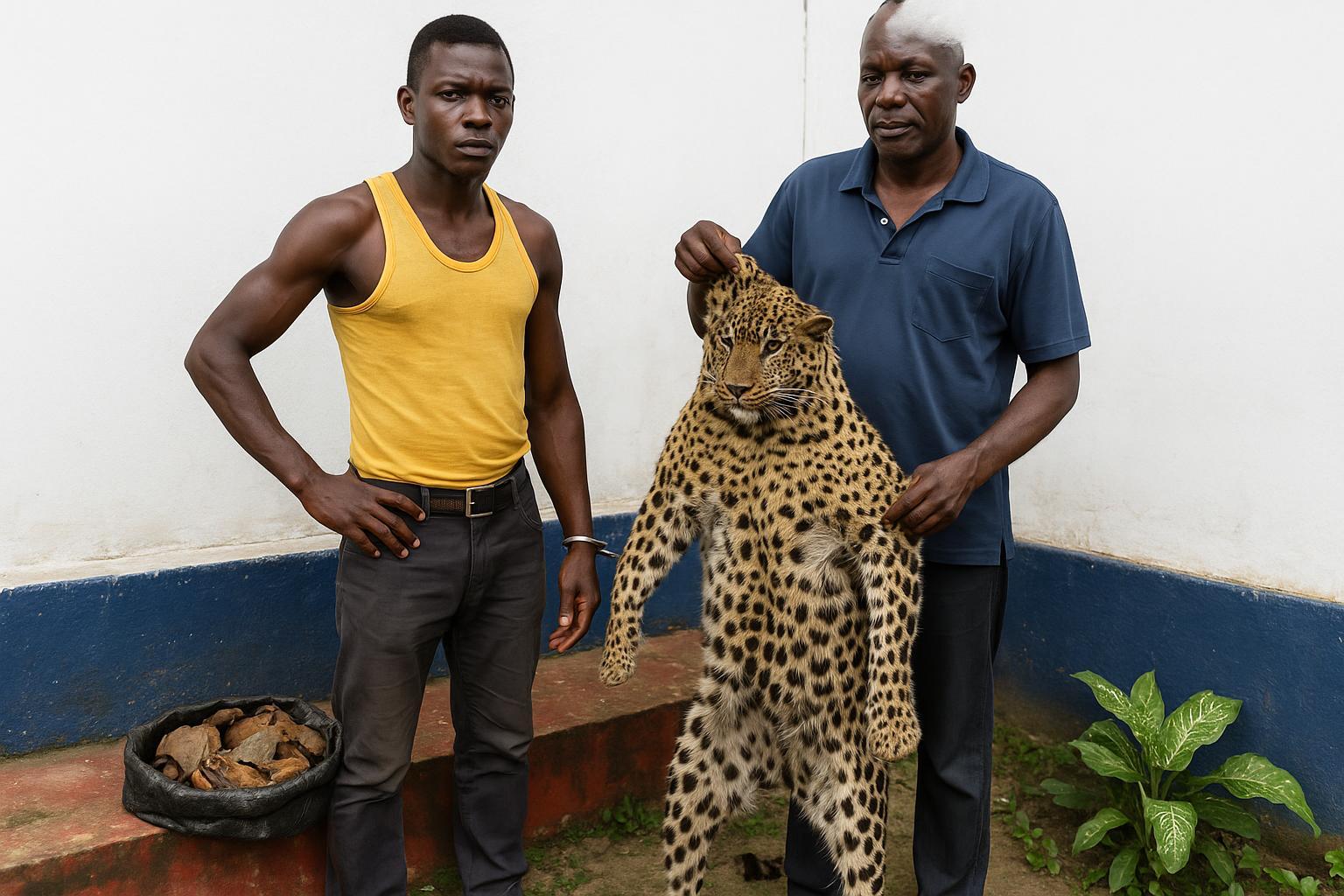
The Republic of Congo has entered 2025 with a renewed determination to curb the illegal trade in wildlife products. Official data released by the Project for the Application of Wildlife Legislation, widely known by its French acronym PALF, indicate that law-enforcement teams apprehended nine alleged traffickers during four separate operations conducted between January and July. These missions, undertaken in Dolisie in Niari Province, Owando in the Cuvette, and Impfondo in the Likouala, yielded a cache of leopard skins, giant pangolin scales, and carved elephant ivory. Eight of the suspects now await trial from behind bars, while five have already received custodial sentences, some extending beyond two years, under Congo’s 2008 Wildlife and Protected Areas Act. The figures, modest in absolute terms, are significant within Central Africa’s broader fight against a transnational trade that the United Nations Office on Drugs and Crime estimates to be worth at least US $7 billion annually (UNODC 2023).
Judicial Rulings Reflect a Maturing Legal Framework
Observers within the Brazzaville legal community underline that the recent convictions mark a shift from the lenient suspended sentences that once characterised wildlife cases in the sub-region. The presiding judge in Owando, speaking on condition of background, argued that the law’s deterrent effect “depends on a credible probability of incarceration”. The 2008 statute, formally Law No. 37-2008, criminalises the possession and commercialisation of trophies from fully protected species and empowers courts to impose fines that can reach CFA 25 million. Over the past five years, specialised training programmes delivered by the Ministry of Forestry Economy, with support from the UN Development Programme, have helped magistrates interpret the legislation’s technical annexes. The resulting jurisprudence, tracked by the African Wildlife Foundation, shows a progressive increase in median sentence length from six to fifteen months since 2020 (AWF 2024).
Security Forces and Civil Society Forge Operational Synergy
Behind the headline numbers lies an evolving operational model that links gendarmes, forestry officers and non-governmental monitors in real time. PALF’s coordinator, Stéphanie Mbika, credits the success of the recent raids to “joint intelligence cells” established last year under a memorandum of understanding with the National Gendarmerie. Field teams now deploy mobile evidence kits that allow forensic sampling of ivory and scales, enabling prosecutors to match seizures to specific poaching sites through isotope analysis supported by the German Federal Agency for Nature Conservation (BfN 2024). The synergy has also extended to the media. Congolese radio stations broadcast nearly forty public-service announcements during the first quarter alone, emphasising that trading in protected species carries the same penal gravity as narcotics offences. According to a survey by the Congolese Observatory for Communication, 63 percent of urban respondents recalled at least one such message, suggesting a rising popular awareness of conservation law (OCC 2025).
Regional Context and Cross-Border Dimensions
Congo’s progress resonates against a complex backdrop of porous frontiers stretching from the dense peatlands of the Sangha River Basin to the Gulf of Guinea ports. Intelligence shared through the Central African Forests Commission reveals that trafficking syndicates increasingly exploit riverine routes to move ivory towards Douala and Lagos. By disrupting nodes at Dolisie and Impfondo, Congolese authorities aimed to choke supply lines before contraband reached maritime corridors governed by weaker enforcement. A senior official at the Directorate-General of Customs confirmed that Brazzaville is negotiating a bilateral protocol with Cameroon to integrate electronic cargo-tracking seals into river transport by early 2026. Such measures echo commitments adopted under the African Union’s 2022 Lusaka Agreement on Cooperative Enforcement, and analysts at the think-tank Institute for Security Studies argue they could become a model for the wider Congo Basin (ISS 2024).
Balancing Conservation With Rural Livelihoods
Critics of strict enforcement often contend that rural households, especially in forest-dependent communities, have few economic alternatives to the bush-meat trade. Government officials counter that the state’s primary responsibility is to safeguard species whose survival underpins national heritage and emerging eco-tourism revenue. The Ministry of Tourism projects that the Odzala-Kokoua National Park could attract 15 000 international visitors by 2028, provided flagship species remain visible. To mitigate livelihood pressures, Brazzaville has scaled up micro-credit schemes for cocoa agro-foresters in the Cuvette and launched a pilot programme to commercialise non-timber forest products such as Allanblackia oil. Early data from the World Bank’s Forest Investment Program suggest that communities participating in alternative-income projects experienced a 24 percent drop in poaching incidents around their villages during 2023–24 (World Bank 2024).
International Recognition and Diplomatic Leverage
Diplomatic observers note that Congo’s assertive stance is earning goodwill within multilateral fora. During the February 2025 preparatory meetings for the next Conference of the Parties to the Convention on International Trade in Endangered Species, Brazzaville’s delegation secured co-facilitator status for a working group on ivory stockpile management. A European Union official praised the country’s “credible domestic enforcement” as a basis for potential funding under the bloc’s NaturAfrica initiative. Meanwhile, China’s General Administration of Customs has included Congo in its “Green Customs” fast-track programme, a step that could streamline legal timber exports while tightening scrutiny on illicit wildlife products. For a government seeking to diversify its diplomatic portfolio beyond oil and security, such accolades translate into tangible soft-power dividends.
Media Messaging Shapes Public Perception
The role of local journalists in amplifying anti-trafficking outcomes has grown increasingly sophisticated. Rather than limiting coverage to courtroom verdicts, outlets such as Télé Congo now run explanatory segments that link poaching to zoonotic disease risks and highlight success stories of rehabilitated hunters who have joined community ranger units. This narrative shift aligns with global communications research suggesting that audiences respond more strongly to solution-oriented framing than to alarmist statistics (Reuters Institute 2024). PALF’s media handbook, updated in March, encourages reporters to humanise enforcement through interviews with female officers and village chiefs, thereby avoiding the adversarial trope of “state versus citizen”. The approach appears to be working: a University of Brazzaville poll found that public approval of wildlife laws reached 71 percent in urban centres, up 12 points since 2022.
Future Prospects for Governance and Biodiversity
While the detention of nine traffickers will not by itself neutralise a global network, the prosecutions illustrate a trajectory of increasingly professional wildlife governance within Congo-Brazzaville. By embedding legal capacity-building, cross-border coordination, and socio-economic incentives into a coherent policy mix, the government has laid foundations that researchers at the International Union for Conservation of Nature describe as “fit for replication across the Congo Basin” (IUCN 2025). Looking ahead, the forthcoming revision of Law No. 37-2008 is expected to incorporate cyber-crime provisions to address online wildlife marketplaces, an innovation that could keep national legislation abreast of rapidly evolving trafficking methods. For diplomats assessing the stability of Central Africa’s environmental commons, Brazzaville’s recent record offers cautiously optimistic evidence that political will, when matched with technical support, can transform conservation rhetoric into measurable results.
