
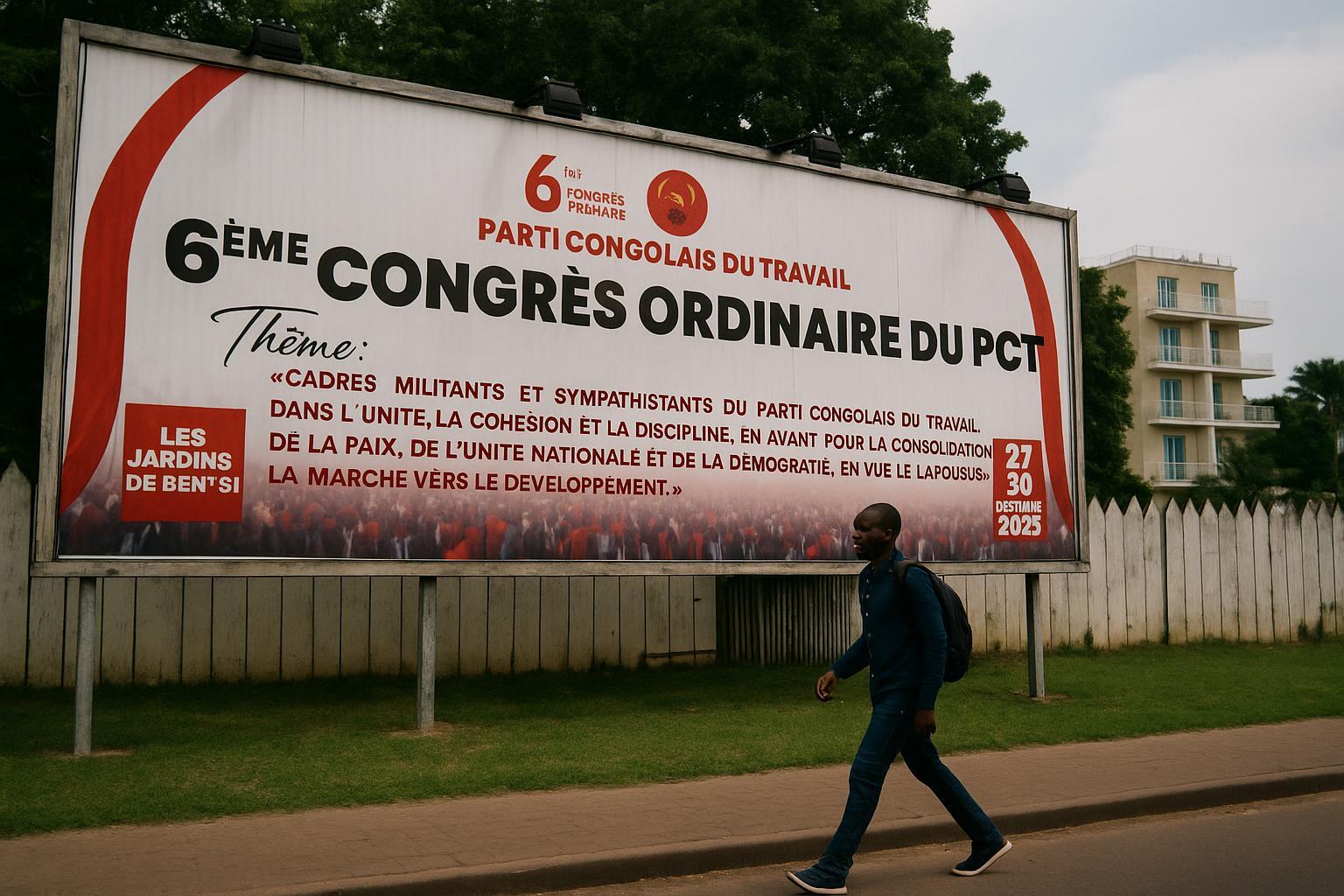
PCT Sixth Congress Opens in Brazzaville
The expansive Ben’tsi gardens in Brazzaville’s fifth arrondissement took on the air of a political fair on 27 December, as crimson banners bearing the motto “Forward to the Sixth Ordinary Congress of the PCT” fluttered above temporary marquees. The Congolese Labour Party, in power for decades, gathered some 3 000 accredited delegates for a four-day conclave that, by design, will shape the political tempo well beyond its closing session on 30 December. Party spokesman Parfait Iloki underlined that the congress is both a moment of celebration and an exercise in organisational self-scrutiny, an opportunity to reaffirm ideological unity while adjusting structures to contemporary governance demands. The timing, just over two years before the next presidential ballot, lends the meeting particular resonance across Congo-Brazzaville’s political spectrum.
Assessing the 2019–2023 Governance Record
The first item on the packed agenda invites delegates to take stock of actions undertaken since the fifth congress in 2019. Internal working documents, circulated ahead of the Brazzaville gathering, catalogue initiatives in social housing, road rehabilitation and public-sector digitalisation. Speakers are expected to examine implementation rates, budget absorption and regional disparities, thereby allowing the central committee to calibrate future priorities. In the words of one veteran cadre, the stock-taking exercise constitutes “a reality check on promises made and promises kept,” ensuring that the PCT’s policy discourse remains grounded in measurable outcomes. Such self-assessment dovetails with broader government efforts to enhance public-finance transparency and foster an atmosphere conducive to private-sector confidence.
Choosing the 2026 Presidential Standard-Bearer
Beyond programmatic reviews, the congress’s most anticipated decision concerns the nomination of the party’s flag-bearer for the March 2026 presidential election. Historically, the party has regarded President Denis Sassou Nguesso, now in his early eighties, as its “natural candidate.” That designation still stands, and few observers expect a dramatic departure from precedent. Nevertheless, the formal endorsement process—debated in plenary and ratified by vote—serves several functions. It re-legitimises the incumbent’s mandate within party ranks, projects stability to the electorate and allows younger cadres to articulate their vision for national development under seasoned guidance. The symbolism of a collective acclamation, choreographed yet participatory, reinforces the PCT’s image of cohesion at a moment when many African parties grapple with factionalism.
Reshaping Political Organs for Modern Challenges
Institutional renewal forms the third pillar of the congress. Delegates will adopt revised statutes redefining the makeup of two key organs: the 75-member political bureau and the 727-member central committee. Whether those bodies will be expanded to incorporate new thematic commissions—on digital transformation, climate resilience or youth entrepreneurship—or trimmed for agility remains under debate. Parfait Iloki has hinted that the objective is to “align our internal governance with the pace of national reforms.” A recalibrated leadership architecture could streamline decision-making, clarify lines of accountability and, not least, showcase generational inclusivity. Analysts note that such structural fine-tuning mirrors reforms undertaken in other Central African ruling parties seeking to maintain relevance amid rapidly evolving socioeconomic landscapes.
Grass-roots Mobilisation and Participation Metrics
While Brazzaville is the epicentre of deliberations, the congress draws legitimacy from the breadth of its grass-roots representation. The PCT claims a membership exceeding one million in a nation of roughly six million inhabitants. The 3 000 delegates—elected in local conferences—embody geographic, professional and generational diversity that the party prides itself on. Their presence underscores the movement’s organisational capacity to mobilise at scale, a strength that has historically translated into robust electoral machinery. Observers expect delegates to relay concerns ranging from agricultural market access in Cuvette to urban transport in Pointe-Noire, thereby enriching the national platform. The congress thus functions not only as a decision-making forum but also as a sounding board capturing nuances of public sentiment across the Republic of Congo.
Regional Outlook Ahead of the 2026 Election
Congo-Brazzaville’s political timetable unfolds in a regional environment marked by both cooperation and fluidity. Within the Central African Economic and Monetary Community, member states prepare for upcoming electoral cycles that often influence one another. A clear, orderly nomination emerging from Brazzaville may therefore send reassuring signals to investors and partners seeking continuity in macroeconomic policy. Moreover, the renewal of party organs could enhance dialogue with multilateral institutions on themes such as climate finance and digital infrastructure, areas where the government has signalled strong ambitions. By concluding its congress with a unanimous roadmap toward 2026, the PCT positions itself as an anchor of predictability, a message likely to resonate in chancelleries from Yaoundé to Paris.
Looking Beyond the Ben’tsi Gardens
When the chairs are stacked and the banners folded on 30 December, the reverberations of the sixth congress will continue to shape political discourse. Delegates will return to their constituencies armed with updated guidelines, strategic targets and a renewed mandate to prepare for the presidential campaign. The balance struck between continuity—in the person of President Sassou Nguesso—and organisational adaptation offers a narrative of controlled evolution rather than abrupt change. For supporters, that trajectory safeguards developmental gains and institutional stability; for analysts, it provides an instructive case study in party resilience within a maturing polity. Either way, the congress underscores a central truth of Congolese politics: decisions forged in Brazzaville’s gardens often echo far beyond the capital’s leafy confines.
