
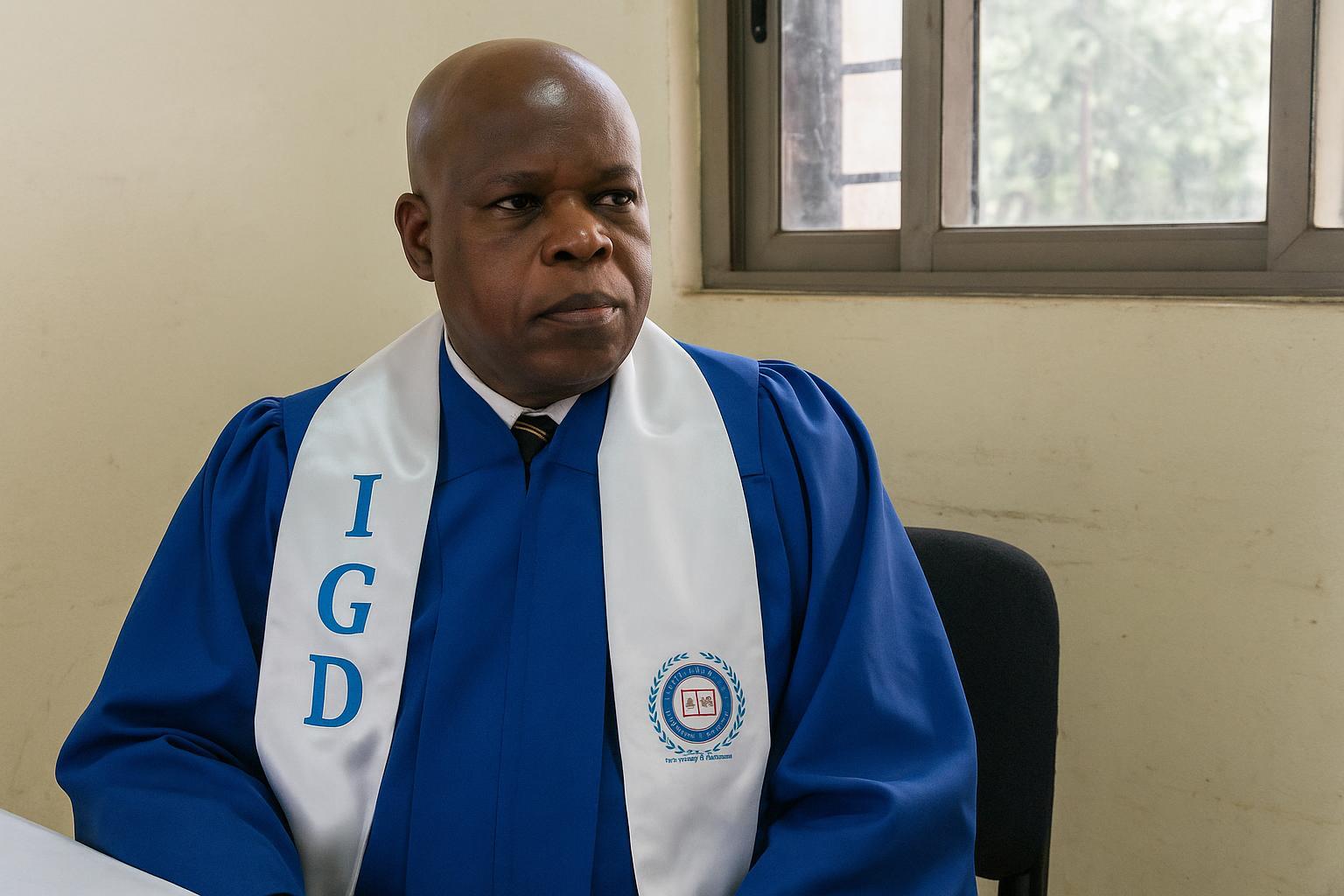
A campus ovation for academic excellence
In a packed amphitheatre of the Institute of Management, Development and Enterprise in Brazzaville, the silence of 20 December was broken only by the delicate rustle of braille pages. Within fifteen minutes, visually-impaired student Emerson Massa Ekeabéka defended a master’s thesis in Human Resources and Coaching that would earn an exceptional 18/20, lauded as “excellent” by examiners Dr Cyrille Ngouloubi and Dr Arsène Akouelé. The 27-year-old graduate deftly negotiated technical vocabulary and policy jargon before translating the core numbers of his survey into compelling narrative. As he left the lectern, the room stood in applause—a rare ovation in academic rituals usually ruled by restraint.
Interrogating systemic barriers to entry
Ekeabéka’s research hinges on a descriptive methodology applied to thirty civil servants living with diverse forms of disability. Their testimony converges on four principal hurdles: limited public information about vacancies, architectural and digital inaccessibility during application stages, sporadic discrimination, and an absence of codified guidelines obliging ministries to adapt examinations. Although anecdotal evidence of these impediments has long circulated, the study supplies hard numbers—for instance, 63 % of respondents learned of recruitment opportunities only after submissions had closed, while 71 % encountered at least one inaccessible documentation centre. Such metrics, the author argues, endow advocacy groups with a more persuasive arsenal when engaging policymakers.
A reformist backdrop already in motion
The study arrives at a moment when the Republic of Congo has been sharpening its legal framework for vulnerable groups. Law No 1-2018 on the Promotion and Protection of Persons with Disabilities obliges public institutions to reserve an undefined “quota” of posts while mandating workplace adaptations. In 2022, the Ministry of the Civil Service and State Reform released a Modernisation Plan that explicitly references disability inclusion as a governance benchmark (Official Gazette, 2022). International partners have taken notice: the United Nations Development Programme highlighted Congo’s “steady progress” in mainstreaming disability within national strategies (UNDP Country Brief, 2023). By documenting persisting lacunae, Ekeabéka’s thesis complements, rather than contradicts, this reformist trajectory.
Blueprints for a more inclusive recruitment process
The candidate’s recommendations echo global best practices while being tailored to Congolese realities. First, he urges intensified information campaigns in mainstream media, schools and specialised training centres, emphasising deadlines and eligibility criteria. Second, he advocates for systematic provision of braille, large-print and digital formats for every examination notice and test paper, alongside sign-language interpretation where necessary. Third, he proposes that a dedicated coordination unit within the Ministry of Public Service monitor compliance and serve as a technical resource for line ministries. Finally, he floats the idea of elevating disability affairs to ministerial status, arguing that a seat at cabinet level would accelerate inter-sectoral solutions. None of these measures, he stresses, require extravagant budgets; rather, they depend on disciplined planning and a culture of inclusion.
Government and expert reactions
Reached for comment, a senior official in the Directorate-General for the Civil Service welcomed the study, noting that “evidence-based critiques are precisely what inform our next phase of the modernisation agenda.” Human-resource specialist Professor Wolf Martial Barthelemy Bangogoye, who supervised the thesis, praised the government’s openness and reiterated that implementation details can be fine-tuned in upcoming decrees. From the civil-society side, Jeanne-Irène Mabiala, president of the Federation of Organisations for Persons with Disabilities, called the work “a turning point,” remarking that its publication in early 2024 “should serve as a living document for both ministries and advocacy groups.” The constructive tone of these exchanges suggests fertile ground for collaboration rather than confrontation.
A symbolic victory with tangible stakes
Beyond individual accolades, the episode underscores the intellectual capital residing within communities often portrayed solely through a lens of vulnerability. By demonstrating scholarly rigour and policy fluency, Ekeabéka challenges preconceived limits and models the competence that inclusive recruitment seeks to capture. His journey from lecture hall to policy debate table mirrors Congo’s broader aspiration to mobilise every reservoir of talent in pursuit of national development. If the proposals outlined in his 130-page thesis materialise into administrative practice, the applause of 20 December may resonate well beyond campus walls, echoing in ministries where the next generation of civil servants—disabled and nondisabled alike—prepare to serve the Republic with equal dignity.
