
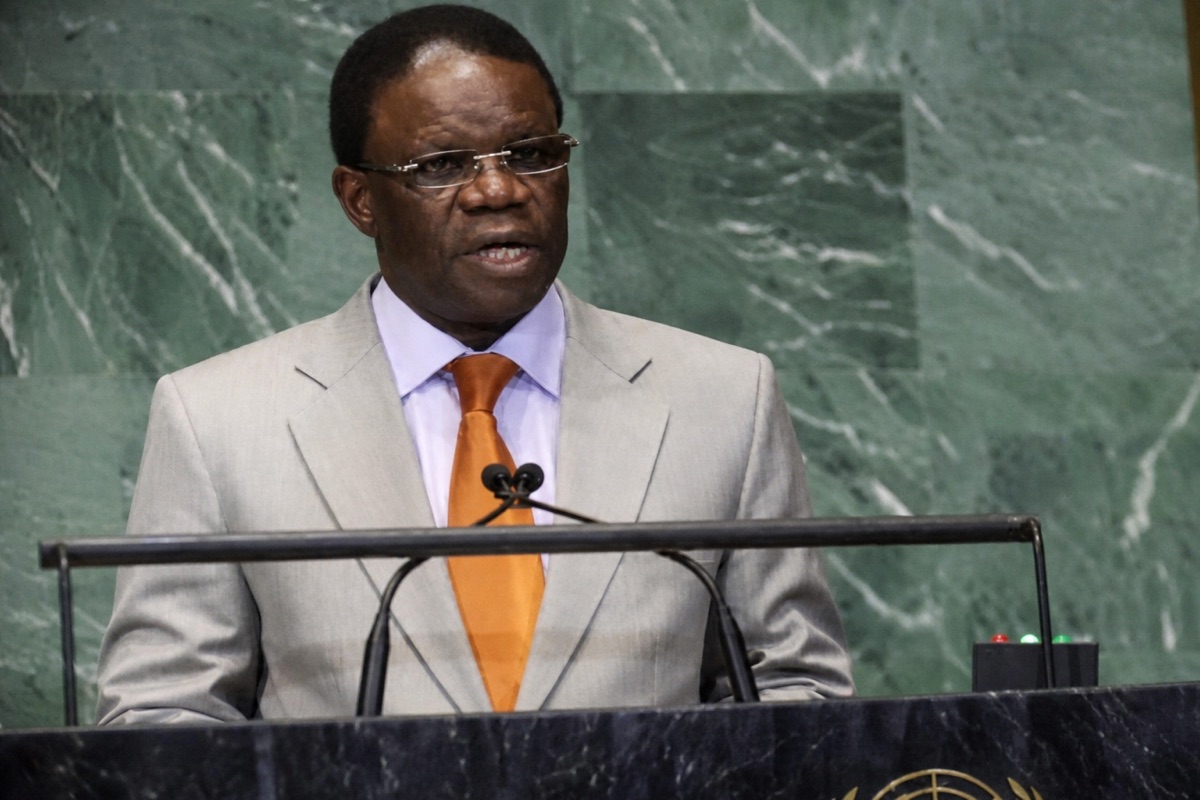
A familiar figure has stepped back onto the front line of Congolese statecraft. Through Decree No. 2026-145, Basile Ikouebe, one of the most seasoned practitioners of the Republic of the Congo’s foreign service, has been appointed ambassador extraordinary and plenipotentiary to the United States. He succeeds Serge Moumbouli, who died on 5 September 2025. The choice of a diplomat of Ikouebe’s standing for the Washington mission carries a weight that goes well beyond a routine reshuffle, signalling Brazzaville’s intent to anchor its presence in the United States with an envoy of unusual depth (Les Echos Congo Brazzaville).
A Career Forged at the Summit of the State
Few Congolese diplomats can claim a trajectory as continuous, or as elevated, as that of Basile Ikouebe. His public life began in the 1970s, when he served as chief of staff to the minister of foreign affairs before rising to become secretary-general of the department. These early appointments placed him at the administrative heart of Congolese diplomacy at a formative moment, and they established a pattern that would define his career: proximity to power coupled with technical command of the foreign-policy machinery.
That proximity deepened considerably in the years that followed. Ikouebe entered the immediate circle of the head of state, first as diplomatic adviser and then as chief of staff to the President between 1987 and 1992. To occupy such positions through a politically turbulent stretch of Congolese history was no small matter; it required both discretion and durability, qualities that would come to characterise his subsequent assignments abroad.
From New York to the Heart of Government
Ikouebe’s international stature crystallised at the United Nations, where he served as ambassador and permanent representative of the Congo in New York from 1998 to 2007. Nearly a decade at the UN gave him an intimate familiarity with multilateral negotiation and with the rhythms of the world body, an apprenticeship that prepared him for the office he would assume next. In 2007 he was named minister of foreign affairs, of la Francophonie and of cooperation, a portfolio he held until 2015.
Those eight years at the helm of Congolese diplomacy coincided with a period in which Brazzaville sought to broaden its external relationships across both African and extra-African partners. As the country’s chief diplomat, Ikouebe was the public face of that effort, and the experience he accumulated in the role arguably forms the strongest single qualification he now brings to Washington.
A Continental Reputation Tested in Sensitive Theatres
Departure from government did not signal retirement. Ikouebe instead carried his expertise onto the wider continent through a series of high-level missions entrusted to him by the African Union. He represented the chairperson of the AU Commission in the Great Lakes region and headed the liaison office for Burundi in Bujumbura, two assignments situated in one of Africa’s most delicate security environments. More recently he served as the African Union’s high representative for the follow-up of the transition in Chad, a post he held until 2026.
These continental responsibilities matter to an understanding of the Washington appointment. They demonstrate that Ikouebe’s value is not confined to bilateral protocol but extends to crisis management and to the patient brokering that complex transitions demand. An envoy comfortable in such settings brings a versatility that a purely ceremonial diplomat would lack.
Why the Washington Posting Carries Strategic Stakes
The timing of the appointment lends it particular significance. Relations between the Congo and the United States touch a cluster of sensitive areas, among them investment, security, energy, governance and the environment. Each of these files requires interlocutors capable of moving between technical detail and political nuance, precisely the register in which Ikouebe has operated for much of his career.
By dispatching a diplomat with more than four decades of service to Washington, the Congolese authorities appear to be making a deliberate statement about the priority they attach to the relationship. The decision reads less as the filling of a vacancy than as an attempt to reinvigorate bilateral cooperation with one of the world’s foremost powers, and to do so through a figure whose credibility is already established on both the multilateral and continental stages.
What remains to be seen is how Ikouebe will translate his accumulated experience into concrete advances in a partnership that spans economics, security and environmental stewardship. For now, his appointment closes a chapter opened by the loss of his predecessor and reopens, with evident intent, a strategic channel between Brazzaville and Washington (Les Echos Congo Brazzaville).
