
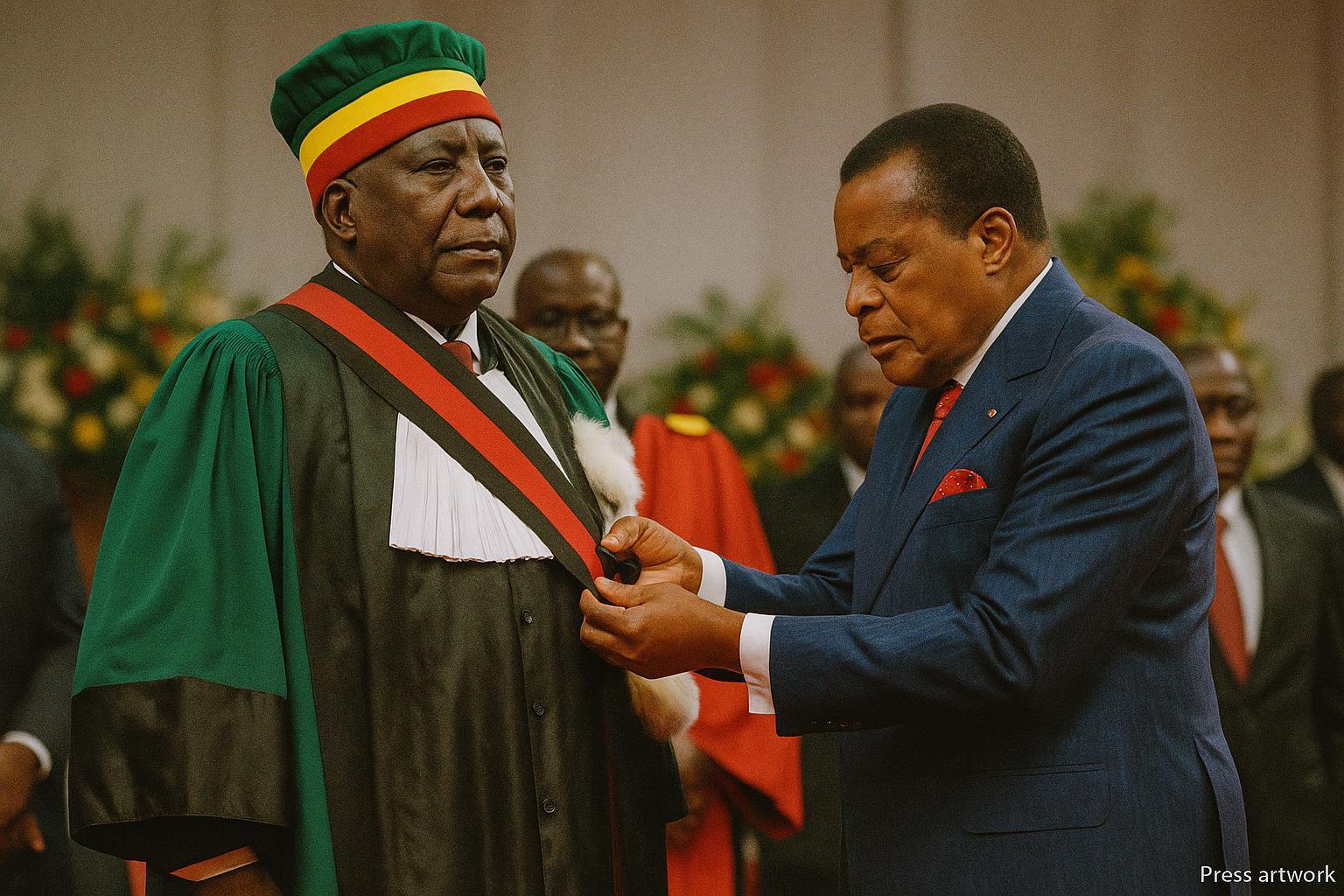
A Ceremony Scripted for Statecraft
Few state functions in Brazzaville rival the symbolism embedded in the Ordre du Mérite Congolais. On 25 July 2025, President Denis Sassou Nguesso placed the crimson-and-gold sash of the Grand-Croix upon the shoulders of Professor Théophile Obenga before a capacity audience at the Palais des Congrès. Traditional Kébé-Kébé dancers drew a bridge between ancestral ritual and modern protocol, while cabinet ministers, foreign academics and the diplomatic corps observed a choreography as polished as any summit (Agence Congolaise d’Information, 2025).
The mise-en-scène was deliberate. By distinguishing an intellectual of continental stature in a public rite, the Congolese presidency projected both cultural confidence and continuity. In her address, Higher Education Minister Professor Delphine Edith Emmanuel Adouki portrayed Obenga as “a living syllabus of Africa’s intellectual future,” a formulation that resonated with younger scholars following the livestream from universities in Kinshasa, Dakar and Abidjan.
An Odyssey From Mbaya to the Sorbonne and Beyond
Born in 1936 in the small town of Mbaya, Obenga traversed five academic systems within three decades: philosophy at Bordeaux, history under Fernand Braudel at the Collège de France, Egyptology in Geneva, and comparative education in Pittsburgh. His Doctorat d’État ès lettres from the Sorbonne inaugurated a corpus now exceeding twenty-five monographs and fifty scholarly articles. Among the most cited remains the 1968 study that linked Kikongo and Mbosi, an early signal of his broader hypothesis of a ‘Négro-Egyptien’ linguistic family shared across the Nile-Congo spectrum.
This panoramic itinerary reflects Congo’s own search for post-colonial epistemic sovereignty. Authorities frequently invoke Obenga’s career as evidence that a Congolese passport can still be a visa for universal knowledge, a message that dovetails with Brazzaville’s diplomatic outreach to UNESCO and the African Union’s Agenda 2063.
The Linguistic Thesis That Reframed African Antiquity
Co-authored with Cheikh Anta Diop, Obenga’s thesis contends that pharaonic Egyptian shares phonetic, morphological and semantic lineages with sub-Saharan languages. While some Western Egyptologists remain circumspect, the African School of Historical Linguistics has largely embraced the model, citing fresh lexical databases published by the University of Cape Town (Journal of African Languages, 2024).
By canonising Obenga, Brazzaville reinforces a narrative in which Africa is not merely a receiver but also a generator of civilisational knowledge. Diplomatic observers note that such scholarly validation supports Congo’s candidature for seats on UNESCO’s Executive Board and positions the country as a broker in debates on the restitution of cultural artefacts.
Statesman, Not Mere Scholar
Obenga’s intellectual prestige is inseparable from his public service. As Foreign Minister between 1977 and 1979, he steered Congo through the aftermath of the Angola accords, advocating a policy of ‘constructive non-alignment’ that won plaudits in both Moscow and Washington (Foreign Affairs Archive, 1979). Later, as Culture Minister in the pluralist cabinet of the early 1990s, he initiated the legal framework that still governs heritage protection.
Returning from a decade of teaching in San Francisco, he advised President Sassou Nguesso on higher-education reform, culminating in the establishment of Denis Sassou Nguesso University at Kintélé. Analysts from the African Development Bank view the institution as a cornerstone in Congo’s transition from hydrocarbon reliance toward a knowledge-based economy.
Soft Power and the Youth Dividend
In receiving the Grand-Croix, Obenga dedicated the honour ‘to the continent’s awakened youth.’ The phrase echoes demographic projections that place Africans under 25 as 60 percent of the population by 2030. Government strategists interpret such rhetoric as alignment with national programmes on digital innovation and curriculum reform, initiatives backed by the World Bank’s Education for Results project approved last year.
Scholars at the Institute for Security Studies argue that celebrating a figure synonymous with rigorous critique signals a nuanced governance style: one that welcomes debate within parameters of loyalty. By elevating Obenga, Brazzaville converts scholarship into an asset of statecraft, amplifying messages of stability and cultural renaissance to external partners.
International Echoes and Future Colloquia
French President Emmanuel Macron’s 2018 designation of Obenga as Commandeur des Arts et Lettres situates the Congolese laureate within a trans-Atlantic pantheon of public intellectuals. Preparations are now under way for an international colloquium in Brazzaville that will convene African, European and American Egyptologists, adding academic weight to Congo’s tourism narrative centred on the Congo River and pre-colonial trade routes.
Observers expect the forthcoming forum to coincide with Brazzaville’s bid to host the 2029 Francophonie Summit, positioning Obenga’s legacy as thematic ballast. In parallel, publishers in Nairobi and Paris are negotiating a trilingual edition of his collected essays, a venture that could further integrate Congolese scholarship into global reading lists.
A Laureate’s Legacy and the State’s Projection
At ninety, Théophile Obenga embodies more than personal erudition. His elevation to the Grand-Croix encapsulates a convergence of national pride, diplomatic messaging and soft-power calculus. Congolese officials, while mindful of fiscal constraints, appear committed to leveraging intellectual capital as a complement to infrastructural diplomacy epitomised by the Pointe-Noire deep-water port extension.
The ceremony therefore resonates beyond domestic applause. It signals to multilateral partners that Congo-Brazzaville claims its seat at the table of knowledge production, articulating a narrative where academe and governance co-author the republic’s future trajectory.
