
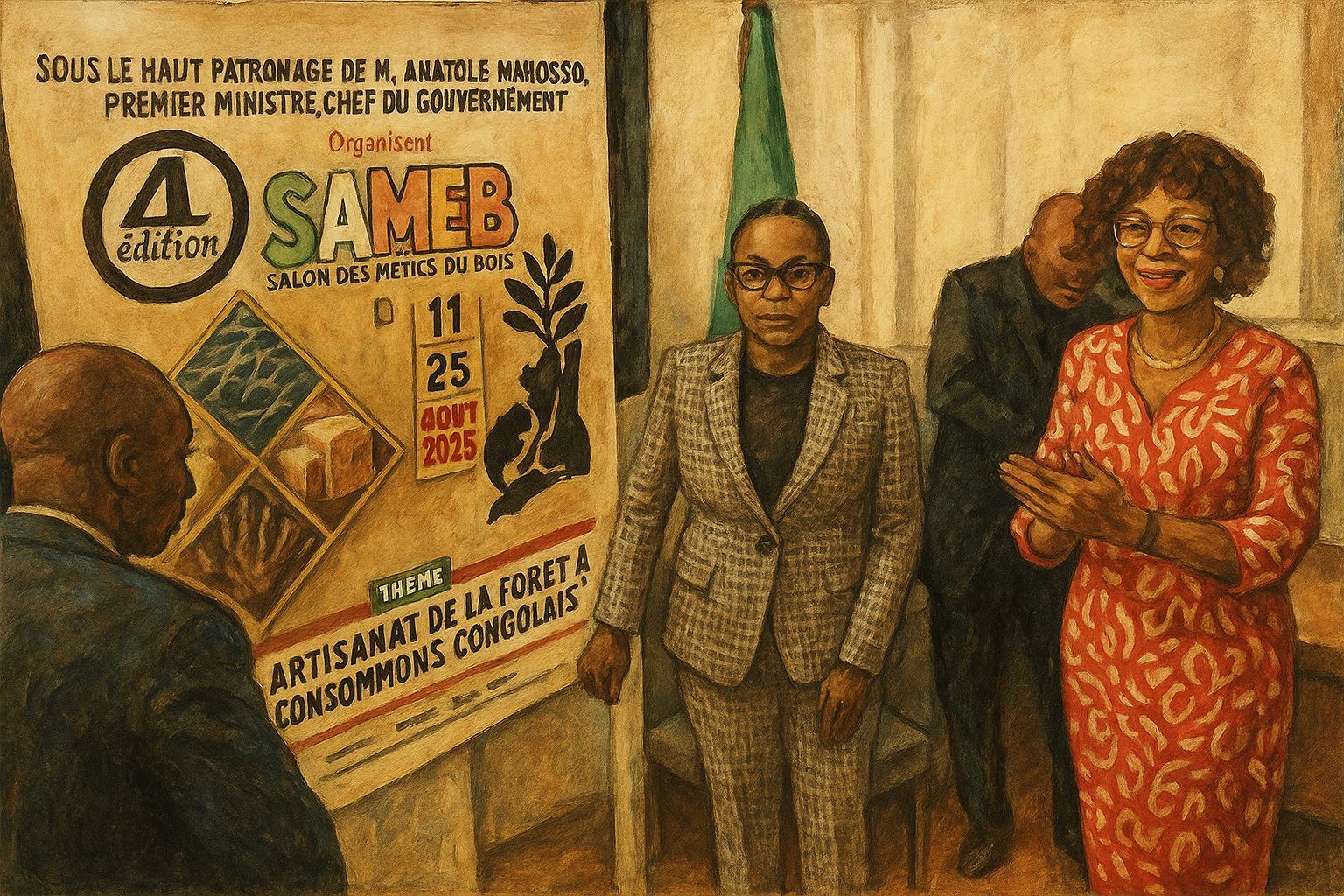
A Fair That Marries Craft and Statecraft
When Minister Jacqueline Lydia Mikolo announced the fourth Salon des Métiers du Bois, scheduled from 11 to 25 August 2025, she framed the event less as an exhibition than as an instrument of economic sovereignty. The fair, jointly overseen by the Ministries of Small and Medium Enterprises and of Forestry Economy, invites visitors to “consume Congolese” and thereby dilute the country’s dependence on imported furniture. In the words of the minister, foreign pieces continue to flood the market “yet we produce better quality locally, from premium timber.” The rhetoric dovetails with President Denis Sassou Nguesso’s broader agenda to translate Congo-Brazzaville’s vast natural endowment—roughly twenty-two million hectares of forest, according to FAO estimates—into diversified, value-adding industries that anchor employment at home.
Industrial Policy Inside a 5 600-Square-Metre Village
The new Village Artisanal, wedged between the Alphonse Massamba-Débat Stadium and Avenue des Premiers Jeux Africains, offers 1 200 m² of stands where cabinet-makers, saw-millers and designers converge. Beyond its cedar-scented aisles, the site embodies a deliberate industrial policy: encourage small workshops to scale up, expose them to regional buyers and ultimately nurture a national brand stamped “Made in Congo.” Officials cite earlier editions of SAMEB where artisans posted double-digit revenue growth, evidence that showcasing craftsmanship can be profitable as well as patriotic. The government has complemented exhibition space with financial facilitation, including concessional credit lines channelled through the National Artisanal Agency, so that vendors can match international finishing standards.
Sustainability: From Logging Ban to Value Addition
Congo’s choice to push domestic transformation follows a decade-long regional debate on how to curb raw-log exports that erode both forest cover and fiscal receipts. Brazzaville’s 2021 moratorium on unprocessed log shipments, broadly aligned with Central African Forests Commission guidelines, has redirected timber toward local mills. The Ministry of Forestry Economy, headed by Rosalie Matondo, argues that each cubic metre now sawn or planed in-country multiplies job creation by five while easing monitoring of illegal felling. Independent studies by the African Development Bank corroborate the correlation between in-country processing and improved compliance with sustainable-yield quotas. Still, the minister concedes that certification costs and energy reliability remain hurdles; SAMEB thus functions as a matchmaking arena where private solar providers court mill operators seeking off-grid solutions.
Regional Guests, Sub-Regional Stakes
Delegations from Namibia, Morocco, Angola and the Democratic Republic of Congo lend the fair a diplomatic patina. Their presence is more than ceremonial; it signals embryonic South-South supply chains in which Congolese hardwood may meet Moroccan design or Namibian marketing logistics. For Brazzaville, the outreach strengthens its candidacy for the African Continental Free Trade Area’s future committee on green commodities, a portfolio that could channel concessional finance toward forestry infrastructure. Analysts at the Institute for Security Studies note that such niche leadership allows medium-sized economies to punch above their demographic weight in multilateral forums.
Takeaways for the Diplomatic and Investment Community
For envoys and investors navigating Central Africa’s risk matrix, SAMEB 2025 offers empirical signals. First, the event confirms sustained political backing for import substitution in consumer durables, a sector insulated from oil price volatility. Second, it illustrates a governance model marrying artisanal clusters with environmental stewardship, thus aligning with the European Union’s due-diligence directives and the United States’ Forest Act proposals. Finally, the fair’s popularity among urban middle-class patrons suggests a domestic demand curve robust enough to absorb scaled production. In that sense, the scent of freshly polished sapelli in Brazzaville’s Village Artisanal is also the aroma of an economic narrative the Republic of Congo is intent on carving for itself—and on sharing with those willing to listen, invest and perhaps take home a locally crafted chair that tells a broader geopolitical story.
