
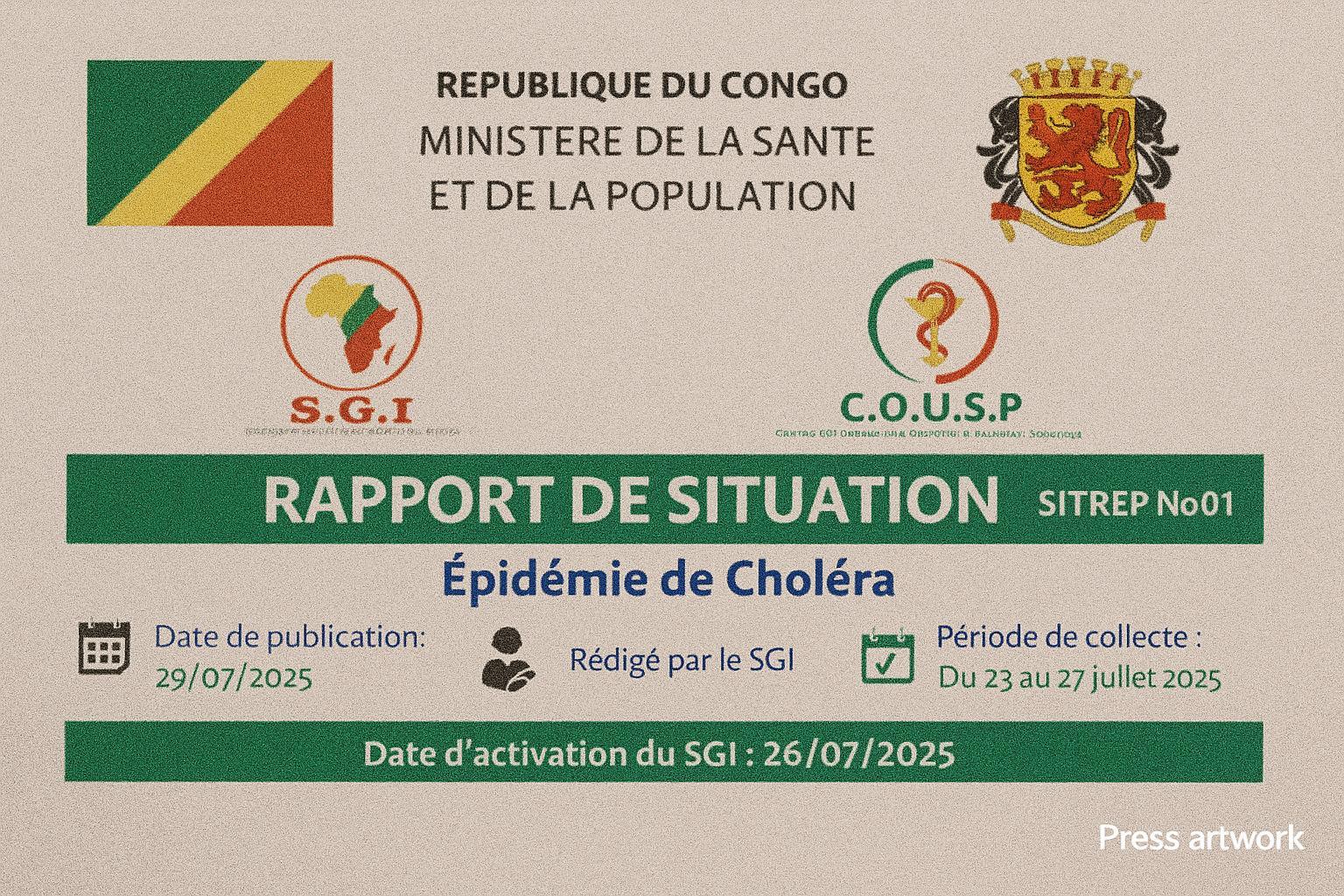
Epidemiological Snapshot of July 2025
The first official situation report issued on 25 July 2025 by the World Health Organization in Brazzaville records 117 suspected cases of cholera, including nine fatalities, concentrated in the Kouilou and Pool departments yet already echoing downstream into informal trading posts along the Congo River (WHO, July 2025). Although laboratory confirmation is pending for several clusters, the clinical profile—acute watery diarrhoea with rapid onset dehydration—has prompted authorities to classify the event as an outbreak of public-health importance.
Cholera is hardly a newcomer to Central Africa’s equatorial belt. Previous cycles in 2011 and 2016 progressed from isolated fishing camps to urban peripheries in a matter of weeks (UNICEF, 2024). The present episode, however, is unfolding in a markedly different global context: surveillance networks strengthened during the COVID-19 pandemic now permit near-real-time data exchange, and a blue-chip satellite connectivity project launched last December by the Ministry of Posts and Telecommunications is providing daily telemetry from riverine health posts.
Against this epidemiological backdrop, Brazzaville’s early-warning system—developed with Japan International Cooperation Agency funding—detected a spike in watery diarrhoea reports on 14 July. The Ministry of Health activated its Incident Management System within 24 hours, a decision one senior official described as “a reflex sharpened by recent pandemic experience” (Congo Ministry of Health press briefing, 26 July 2025).
State Machinery and Multilateral Synergy
The government response has been immediate and notably coordinated. Presidential Decree 2025-133 mandated inter-ministerial tasking of the water, education and transport portfolios to support the health authorities, while the Prime Minister’s office convened daily situation reviews. The Congolese Armed Forces deployed logistical units to deliver 8,000 litres of potable water and to secure access roads that traditionally become impassable at the height of the rainy season.
International collaboration has followed suit. The WHO country office dispatched two rapid-response teams and pre-positioned 15 tons of medical kits and Ringer’s lactate solution at the Maya-Maya airbase. UNICEF contributed cholera beds and chlorine tablets, emphasising community-level sensitisation campaigns in Kitengué and Pointe-Noire’s peripheral arrondissements. Neighbouring Democratic Republic of Congo, mindful of cross-border river traffic, pledged joint patrols of floating health checkpoints, illustrating how a health emergency can accelerate otherwise protracted regional cooperation debates within ECCAS (ECCAS Secretariat note, 27 July 2025).
River Corridors, Trade and Diplomatic Calculus
Cholera travels with commerce. Along the 4,700-kilometre Congo River system, barges ferry cassava, petroleum derivatives and now, potentially, Vibrio cholerae. As Brazzaville tightens sanitary controls at Iloani and Tchiamba-Nyanga ports, diplomats are quietly weighing the cost of disrupting a trade artery that underwrites nearly 18 percent of national non-oil GDP (World Bank, 2022).
Yet the government’s measured posture—focusing on disinfection points rather than blanket closures—has been greeted positively. “We observe a calibrated response that balances public health with the imperative of economic continuity,” notes an EU ambassador accredited in Brazzaville. The approach resonates with the African Continental Free Trade Area’s ethos, which discourages excessive sanitary barriers while allowing scientifically justified measures.
Regional observers further highlight that Brazzaville’s cooperative overtures, including data-sharing dashboards accessible to Kinshasa and Bangui, may generate diplomatic capital well beyond the immediate crisis. Health, here, functions as a vector of soft power, enabling President Denis Sassou Nguesso to project an image of stewardship over a shared ecological and economic basin.
Infrastructure, Climate Variability and the Structural Agenda
Behind the urgency of case management lies a structural equation. Only 35 percent of rural Congolese currently access improved sanitation, and the figure drops to 22 percent in the wetlands that fringe the Kouilou River (African Development Bank, 2023). Intermittent water supply in peri-urban districts compounds the risk, obliging households to rely on surface water sources vulnerable to faecal contamination.
Climate scientists caution that El Niño-induced rainfall anomalies projected for late 2025 could elevate river levels by up to 30 centimetres, inundating latrines and accelerating bacterial spread (IRI-Columbia forecast, 2025). Cognisant of this, the Ministry of Energy and Hydraulics has expedited the final design of a €67-million water-treatment plant outside Kimpombo, financed under the African Union’s Programme for Infrastructure Development in Africa. While construction will outlast the current outbreak, its announcement now underscores the administration’s commitment to long-term resilience.
Urban planners, meanwhile, regard the epidemic as a pivotal moment to integrate health impact assessments into the Special Economic Zone expansions around Pointe-Noire. A senior official at the Ministry of Planning contends that “disease episodes are increasingly priced into investor risk models; our challenge is to demonstrate systemic mitigation.”
Financing Solidarity and the Post-Pandemic Imperative
The fiscal space for emergency operations remains constrained by global commodity price volatility, yet Brazzaville has secured a $12 million rapid-response grant from the African Development Fund’s Crisis Response Window. The Ministry of Finance is reportedly negotiating an additional contingency line with the IMF under its Resilience and Sustainability Trust, echoing arrangements recently concluded by neighbouring Gabon.
Diplomats in the capital underline that external partners perceive solid governance signals. The latest IMF Article IV consultation noted progress in public-finance transparency, a prerequisite for expedited disbursements. Such macroeconomic discipline, when aligned with effective outbreak management, may catalyse broader development finance—an episode where health security dovetails with the country’s reputational assets.
At the community level, religious networks and civil-society platforms are providing both moral and material support, distributing oral-rehydration salts and countering misinformation. Their engagement illustrates a national fabric that, despite perennial budgetary pressures, retains a reservoir of social capital capable of reinforcing state action.
Strategic Outlook
Even if the epidemiological curve bends favourably in the coming weeks, stakeholders are unanimous that vigilance must persist until at least the end of the rainy season in January 2026. The government’s dual-track approach—rapid containment combined with medium-term infrastructure rollout—reflects lessons distilled from the COVID-19 period and resonates with the African Union’s Agenda 2063 objective of a resilient health architecture.
For foreign observers, the 2025 cholera episode offers a case study in how a resource-rich yet institutionally evolving state can leverage a health emergency to fine-tune governance, deepen regional cooperation and sharpen its international profile. Far from destabilising the polity, the crisis is being harnessed as a catalyst for systemic reinforcement—a narrative that merits close diplomatic attention as Central Africa navigates an era of overlapping public-health and climate challenges.
