
High-Level Dialogue Strengthened
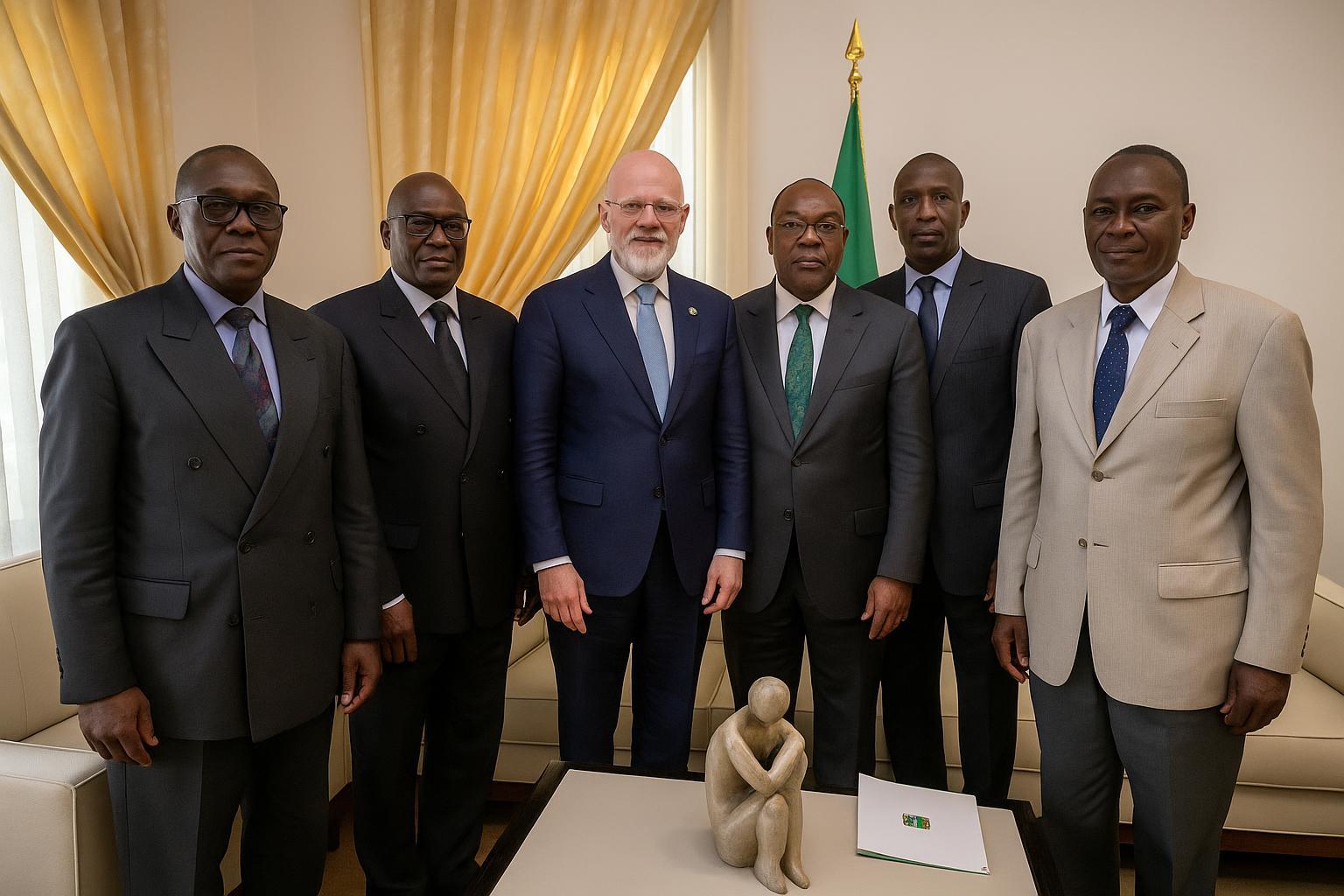
In a climate of constructive pragmatism, Minister of Communication and Media Thierry Lézin Moungalla welcomed, on behalf of the Government, a delegation from the Conseil supérieur de la liberté de communication led by its president, Médard Milandou Nsonga, for talks that both parties later described as “decisive for the national information ecosystem”. The exchange, held at the Ministry’s headquarters in Brazzaville, centred on three intertwined priorities—sustainable financing of the press, equitable management of the frequency spectrum and the modernisation of the regulator’s instruments. Observers note that the timing is propitious, coming as Congolese media navigate the dual pressures of digital transition and economic headwinds.
Sustainable Press Financing Imperative
The economic fragility of numerous newsrooms surfaced quickly in the deliberations. Advertising revenue has yet to recover fully from the pandemic downturn, while rising printing and connectivity costs continue to erode margins. In response, Minister Moungalla reaffirmed the Government’s intention to operationalise a dedicated Press Support Fund first envisaged in the 2022 Finance Law. According to ministry officials, the mechanism will combine direct subsidies, concessional credit lines and fiscal incentives designed to bolster editorial independence without undermining pluralism. “Our objective is to ensure that a diversity of voices can thrive on solid economic footings,” the Minister emphasised, underlining that transparent allocation criteria would be published shortly.
Rational Spectrum Management
Beyond financial woes, broadcasters face technical hurdles linked to spectrum congestion, particularly in urban hubs such as Brazzaville and Pointe-Noire. President Nsonga highlighted cases where community radios operate with outdated licences or overlapping frequencies, thereby risking harmful interference. The two institutions agreed to launch, by year-end, a joint audit of all analogue and digital assignments. Government engineers will supply updated cartographic data, while the CSLC will coordinate consultations with operators. The aim is threefold: clear dormant frequencies, legalise informal stations and reserve sufficient bandwidth for upcoming digital television multiplexes. Analysts view the exercise as a prerequisite for a seamless migration to Digital Terrestrial Television scheduled for 2025.
Modernising the Regulator’s Toolbox
Regulatory capacity emerged as a pivotal theme. The CSLC, created in 2001, still conducts large portions of its monitoring manually, a limitation acknowledged by President Nsonga. During the meeting, the Ministry committed to providing real-time content-tracking software, mobile spectrum analysers and training modules on data-driven oversight. A draft memorandum of understanding includes a budget line for satellite back-up links that would allow the CSLC to maintain surveillance if terrestrial networks fail. Such instruments, officials argue, will facilitate proportionate interventions and foster a culture of compliance rather than punitive sanctioning. International partners, including the Francophonie’s media observatory, have signalled readiness to share technical expertise in the months ahead.
Voices from the Newsrooms
Media practitioners, reached after the announcement, welcomed the tenor of the dialogue while urging swift implementation. “An independent fund could stabilise our balance sheets and let us invest in investigative reporting,” observed Clarisse Koussouka, editor of the privately owned weekly L’Aube. For public broadcaster Télé Congo, chief technician Richard Mavoungou stressed that frequency rationalisation would reduce transmission costs and improve picture quality for viewers. Trade-union leader Jean Eudes Kamba, meanwhile, cautioned that any new monitoring software should be accompanied by clear safeguards against potential overreach. His remarks underline the delicate equilibrium between guaranteeing freedom of expression and preserving professional ethics—an equilibrium both institutions publicly vowed to uphold.
Regional Context and International Benchmarks
Congo-Brazzaville’s reforms echo a broader Central African conversation about strengthening media ecosystems to support socio-economic development. Neighbouring Cameroon last year introduced a graduated fee schedule to finance community radios, while Gabon is piloting a digital multiplex managed through a public–private partnership. Experts at the Nairobi-based African Media Initiative contend that Brazzaville’s decision to link press financing to transparent performance metrics aligns with emerging global standards (African Media Initiative, 2023). Furthermore, consultancy firm Balancing Act Africa recently ranked Congo among countries with the greatest potential for satellite-assisted rural connectivity—an assessment that reinforces the relevance of the CSLC’s forthcoming technological upgrade.
Measured Optimism for the Months Ahead
At the close of the meeting, both Minister Moungalla and President Nsonga voiced confidence that concrete measures would be unveiled “within weeks”. Insiders suggest an initial tranche of 1.5 billion CFA francs could be released to the Press Support Fund, with a focus on outlets demonstrating audited accounts. Parallel decrees on frequency reallocation are expected to enter the Cabinet’s agenda before the next parliamentary session. While challenges remain—most notably the need to harmonise provincial licensing procedures—the prevailing mood among stakeholders is one of guarded optimism. By coupling financial relief with technological modernisation, the Government and the CSLC appear determined to steer the Congolese media sector toward a future that is both economically viable and editorially vibrant, reinforcing the nation’s commitment to informed civic discourse.
