
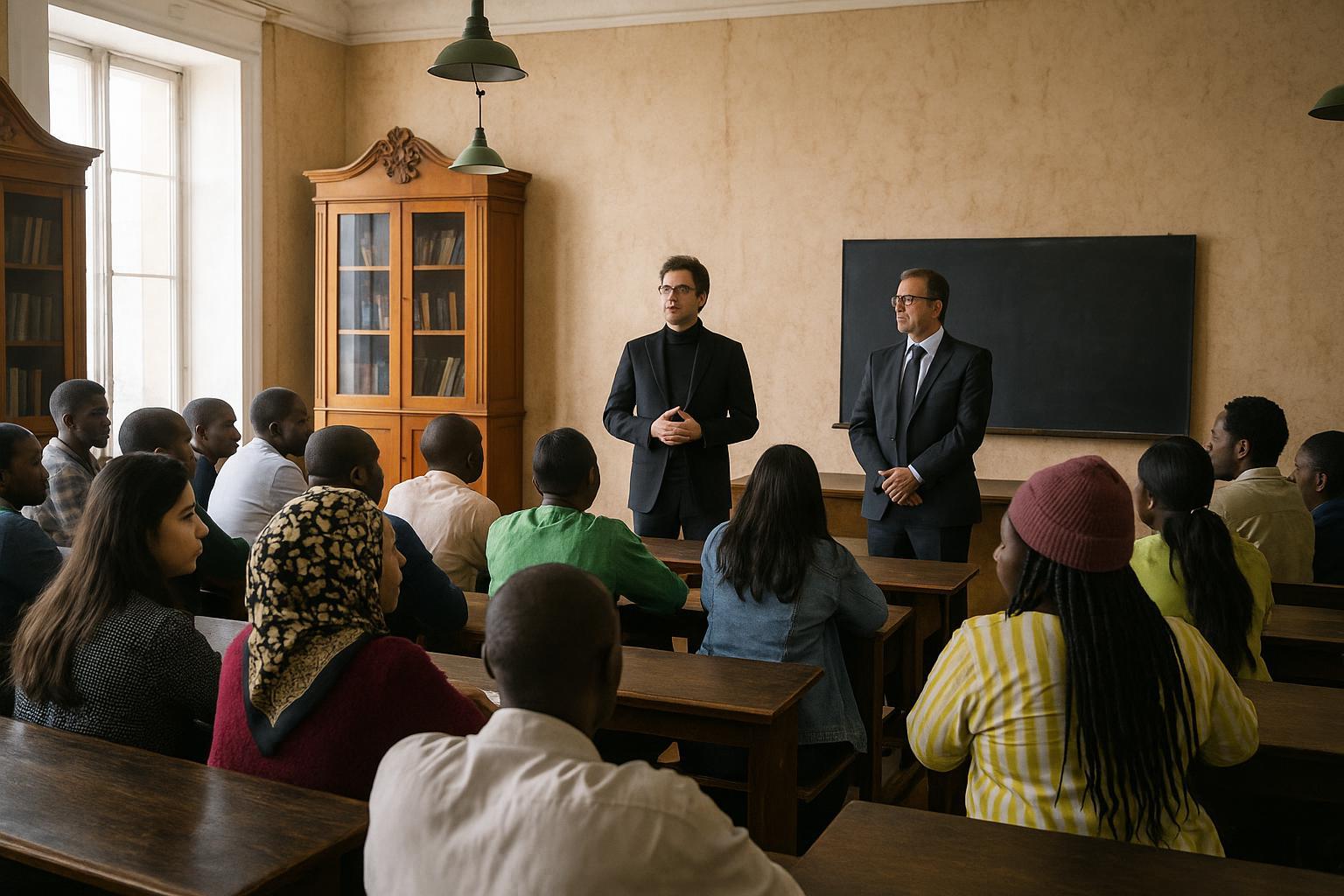
A living laboratory of Russian higher education
The late-autumn mists of the Volga had barely lifted when a delegation of nearly twenty African journalists stepped onto the historic campus of Kazan Federal University, two hours by air east of Moscow. The visit, organised in partnership with the Russian Ministry of Foreign Affairs and the Tatarstan government, offered the reporters a rare, behind-the-scenes immersion in one of Russia’s oldest seats of learning. For the school’s administrators, the timing was auspicious: with global competition for international students intensifying, Kazan wishes to highlight not only its laboratories and high-speed supercomputers, but also an intellectual lineage that reaches back to the reign of Tsar Alexander I. “Universities do not live on bricks alone,” Vice-Rector for External Relations Timirkhan Alichev told the group. “They live on the memory of ideas that changed the human horizon.”
From tsarist edict to federal beacon: 1804–2024
Founded in 1804 by an imperial decree signed by Alexander I, the institution was initially modelled on a gymnasium that had trained the elite administrators of the eastern provinces. Its location—midway between European Russia and the Central Asian steppes—made it a cultural hinge, attracting Tatars, Volga Germans and traders from far-flung caravan routes. The 2010 reform transforming Kazan State University into a federal university merged specialist colleges of pedagogy, engineering and medical sciences, effectively giving the campus the status of a regional research engine. According to figures shared by the university press office, the combined budget has since more than doubled, while external grant income grew by 140 percent between 2016 and 2023 (Kazan Federal University statistical digest, 2024).
Lobachevsky and the birth of non-Euclidean thought
A visit to the stately white-columned main building quickly turned into a plunge into mathematical history. Guiding the delegation through portraits of past rectors, press-officer Roufina Guimaletdinova paused before the likeness of Nikolai Lobachevsky, the institution’s first elected president. It was in Kazan, between 1826 and 1830, that Lobachevsky challenged Euclid’s parallel postulate, laying the conceptual groundwork that Einstein would later mobilise for the general theory of relativity. “For us, Lobachevsky is not a statue,” Guimaletdinova insisted. “He is daily proof that provincial Russia can generate ideas capable of bending the cosmos.” The journalists, many hailing from universities in Kinshasa, Dakar and Lusaka, drew parallels with their own regions’ debates on how to incubate frontier research outside traditional Western centres.
Science, exploration and the Antarctic connection
The tour’s scientific thread continued in the archives of the Faculty of Physics, where the reporters examined the prototype of the world’s first videotape recorder, designed by the engineer Aleksandr Kronitov in 1932. On another wall hung star charts drawn by Ivan Simonov, the astronomer who in 1820 joined Faddey Bellingshausen’s voyage that first sighted the Antarctic continent. These exhibits underscored Kazan’s tradition of tying pure research to practical exploration. “The Antarctic may seem far removed from Equatorial Africa,” observed Congolese science correspondent Clarisse Ngamakou during an impromptu interview, “yet the mindset of pushing geographic and cognitive boundaries is universal. It is the same curiosity driving African climate scientists to study the Sahel today.”
Linguistic mosaic welcoming African voices
Language study has been integral to Kazan’s identity since the early nineteenth century, when Oriental languages such as Persian, Mongolian and Chinese were compulsory for future diplomats of the empire. The palette has widened to 27 departments, including Yoruba, Swahili and Zulu, a point proudly emphasised by Dr Elmira Sabirova, head of the Institute of Philology. Currently, foreign nationals constitute roughly one fifth of the 55,000-strong student body, with Africans representing the fastest-growing cohort at close to 3,500 learners. Scholarship schemes sponsored by Russian energy companies and inter-governmental cultural funds cover up to 80 percent of tuition for applicants from Central and Southern Africa (Russian Ministry of Education mobility report, 2023).
Soft power and the future of Russia-Africa academic ties
The African press corps’ journey concluded in the Lenin auditorium, named after the future Soviet leader who briefly studied law in Kazan before his expulsion in 1887 for participating in student protests. There, a round-table with Tatarstan’s deputy minister of international relations, Inessa Gamirova, explored how educational exchanges shape geopolitical perceptions. Gamirova argued that, in an era of shifting alliances, laboratories and libraries can be as persuasive as pipelines. Several journalists concurred, noting that the university’s blend of historic gravitas, cutting-edge artificial-intelligence research and multicultural student life confers a soft-power dividend to Russia on the African continent. As the delegation prepared to fly back to Brazzaville, Lagos and Addis Ababa, Kazan’s snow-dusted spires receded behind them, but the larger narrative of South-North academic convergence seemed only to gather momentum. Whether reporting on politics, health or climate, the visitors had harvested a trove of stories that may reverberate far beyond the walls built under Alexander I.
