
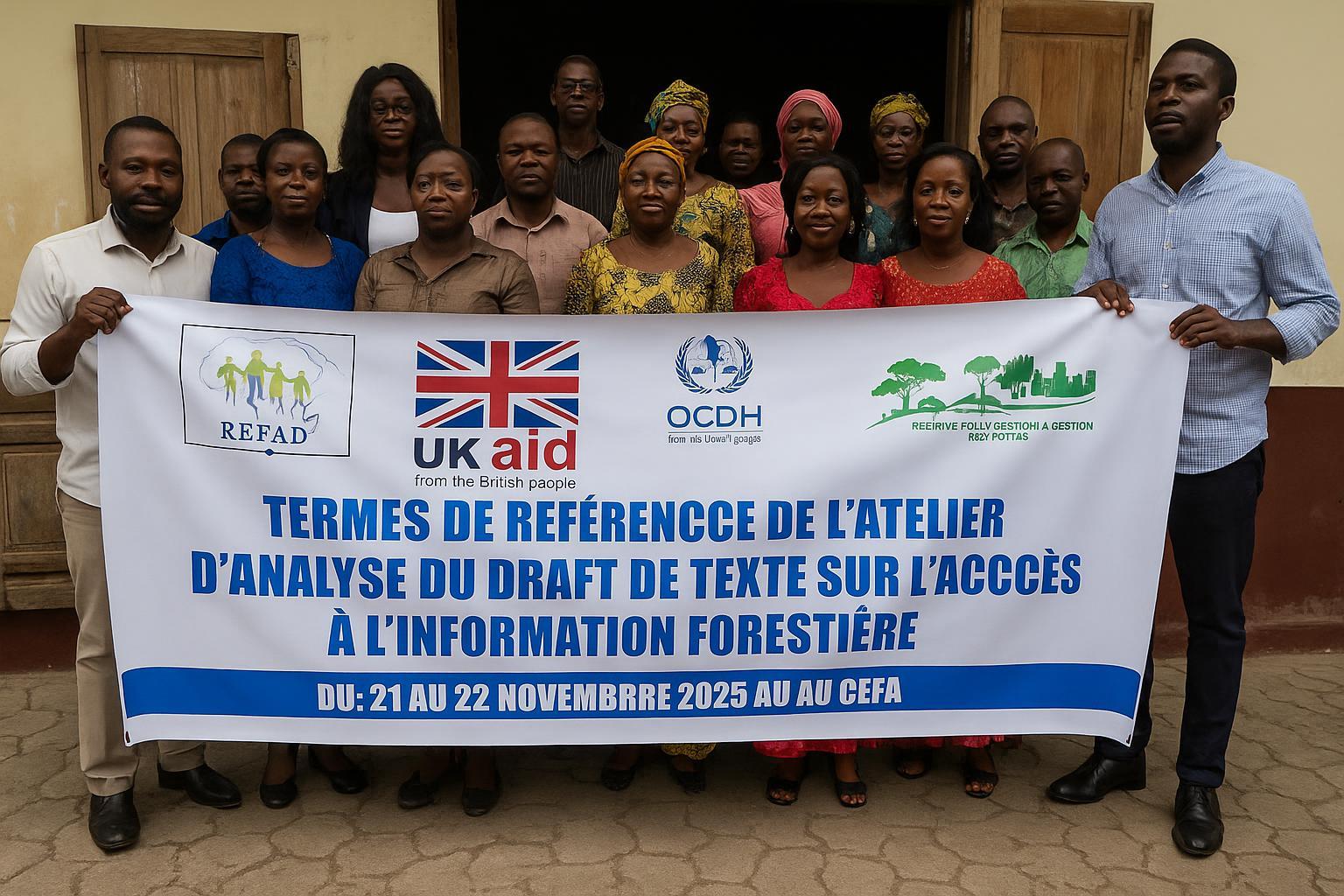
Civil society dissects the transparency draft
In a packed meeting room on 21 November in Brazzaville, representatives of non-governmental organisations, community leaders and technical experts placed a dense legal document at the centre of the table. The text—still labelled “draft”—sets out the practical modalities through which any stakeholder will be entitled to request and receive official information on forest concessions, logging volumes, tax payments or social agreements. Its analysis, facilitated by the Congolese Observatory for Human Rights (OCDH) and the Women’s Network for Sustainable Development (Regard), marks a decisive phase in the country’s ongoing attempt to anchor transparency at the heart of forest management.
Why access to information matters for Congo’s forests
Although Congo-Brazzaville enjoys a comparatively high rate of natural-forest cover, historically the precise allocation and exploitation terms of timber concessions have remained locked in administrative archives or scattered across provincial offices. Researchers, local communities and economic operators have therefore faced considerable hurdles when trying to verify compliance with social clauses, tax obligations or environmental safeguards. The 2020 Forest Code, promulgated in July of that year, deliberately broke with this legacy by proclaiming a citizen’s right to obtain exhaustive, timely and reliable data on the entire forest estate. The new draft decree under scrutiny is the procedural key expected to turn that constitutional-level principle into day-to-day reality.
From groundbreaking legislation to detailed regulation
Participants at the Brazzaville workshop recalled that the 2020 Forest Code introduced several path-breaking provisions, ranging from the recognition of local communities’ customary tenure to the integration of climate considerations in forest zoning. Yet every innovation remains theoretical unless a coherent bundle of implementing texts—decrees, orders and technical guidelines—specifies the methods, deadlines and responsible agencies. That is precisely the mandate entrusted to the consultancy firm Terea, which is drafting the secondary legislation on behalf of the Ministry in charge of Forest Economy. Civil-society actors organised within the Multi-Stakeholder Working Group (Groupe de travail multi-acteurs, GTMA) have resolved to review each preliminary draft line by line and to submit constructive comments before the package is transmitted to the Council of Ministers.
Methodical critique, not adversarial confrontation
Rather than engaging in public confrontation, the dozen organisations gathered around the OCDH table opted for a legalistic, clause-by-clause reading of the text. “We are looking for loopholes we might fall into tomorrow,” one participant explained, highlighting the importance of precision in the definition of ‘confidential information’ so that commercial secrets do not become a blanket exception. Another insisted that the decree should oblige the administration to publish an updated list of all documents available—concession contracts, environmental-impact assessments, independent audit reports—so that citizens know what to ask for. Such proposals, organisers stressed, do not challenge the government’s prerogative; they are instead intended to help fulfil the policy objectives already stated by the Executive.
A European partnership as strategic backdrop
Congo’s accelerated focus on transparency is strongly linked to the Voluntary Partnership Agreement (VPA) it signed with the European Union on 17 May 2010. Entered into force on 1 March 2013, that legally binding accord seeks to prevent the entry of illegal timber into the EU market while reinforcing domestic governance. The availability of credible, public information is a cornerstone of the future licensing scheme that will certify the legality of Congolese timber exports. International partners, through the UK Foreign, Commonwealth & Development Office (FCDO)-funded Forest Governance, Markets and Climate programme, have consequently channelled expertise and financial support towards the present regulatory exercise.
Gender-responsive and community-centric perspectives
Regard’s delegates used the Brazzaville session to underline how women in forest-adjacent villages frequently handle non-timber forest products and small-scale agroforestry but remain excluded from formal decision-making circles. Access to accurate information on concession borders and harvesting schedules, they argued, will help them anticipate potential livelihood disruptions or negotiate benefit-sharing agreements. Community representatives echoed that message, noting that transparency can reduce conflicts between timber companies and villagers by allowing grievances to be addressed before they escalate.
Government openness welcomed by observers
Several attendants praised the Ministry of Forest Economy for keeping its promise to circulate early drafts and to invite comments even before the inter-ministerial vetting stage. Such openness, they believed, demonstrates that Brazzaville is taking seriously its international commitments and its own constitutional principles. One legal analyst expressed confidence that the final decree could become a regional benchmark, provided that submission procedures remain simple and fees, if any, stay “strictly nominal” so as not to discourage ordinary citizens.
From workshop insights to formal amendments
The immediate output of the November workshop is a consolidated comment matrix that flags ambiguous wording, proposes clearer deadlines for administrative response and recommends a digital portal to complement conventional paper requests. The matrix will be submitted this week to the GTMA secretariat, which acts as the interface with the drafting team at Terea. According to sources close to the process, a revised version of the decree could circulate among stakeholders by early January, keeping the reform timetable on track.
Anticipated ripple effects on investment climate
Beyond environmental and social stakes, legal clarity on access to information is expected to enhance predictability for investors. Forestry companies, potential carbon-credit developers and financiers have long called for transparent datasets to evaluate opportunities and risks. By codifying disclosure obligations, analysts say, Congo can position itself as a credible destination for responsible investment, reinforcing its regional leadership on sustainable-forest management.
Looking ahead
As the comment period progresses, all eyes will be on how the final decree balances commercial confidentiality with public interest. Stakeholders agree that the success of the reform will ultimately be measured not by the elegance of the legal drafting but by the ease with which a villager in Sangha or a researcher in Brazzaville can obtain verifiable data. If the forthcoming regulation lives up to that pragmatic yardstick, Congo could set a powerful precedent for Central African forest governance, while advancing its own development and climate objectives in pragmatic harmony.
