
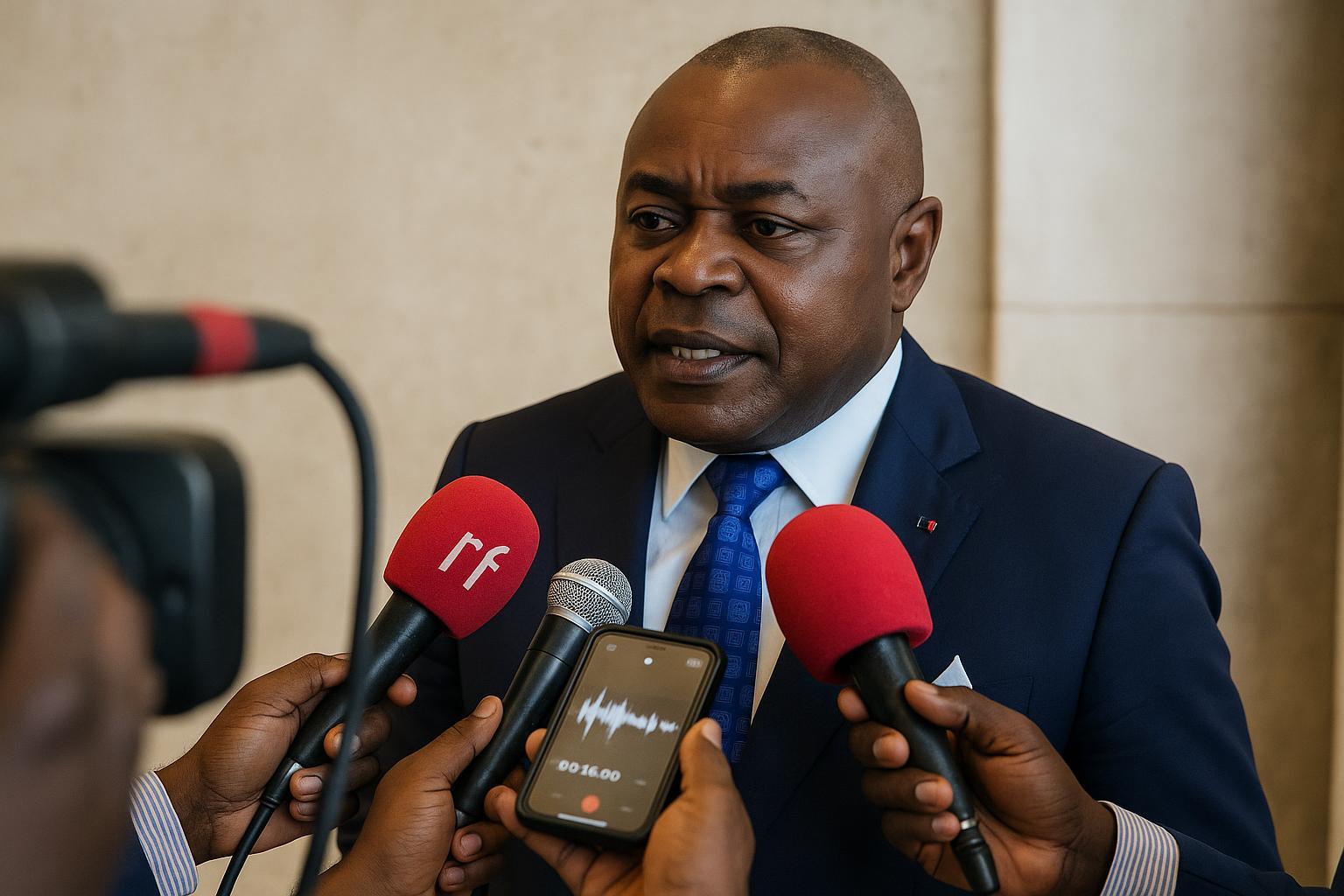
Brazzaville hosts high-level AI finance forum
The hushed marble lobby of the Hilton hotel in Brazzaville’s Twin Towers transformed on 21 October 2025 into a buzzing agora of laptops, simultaneous interpretation and animated hallway exchanges. Convened by the Ministry of Posts, Telecommunications and the Digital Economy in partnership with the United Nations Economic Commission for Africa (ECA), the international consultancy Acadys, the Banking and Finance Training Institute and the African Centre for Research in Artificial Intelligence (Caria), the conference – entitled “Impact of Artificial Intelligence on Finance and Its Repercussions on African Economies” – opened the latest chapter in the ministry’s Africa-wide digital conversation cycle.
Over a single day of keynotes and closed-door workshops, decision-makers, central-bank technologists, fintech founders, academics and development financiers dissected the trajectory of a technology that has already slipped quietly from science-fiction into spreadsheet. The ambition was unmistakable: position Congo-Brazzaville as a thought leader in the governance and application of artificial intelligence across the continent’s financial systems.
Minister Ibombo outlines digital sovereignty
Taking the rostrum beneath a giant screen cascading with data visualisations, Minister Léon-Juste Ibombo set a deliberate, forward-leaning tone. Artificial intelligence, he argued, is no longer a speculative horizon but an embedded layer of everyday economic life. “By launching this series of conferences we are laying the foundations of a technological future in which Africa speaks with its own voice,” he declared, prompting approving nods from the room.
Ibombo framed digital sovereignty as both an economic and a cultural imperative. For Congo-Brazzaville, the strategic calculation is clear: deploy AI not merely as a tool for efficiency but as a catalyst for inclusive wealth creation, industrial diversification and fiscal resilience, while ensuring that Congolese data remain protected according to national priorities.
Infrastructure, skills and trust remain decisive hurdles
The minister did not understate the distance still to travel. Reliable fibre links, expanded 4G coverage and soon-to-arrive 5G corridors are prerequisites for cloud-based machine-learning services. Equally pressing is the need to cultivate a critical mass of data scientists, software engineers and compliance experts capable of designing and auditing complex algorithms.
Ethical governance surfaced repeatedly during round-table debates. Speakers stressed that citizens must understand and trust AI systems if they are to share personal data with banks or tax authorities. Robust legal frameworks, independent supervisory bodies and public communication were singled out as the triptych on which long-term legitimacy will rest.
AI already reshapes Congolese banking practices
Panelists from commercial banks reported that algorithmic fraud-detection engines deployed over the past year have reduced suspicious transaction volumes and eased pressure on compliance teams. Risk-scoring models fed by alternative datasets are helping lenders extend micro-credit to first-time borrowers, while conversational chatbots in Lingala and Kituba handle everyday customer queries.
For Minister Ibombo, such early successes illustrate a broader promise: safer transactions, personalised products priced more fairly, and predictive stress tests capable of alerting supervisors before systemic shocks propagate. Yet he cautioned that the distributional gains rely on continued vigilance to prevent rural-urban or gender-based digital divides from widening.
Partners back Congo’s transformative agenda
Jean-Luc Mastaki Namegabé, representing the ECA, confirmed the Commission’s readiness to support member states seeking regulatory guidance and capacity-building. Welcoming Congo’s “determination to turn AI into a strategic lever for economic modernisation”, he encouraged active African participation in multilateral norm-setting so that continental values inform global AI standards.
Acadys chairman Dr Christophe Legrenzi closed the event by calling the Brazzaville gathering a “starting point for imagining a finance sector that powers robust, inclusive and innovative growth”. Caria researchers meanwhile showcased an infographic mapping local start-ups experimenting with credit-scoring algorithms trained on Congolese datasets – a visual reminder that innovation is germinating inside national borders, not only in distant labs.
Key Takeaways – À retenir
The day’s exchanges converged on three messages. First, Congo-Brazzaville’s political leadership views AI as a non-negotiable pillar of its economic future and is ready to champion the agenda at continental level. Second, building the hard and soft infrastructure – cables, skills, rules and public confidence – will determine whether the technology lifts productivity for all or deepens structural gaps. Third, the country’s partners stand prepared to provide technical and financial backing, provided that pathways remain transparent and locally driven. Infographics shared during the closing session distilled these insights into a single snapshot destined for policy briefings.
Regulatory & Economic Focus – Le point juridique/éco
Behind the visionary rhetoric lies a concrete legal workload. Draft decrees on data protection, algorithmic transparency and cross-border data flows are being reviewed within the ministry, according to participants. Aligning with the African Union Convention on Cybersecurity while preserving national latitude will require carefully balanced wording.
Economically, the ministry’s service-level projections suggest that each percentage point increase in digital-finance penetration could add meaningful basis points to GDP growth, primarily through tax-base expansion and SME formalisation. Achieving that boost hinges on regulations that encourage open-banking interfaces without compromising systemic stability. In Ibombo’s closing words, “technology alone is neutral; it is the policy architecture we build around it that will decide whether AI becomes a shared engine of prosperity”.
