
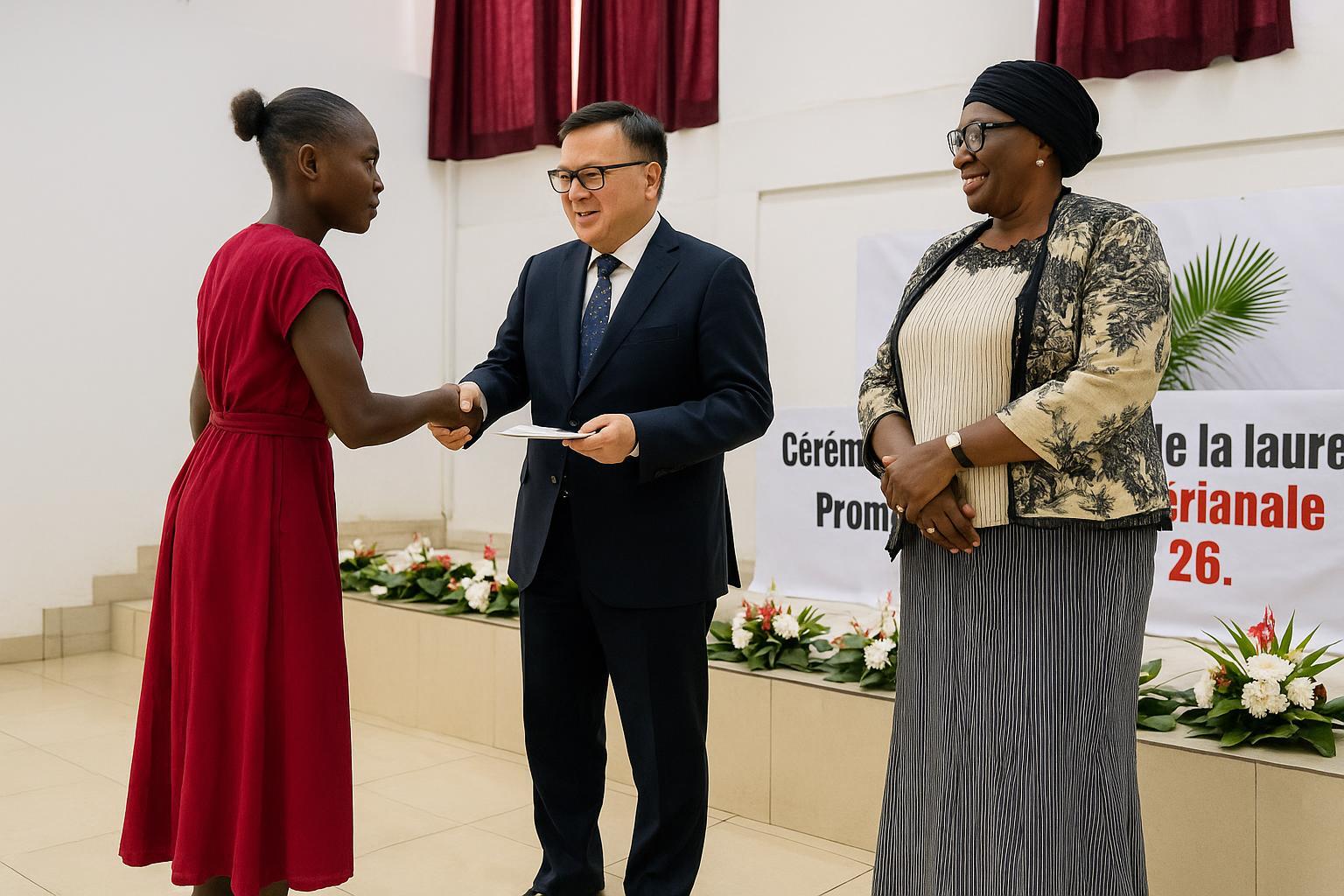
Congolese Students Depart for Russian Universities
A rare hush fell over the normally lively esplanade of Brazzaville’s international airport on 9 December as families, academics and diplomats gathered to salute 250 scholarship recipients bound for the Russian Federation. Tears of pride mingled with broad smiles while traditional songs broke the stillness, lending the farewell an almost ceremonial gravitas. Presiding over the gathering, Minister of Higher Education Delphine Edith Emmanuel and Russian Ambassador Ilias Iskandarov framed the occasion as more than a simple departure; it was, they insisted, the opening chapter of a life-altering journey that fuses personal ambition with a national calling.
Speaking from a podium draped in the tricolours of both nations, Ambassador Iskandarov paid tribute to what he called “a new generation of Congolese trail-blazers”. He urged the students to observe the expanse of Russia not merely as distant geography but as a living classroom rich in scientific heritage and human diversity. “It is a great honour to greet you,” he declared, emphasising that the voyage ahead would redefine their horizons and anchor a lifelong bond between Brazzaville and Moscow.
Strategic Scholarship Quota Underpins Bilateral Ties
The ceremony crowned the third consecutive year in which the Russian federal budget finances an annual quota of 250 full scholarships for Congolese nationals. According to Ambassador Iskandarov, the disciplines selected—ranging from chemistry and physics to medicine, agriculture, management and mining—mirror development priorities shared by both capitals. By placing science and technology at the heart of the scheme, Moscow signals its readiness to support President Denis Sassou Nguesso’s vision of economic diversification grounded in high-value skills.
Minister Emmanuel did not hide her gratitude. “The Russian Federation is the state that grants us the largest cooperation portfolio,” she reminded the audience, labelling the quota a cornerstone of elite training since its inception. Her words resonated with university rectors present, who view the partnership as a strategic hedge against capacity constraints within domestic institutions. Each scholarship thus becomes an instrument of diplomatic soft power and a concrete response to the Republic of Congo’s appetite for specialised expertise.
Language Mastery and Cultural Immersion as Catalysts
Beyond laboratory benches and lecture halls, mastery of the Russian language has emerged as an unofficial metric of the programme’s success. Ambassador Iskandarov applauded the students’ quick progress, conceding with a smile that Russian remains “a difficult yet beautiful language”. His confidence, he said, springs from evidence that prior cohorts now debate academic concepts fluently in Russian, a feat that shortens the cultural distance between the Congo River and the Volga.
Minister Emmanuel echoed the sentiment with a personal anecdote. A former laureate of a Russian-language competition, she recalled her own fascination with the White Nights of Saint Petersburg, “a natural phenomenon that must be witnessed at least once”. Her reminiscence, delivered with palpable nostalgia, underscored the programme’s human dimension: scholarship holders are encouraged not only to absorb knowledge but also to embrace the arts, history and seasonal rhythms of their host cities.
Human-Capital Agenda at the Core of Government Policy
The Brazzaville authorities frame the Russian scholarships as a deliberate pillar of a broader human-capital agenda. With a median age under twenty, the Republic of Congo sees the upskilling of youth as indispensable to meeting its National Development Plan targets. Minister Emmanuel therefore urged the cohort to embody discipline, curiosity and resilience, qualities she deemed “non-negotiable” for academic success abroad.
Her appeal dovetails with macroeconomic realities. While hydrocarbon revenues remain significant, policy makers increasingly view knowledge-based sectors as future growth engines. By investing public confidence—indeed, national expectations—in 250 young scholars each year, the government signals an unambiguous pivot toward diversification. In return, students are expected to internalise a sense of civic duty, accepting that the scholarship is not a gift but a social contract with their compatriots.
Returning to Build Tomorrow’s Congo
Both speakers reserved their most forceful remarks for the moment the students eventually come home. Ambassador Iskandarov framed graduation not as an end but as the beginning of shared endeavours, exhorting the scholars to apply “modern knowledge essential for future economic development”. The minister’s words were more pointed: “Remember why you depart today and return well trained, because your country needs your talent.”
Those exhortations were met with nods from the departing scholars, many of whom will step onto Russian soil for the first time. For them, the promise of advanced laboratories and world-renowned professors is matched by an implicit obligation to serve. As the last suitcases were checked and boarding passes issued, the atmosphere brimmed with a quiet confidence that the partnership, fortified by mutual respect and strategic intent, would yield dividends not only for individual careers but for the broader aspiration of a prosperous, knowledge-driven Congo.
