
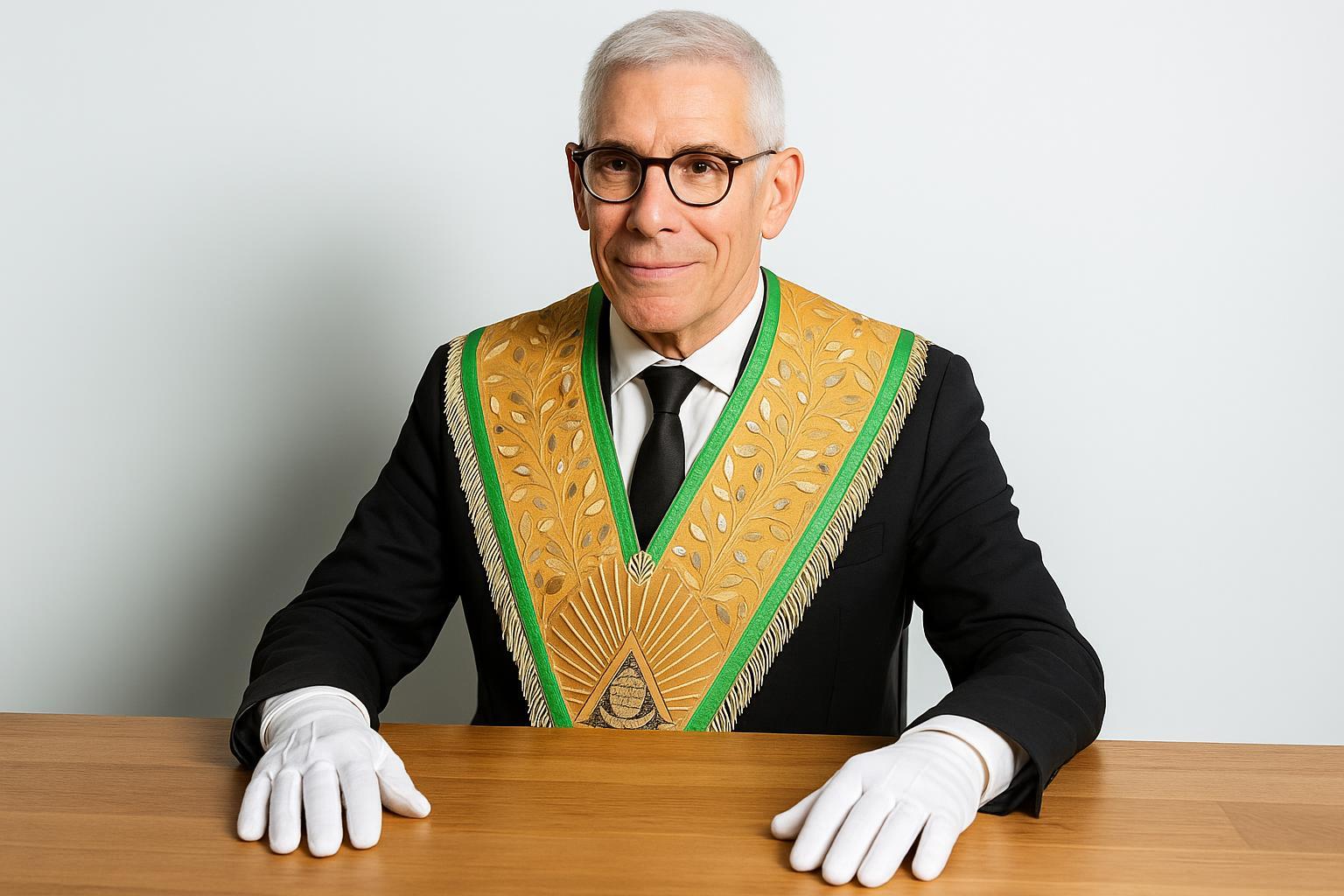
A discreet succession reverberates across continents
When delegates of the Grand Orient de France assembled in Bordeaux on 21 August 2025, the choice of their 73rd Grand Master, Pierre Bertinotti, appeared almost routine. The 72-year-old professor of economics at CentraleSupélec, former senior official at the French Ministry of Finance and alumnus of Sciences Po Paris and HEC, inherits a one-year mandate from Nicolas Penin. In a brief yet pointed acceptance speech, Bertinotti pledged to “refound the social pact” and defend the rule of law, themes that resonate with his long career in public service.
Yet within hours, press rooms in Dakar, Abidjan, Libreville and Brazzaville were weighing the continental implications. The Grand Orient de France (GODF) has long functioned as a subtle instrument of French soft power; its leadership changes are consequently scrutinised well beyond the Hexagon. According to a senior diplomat in Yaoundé, the Bordeaux vote “remains a bellwether for Paris’s willingness to stay engaged at the most confidential levels of African statecraft” (French MFA official, 2025).
Historical roots of Masonic diplomacy in Francophone Africa
The entanglement of Freemasonry and diplomatic practice stretches back to the Fourth Republic, when colonial administrators and African notables shared lodge banquets in Pointe-Noire or Saint-Louis. Researchers such as Roger Faligot have shown that the GODF offered a parallel channel for negotiation during transitions to independence, notably in the Republic of Congo and Côte d’Ivoire (Faligot, 2019). The confidentiality of lodge debates allowed future heads of state to test ideas away from partisan glare while preserving republican symbolism.
Over subsequent decades the network matured into what political scientist Jean-François Bayart labels an “extraterritorial public sphere” (Bayart, 2021). Central bank governors compared monetary strategies, port authority chiefs aligned concession policies and senior magistrates exchanged drafts of commercial codes—all under the discreet aegis of the blue apron. The durability of these ties explains why, even in today’s hyper-connected world, a change at the top of the GODF still commands attention in African chancelleries.
Brazzaville lodges: continuity in an era of stability
In Congo-Brazzaville, where institutional continuity under President Denis Sassou Nguesso has fostered cautious but steady modernisation, Masonic workshops linked to the GODF remain vibrant arenas of informal dialogue. Local observers recall that discussions in the Brazzaville lodge contributed intellectual momentum to the 2002 oil-revenue transparency framework that preceded the country’s accession to the Extractive Industries Transparency Initiative. A senior official at the Ministry of Planning notes that “such fora permit technocrats and elected representatives to refine policy proposals without the noise of social media” (Congo Planning Ministry, 2024).
Far from supplanting official channels, these circles complement them. When the Congo Basin Climate Commission sought expertise on green financing in 2023, economists with lodge affiliations acted as bridge-builders between French development banks and Congolese agencies. Their involvement, welcomed by the government, underlines the pragmatic utility Brazzaville still finds in Masonic diplomacy.
A crowded arena of influence
The GODF, however, no longer occupies the field alone. Chinese-backed alumni groups, Turkish charitable foundations and Gulf business councils all sponsor elite networks across Francophone Africa. According to the African Development Bank, Chinese foreign direct investment into Central Africa rose from 1.3 billion dollars in 2010 to 10.7 billion in 2024. Parallel to that surge, Moscow has multiplied cultural centres and military cooperation accords, while Ankara’s Yunus Emre Institutes now teach Turkish in twelve regional capitals (AfDB 2024; IFRI 2024).
These newcomers rarely advertise esoteric symbolism, yet they replicate the relational logic that once made Masonic ties unique: shared initiation rites—whether commercial, linguistic or ideological—forge loyalty across borders. Against this backdrop, Bertinotti inherits a venerable institution that must prove its relevance in a marketplace of influence far more densely populated than in the 1980s.
Bertinotti’s roadmap: gravitas and outreach
Associates describe the new Grand Master as austere in manner but agile in thought. His first policy note to the GODF’s Council of the Order emphasises digital inclusion, ecological transition and the governance challenges posed by artificial intelligence—concerns that African partners increasingly prioritise (UNECA 2025). Bertinotti is reportedly planning a West-Central African tour early next year, with stops in Dakar, Brazzaville and Cotonou, to “listen before suggesting” as one aide phrases it.
His academic prestige could prove enabling. A former student at CentraleSupélec, now head of a pan-African fintech hub in Lagos, argues that “Bertinotti speaks the language of algorithms and balance sheets; that lends him credibility with a generation of technocrats who might otherwise regard Freemasonry as antiquated” (Interview, 2025). For governments seeking discreet expertise—ranging from sovereign-debt restructuring to climate-risk insurance—the GODF under his tenure could thus re-emerge as a relevant broker.
Prospects for Franco-African soft power
Opinion polling by Afrobarometer shows that favourable perceptions of France in sub-Saharan Africa declined from 63 percent in 2008 to 47 percent in 2023. While the Élysée has launched public-diplomacy campaigns, the more intimate space of fraternal lodges may offer a complementary track. Bertinotti himself told reporters in Bordeaux that “dialogue succeeds where shallowness fails”—a maxim seemingly tailored to an era of hashtag politics.
For Congo-Brazzaville, the persistence of Masonic diplomacy dovetails neatly with national objectives: economic diversification, climate stewardship and regional stability. By engaging such networks in parallel with multilateral forums, Brazzaville reinforces a multilayered diplomatic toolkit without courting controversy. Whether Bertinotti’s single year at the helm suffices to recalibrate the GODF’s African posture remains uncertain, but the quiet choreography set in motion at Bordeaux has already reminded capitals along the Congo River that soft power often wears white gloves rather than epaulettes.
