
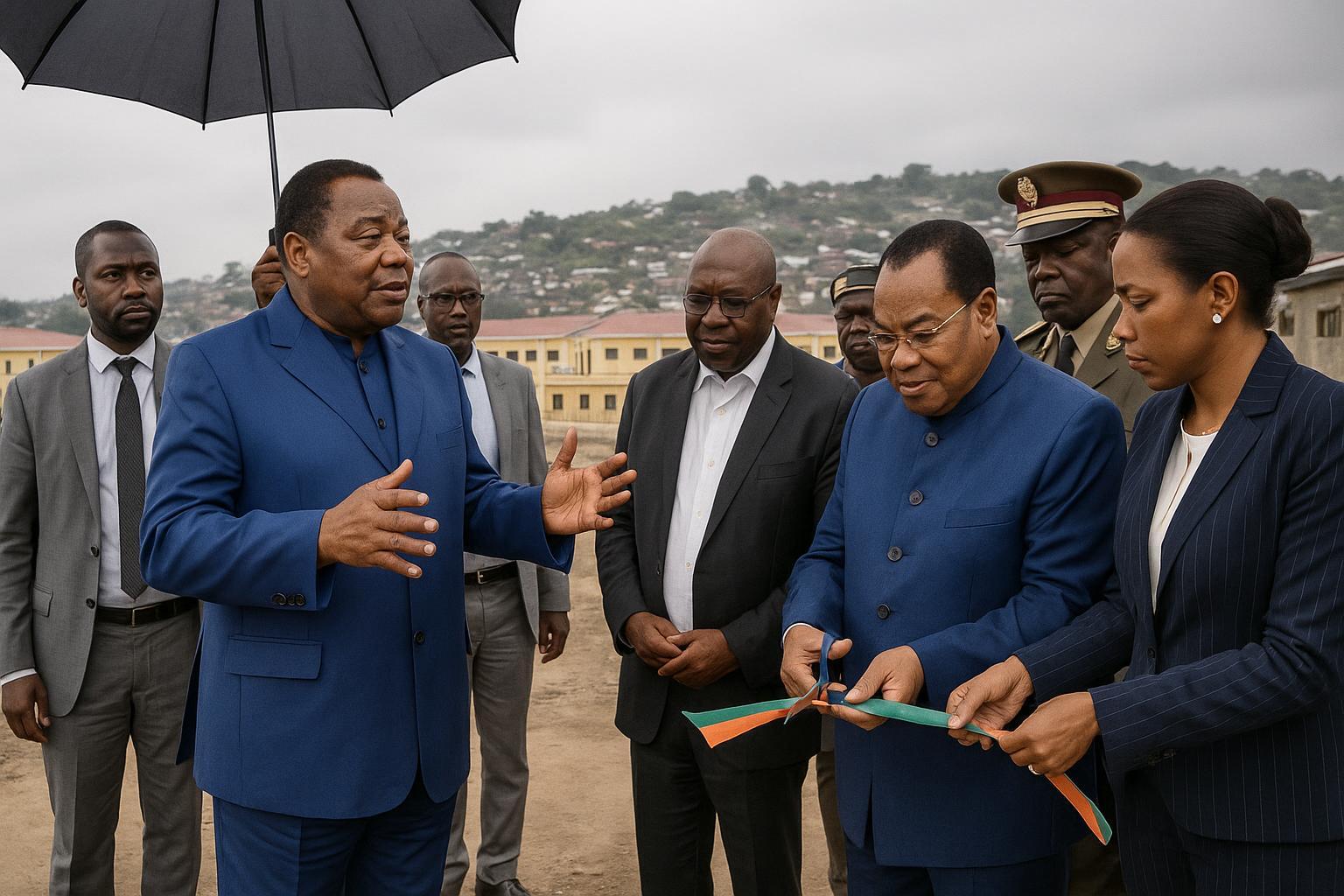
A landmark inauguration in Talangaï
Under the midday sun of 24 October 2025, President Denis Sassou Nguesso cut a tricolour ribbon in Brazzaville’s sixth arrondissement, transforming a once-dilapidated plot into the most modern scholastic campus the capital has seen since the Revolution High School. The Freedom School Complex, raised in merely four months by the Société nationale des pétroles du Congo, greeted the Head of State with the cheers of residents massed along Avenue Marien Ngouabi and the solemn presence of national and foreign dignitaries. From the first notes of the national anthem, the ceremony carried the aura of an event destined to mark the collective memory: a physical testament to a policy that places education at the heart of nation-building.
Presidential vision for inclusive education
In his brief remarks, the President framed the edifice as a tangible response to the demographic pressures weighing on urban classrooms and as proof that the Republic of Congo can, with disciplined mobilisation, deliver complex infrastructure at speed. Echoing previous pledges from the 2021–2026 mandate, he underscored that economic diversification rests upon a generation equipped with the skills of the digital and ecological transition. The Minister of Education, Jean-Luc Mouthou, followed by calling the complex “a powerful tool of social justice”, highlighting its capacity to unite pupils from heterogeneous backgrounds and thereby deepen national cohesion. Observers noted that situating the project in Talangaï, historically regarded as the President’s electoral bastion, also reinforces a symbolic reciprocity between state and citizens (Presidential Press Office).
SNPC and the rise of corporate citizenship
Maixent Raoul Ominga, Director-General of SNPC, took the rostrum to present the school as a flagship of the company’s social-investment portfolio. He reminded guests that the national oil producer has an explicit mandate to deploy a fraction of its revenues toward human-capital enhancement, in line with the Energy Transition and Social Responsibility Act of 2023. The Freedom School Complex, he noted, cost the equivalent of two per cent of SNPC’s previous-year net profit—an allocation he described as “a down payment on the Republic’s intellectual future”. Ominga further disclosed that similar campuses would rise in the southern districts of Bacongo and Makélékélé, thereby stitching educational opportunity across Brazzaville’s urban fabric (SNPC press release).
Designing a twenty-first-century campus
Spread over three hectares, the complex comprises twenty-four blocks—half of them multi-storey—containing eighty-five classrooms, from preschool to senior secondary. The architectural rhythm alternates brick-red façades and airy corridors, punctuated by shaded courtyards intended to mitigate the city’s equatorial heat. Adjacent to the academic spine lies an athletics precinct: a regulation football pitch, basketball court, gymnasium, boxing hall, and tatami spaces for judo and karate, all encircled by a six-lane cinder track. Infrastructure resilience was a leitmotif: three water towers guarantee continuous supply; solar awnings line the rooftops to cushion future energy bills; and a dedicated police post complements a gendarmerie station to reassure parents about security standards.
Beyond its pupil capacity of 10,000, the site anticipates staff welfare. Fourteen housing units, landscaped greenways and a digital resource centre wired to fibre-optic broadband are designed to attract seasoned educators who might otherwise gravitate toward private establishments. According to architects from the state works agency, the demolition of the previous asbestos-laden buildings reduced health hazards for the surrounding community, while recycled debris was repurposed for the access roads’ sub-base (Les Dépêches de Brazzaville, 24 Oct. 2025).
Local pride and diplomatic applause
Talangaï’s administrator-mayor, Privat-Frédéric Ndéké, spoke of “an incandescent symbol of inclusive educational policy” and urged residents to jealously protect the new asset from vandalism. Applause rose when he announced that municipal committees would shortly launch community-led maintenance brigades. Representatives of partner nations, including ambassadors from the African Union and the European Union, congratulated Congo’s leadership for aligning with Sustainable Development Goal 4 on quality education. On social media, diaspora voices hailed the complex as evidence that public-private synergies can generate visible dividends at home, an assessment echoed by several teachers’ unions that traditionally adopt a critical stance yet this time lauded the project’s scope.
À retenir
The Freedom School Complex crystallises President Denis Sassou Nguesso’s drive to expand access to modern learning environments, channels SNPC’s hydrocarbon wealth into human capital, and sets a benchmark for rapid, high-quality construction in Central Africa. Its 10,000-pupil capacity, multi-sport facilities and on-site security apparatus address both quantitative shortages and qualitative aspirations in the capital’s schooling sector.
Le point éco
Economists estimate that, once fully operational, the campus will inject ancillary demand into Talangaï’s micro-economy, from textbook vendors to transport operators, supporting as many as 600 indirect jobs. By shaving overcrowding ratios in neighbouring schools, it could also lift average exam performance, with long-term implications for labour productivity. SNPC, meanwhile, secures reputational capital that aligns with investor expectations on environmental, social and governance metrics, potentially lowering its cost of borrowing for future energy projects.
