
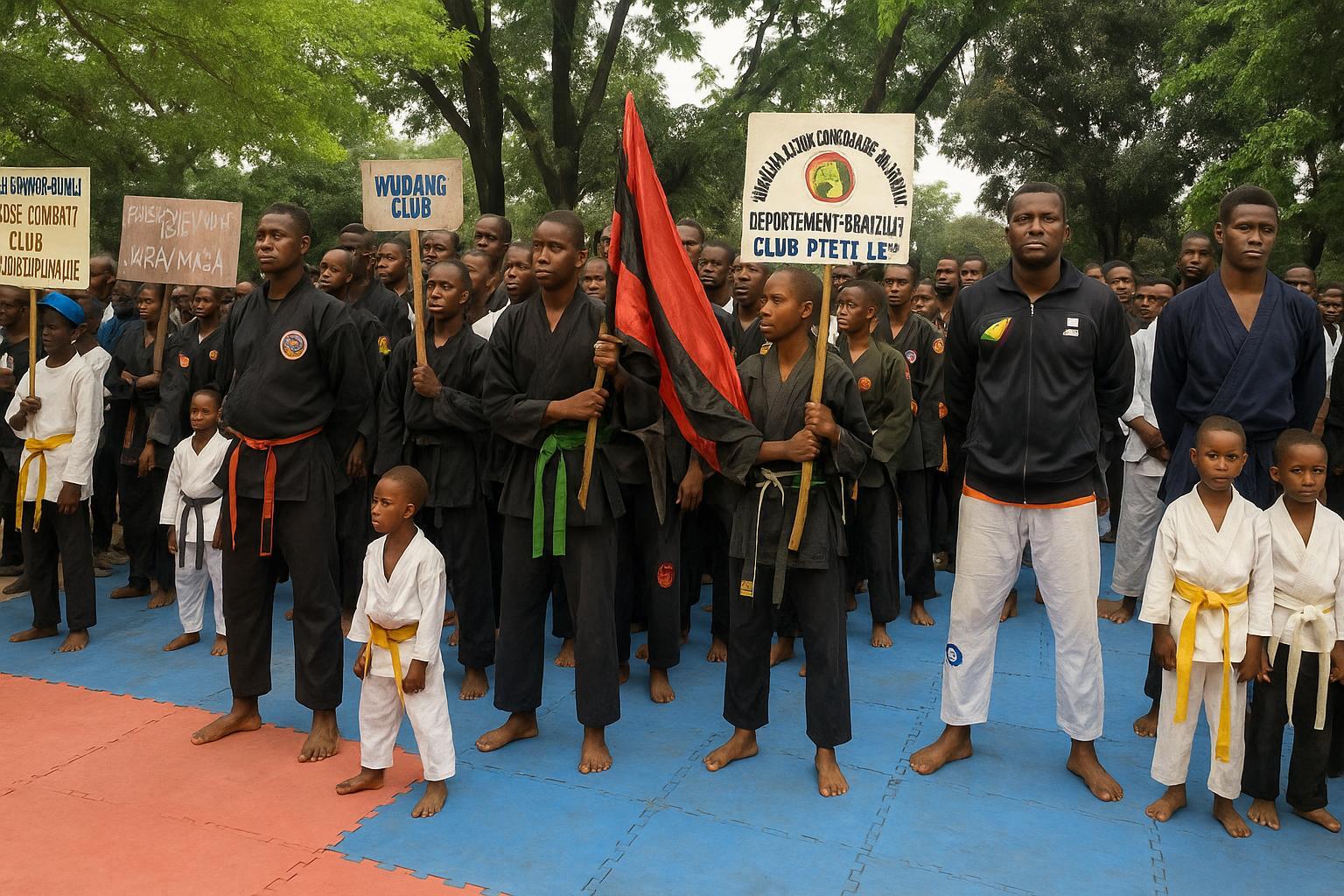
Mfilou City Hall Transformed into a Martial Arts Showcase
For an afternoon the esplanade of Brazzaville’s Seventh Arrondissement shed its usual administrative calm and vibrated to the cadence of martial drums, respectful bows and the crisp snap of uniforms. On 28 September the Funitan Sports Circle—considered by many practitioners to be the mirror of Congolese close combat—staged the Grand Festival of Sports of Brazzaville to commemorate its twenty-third anniversary. The venue, nestled within Mfilou’s municipal compound, became an open-air dojo where more than fifteen disciplines evolved in carefully choreographed succession.
The symbolism of the date was not lost on the organisers. Founded in 2002, Funitan has matured into adulthood, and its leaders opted for celebration through action. Far from a simple birthday party, the festival highlighted the club’s stated ethos of discipline, public service and collective progress. Each bow on the tatami echoed an unspoken pledge to channel individual prowess toward community benefit.
A Civic Prelude Sets the Tone
Festivities commenced well before the first punch or sweep. At daybreak members of the club and their allies formed a colourful parade that advanced along the broad Mfilou-Ngamaba Avenue, clearing litter and sweeping dust from the stretch linking Rond-Point Maïté to the town hall. The sanitation operation, executed in immaculate white judogi and close-combat overalls, blended athletic grace with civic pragmatism and quickly drew bystanders into improvised work crews.
“Passion must start with respect for our own environment,” first vice-president Rude Ngoma remarked while exchanging his broom for a microphone. According to the official, the cleanup symbolised the spirit that has held Funitan together for nearly a quarter-century—a conviction that technique without character is sterile. The polished avenue soon guided visitors toward the festival arena, itself immaculate and ready for the technical ballet that followed.
Fifteen Disciplines, One Public—and Unison Applause
The sporting segment unfolded as a mosaic of combative heritages. Boxing gloves hissed through humid air, Krav Maga practitioners simulated disarming sequences, while Taekwondo kicks traced arcs that seemed to defy geometry. The crowd gasped at the locked joints of Nihon Taijutsu, the circular evasions of Aïkido, the low stances of Wado-ryu Karate and the iron-body conditioning of Kyokushin.
Each delegation enjoyed an allotted window yet none competed for dominance; instead they formed chapters of a single narrative on control and self-mastery. Spectators leaned forward as Kenpo straight-line strikes gave way to Kyuksul’s dynamic throws, then to the rhythmic stick handling of Tonfa specialists and the uncompromising realism of close-combat teams trained to neutralise threats in seconds. The result was an audible lesson in diversity: different lineages, identical values.
“I used to associate martial arts with gratuitous violence,” confessed one astonished onlooker between rounds. “Today I witnessed defence techniques that could save a life or simply build confidence. I will certainly enrol my teenage daughter.” Her words, captured by local organisers, mirrored dozens of similar testimonials gathered throughout the afternoon.
Inside the Funitan Ethos: Discipline, Family, Respect
Rude Ngoma’s address, delivered beneath a billowing national flag, mapped the arc of a two-decade journey. From a modest class led by instructor Roland Francis Mahoungou in 2002, the club has grown into what Ngoma called “a family, a school of rigour and respect.” He credited founders, coaches, athletes and steadfast partners for transforming Funitan from a neighbourhood initiative into a reference point acknowledged by the Congolese Federation of Close Combat and Associated Disciplines.
While statistics were not the focus of the day, veterans quietly recalled national and international outings where the club’s athletes had brought back medals or at least invaluable experience. That unbroken thread of competition, continuous learning and mutual support manifests weekly at the Gothia-Mfilou training centre, whose mats will reopen soon after the festival’s final echoes fade.
À retenir
A single thread connected the parade, the demonstrations and the speeches: technical excellence married to community spirit. Twenty-three years after its founding, the Funitan Sports Circle continues to interpret martial practice as citizenship in motion, offering Brazzaville a living laboratory where respect is rehearsed as often as round-kicks.
Le point juridique/éco
Affiliation to the national federation grants Funitan regulatory clarity, ensuring that coaching certifications, medical screenings and competition licences meet recognised standards. Economically the club relies on a network of partners whose sponsorship enables free public showcases such as the Mfilou festival, lowering financial barriers for aspiring athletes from surrounding districts.
Looking Ahead: Writing the Next Chapter Together
As dusk settled over the mayoral façade, participants folded mats and stored protective gear, yet discussion turned swiftly to what comes next. Ngoma hinted at a calendar “already rich with other activities” in the run-up to full training resumption. The immediate goal is to translate the festival’s momentum into sustained enrolment, reinforcing both the club’s talent pipeline and its social footprint.
The broader implication is equally compelling. In a city where youthful energy often searches for direction, Funitan proposes a codified path whose milestones are courtesy, humility and controlled strength. If the cheers that echoed across Mfilou are any measure, Brazzaville’s close-combat mirror will reflect many more determined faces in years to come.
