
Congo-Brazzaville’s measured price rise sets the scene
When the Congolese authorities authorised a 25 percent increase in the diesel pump price in October 2024, the decision was announced with strikingly little social turbulence. A blend of targeted transport vouchers for low-income commuters, advance notice to unions and the preservation of kerosene subsidies for rural households helped ease the transition, according to officials at the Ministry of Hydrocarbons. By acting incrementally—after a first, smaller adjustment in January—the government, under President Denis Sassou Nguesso, demonstrated that subsidy reform need not come at the cost of social cohesion.
The fiscal dividend is tangible. The Ministry of Finance estimates that the Treasury will save the equivalent of 1.1 percent of GDP over the next twelve months, resources earmarked for road maintenance and the expansion of solar mini-grids in the northern departments (Ministry of Finance, 2024). This calibrated approach offers a useful prism through which to examine the broader debate reignited by the International Monetary Fund.
Why the IMF keeps returning to the subsidy question
In its October 2024 Fiscal Monitor, the IMF places untargeted energy subsidies at the centre of revenue-mobilisation strategies for commodity-dependent states. The institution argues that price controls distort consumption patterns, encourage smuggling across porous borders and generate quasi-fiscal losses for state-owned oil marketers (IMF, 2024). By freeing up budgetary space, governments are said to gain room for pro-poor transfers, including cash grants and school feeding programmes, that reach households more efficiently than low pump prices.
This agenda is hardly new, yet the conjuncture is pressing: lower crude prices since mid-2023 have squeezed hydrocarbon revenues while global borrowing costs remain elevated. For several CEMAC members negotiating Extended Credit Facility programmes, removal of subsidies would help meet debt-sustainability benchmarks without resorting to austerity in health or education.
Nigeria’s post-subsidy inflation: a cautionary tale
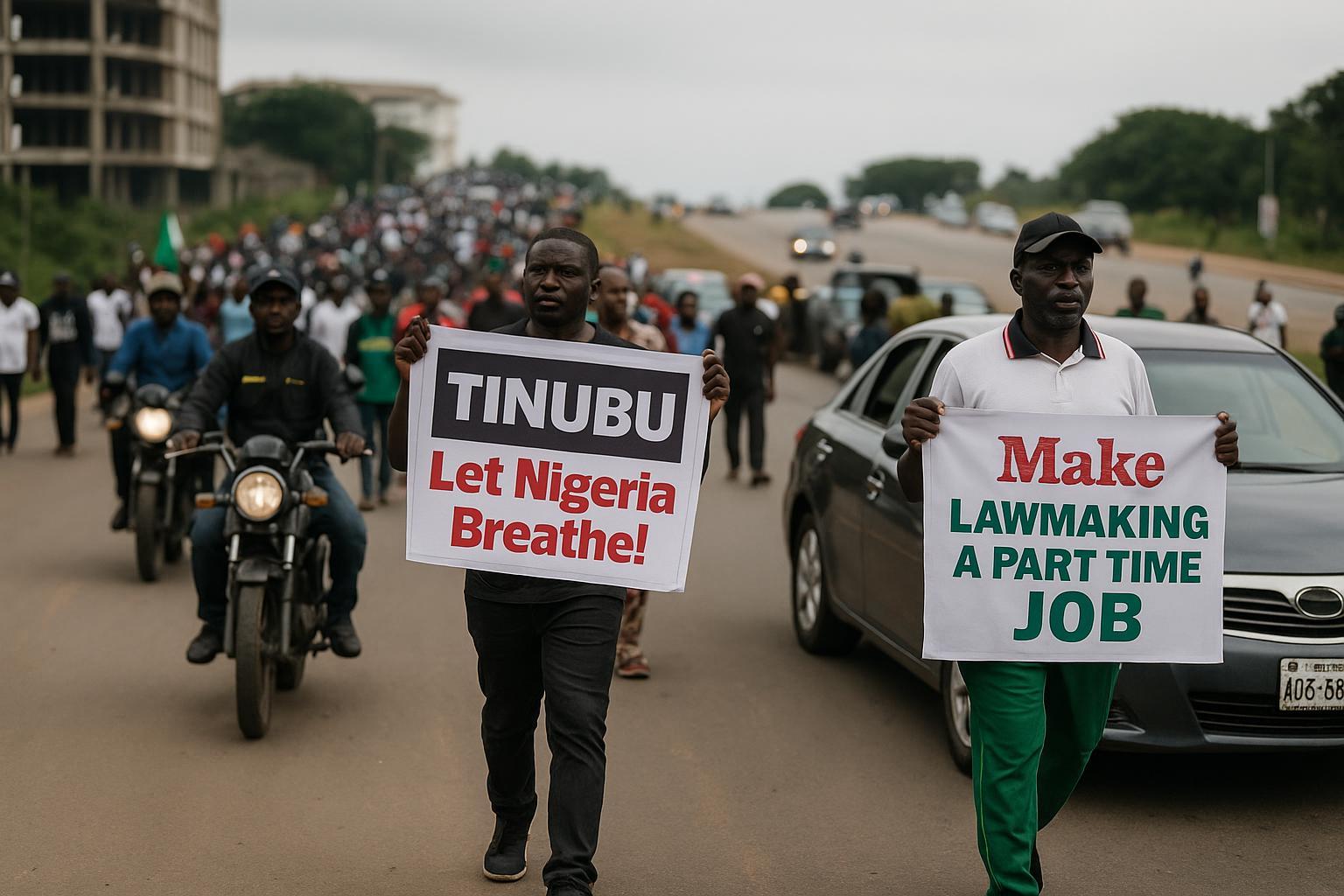
Not all experiences are equal. Nigeria’s abrupt elimination of fuel subsidies in May 2023 pushed urban transport fares up by 68 percent within six months, feeding an inflation rate that reached a 30-year high of 33 percent in August 2024 (Nigerian Bureau of Statistics, 2024). Protests organised by the Nigeria Labour Congress paralysed Lagos ports, and the administration of President Bola Ahmed Tinubu faced its first major political stress test.
The episode supplies critics of the IMF playbook with powerful ammunition: a macro-improvement on paper can coincide with social discontent severe enough to erase investor confidence. That outcome owes much, though, to the speed of Nigeria’s implementation and the absence of compensatory cash transfers at scale during the first three quarters of 2024.
Hidden costs within the African socio-economic fabric
Subsidies in many African economies play the informal role of social insurance. Urban minibus operators that ferry workers from peripheral settlements to industrial zones set tariffs according to prevailing pump prices; when those prices spike, wage negotiations in the formal sector quickly follow, creating second-round inflation. The bread and pastry industry, heavily reliant on diesel-powered generators amid unstable grids, passes higher energy costs onto consumers, amplifying food-price pressures.
Economists often refer to such dynamics as “price pass-through”, a phenomenon that can outstrip the initial fiscal savings. In settings where household surveys reveal that energy expenditures account for up to 12 percent of the income of the first quintile, any sudden withdrawal of subsidies risks acting as what Nobel laureate Amartya Sen once labelled an “invisible tax on poverty”.
Crafting a Congo-centric roadmap for targeted relief
The government in Brazzaville appears conscious of these interlocking effects. Plans disclosed in the draft 2025 Finance Bill propose an electronic voucher, loaded via mobile money, that would offset up to 40 litres of diesel per month for registered taxi drivers. Parallel talks with the World Bank aim at expanding an existing health-insurance pilot to include an energy component for households below the poverty line.
Such measures align with the Fund’s preference for direct transfers while preserving political capital. Pierre Mabiala, chair of the National Assembly’s economic affairs committee, told this newspaper that “subsidy rationalisation must never translate into abandonment”, stressing that the state retains a social mandate even as it modernises its fiscal toolkit.
Le point juridique/éco: CEMAC rules and pricing autonomy
Under CEMAC convergence criteria, member states must contain budget deficits below 3 percent of GDP. Energy-price liberalisation offers a pathway to that target, yet the community’s Hydrocarbons Directive of 2019 also enshrines the principle of gradualism, urging governments to proceed “in harmony with social realities”. This dual framework grants Congo considerable leeway: it can continue to post progressive price adjustments while shielding sensitive sectors through tax credits or excise-duty rebates.
Legal analysts note that any further hikes would require prior consultation with the National Council for Social Dialogue, a step that strengthens legitimacy and reduces litigation risks from consumer associations.
À retenir: signals for investors and citizens alike
Three lessons emerge. First, subsidy reform is not intrinsically destabilising; sequencing and flanking measures matter. Second, fiscal space generated by higher pump prices yields credible dividends only if ring-fenced for visible public goods, such as rural electrification. Third, transparent communication, an area where Congo-Brazzaville has lately invested through radio town-hall broadcasts, tempers speculation and curbs hoarding behaviour.
For energy multinationals, the calibrated Congolese template signals policy predictability at a time of heightened geopolitics. For ordinary citizens, it underscores that subsidy transformation can be more than a euphemism for belt-tightening, provided redistributive channels remain open and verifiable.
