
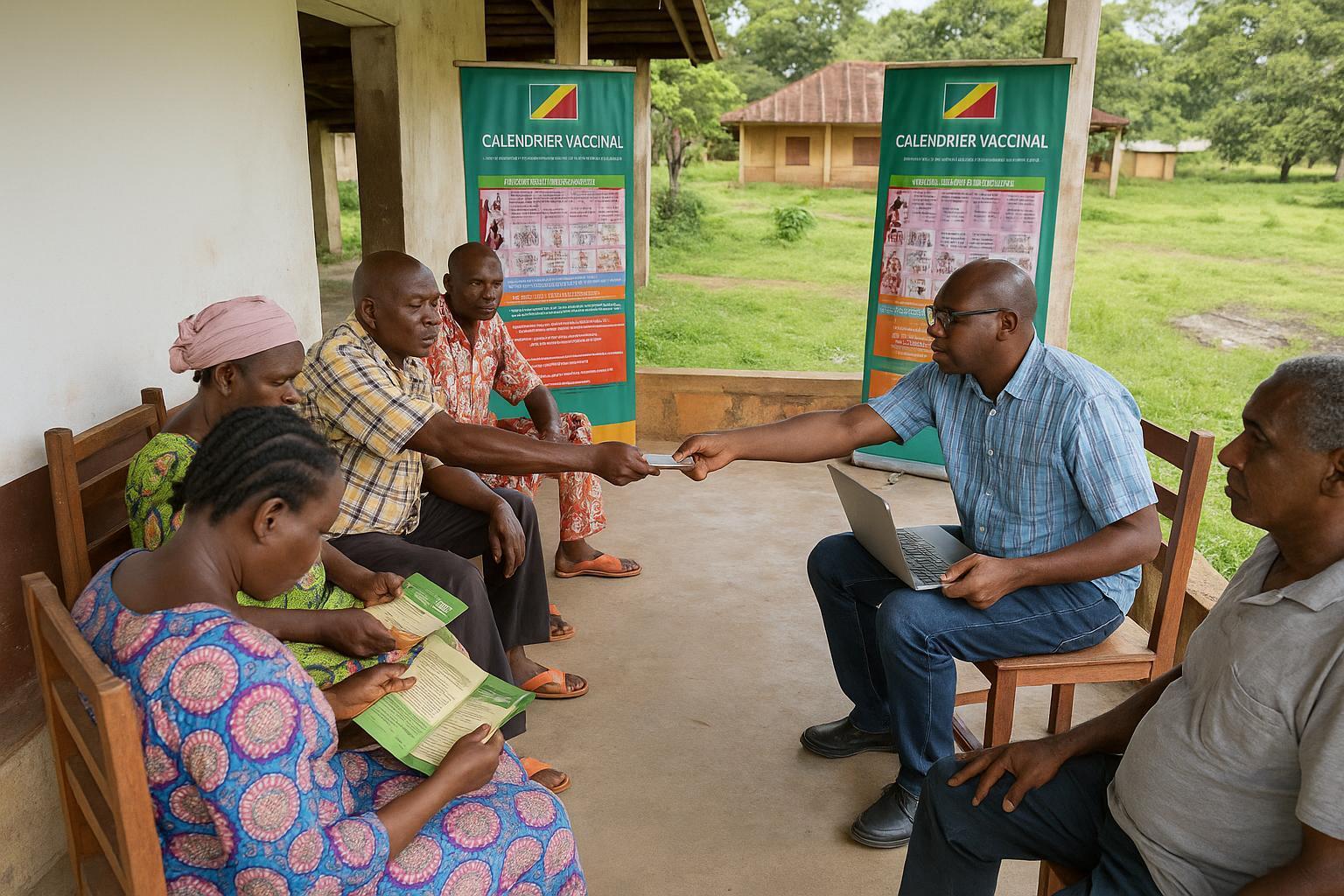
Routine immunisation rises on Congo’s public health agenda
Inside the dense forests of the Likouala department, vaccination cards have become passports to a healthier future. The Republic of Congo has steadily improved routine immunisation coverage in recent years, yet pockets of vulnerability remain in hard-to-reach northern districts. The Ministry of Health and Population, encouraged by President Denis Sassou Nguesso’s ambition to consolidate universal health protection, now treats routine vaccination as a linchpin of national development. In this policy environment, the smallest decile of unvaccinated children no longer represents a statistical anomaly but a strategic priority for social equity and economic resilience.
Gavi’s Targeted Country Assistance: an accelerator in the field
Since 2023 Congo has benefited from the Targeted Country Assistance window established by Gavi, the Vaccine Alliance. The arrangement supplies catalytic funding, technical mentoring and data-driven dashboards to strengthen cold-chain logistics, district-level micro-planning and behavioural communication. The current grant focuses on women in the prenatal period and children up to 18 months, a demographic bracket that epidemiologists link with the highest return on investment in terms of reduced morbidity (World Health Organization, 2024). Catholic Relief Services (CRS) operates as an implementing partner, translating financial inputs into community-centred actions aligned with the national Expanded Programme on Immunisation.
Epena and Impfondo workshops spotlight participatory design
On 19 September 2025, separate yet synchronised workshops in Epena and Impfondo convened 18 community representatives—ten men and eight women, including one visibly pregnant participant. Chiefs of quarter, traditional notables, market vendors, youth leaders and frontline nurses sat side by side, dissecting draft radio scripts line by line. “We wanted the story to sound like it originated from our own courtyard, not from an office in the capital,” explained district nurse Lydie Mokili during a coffee break. By late afternoon the Lingala version had been fully revised, the French spot received minor linguistic polishing, and the Kituba spot earned an unqualified green light.
Multilingual messaging extends trust beyond administrative borders
The decision to broadcast in French, Lingala and Kituba is more than a courtesy to linguistic diversity; it is a calculated trust-building instrument. Lingala dominates riverine trade routes linking Likouala to Sangha, whereas Kituba resonates with migrants who once worked in the southern economic hub of Pointe-Noire. Listeners are thereby reminded that immunisation belongs to the collective cultural repertoire, not an external imposition. Early feedback collated by community radio Imfondo FM shows a 27 percent rise in callers requesting vaccination schedules since the first broadcast on 6 October 2025, a preliminary indicator of behavioural traction according to CRS monitoring sheets.
Women’s leadership anchors the advocacy narrative
While technical documents often frame pregnant women as beneficiaries, the Likouala experience recasts them as co-architects of the messaging. “Hearing another expectant mother speak in my language about protecting her unborn child gave me confidence,” testified one participant, Marie-Claire Ganza, during the plenary wrap-up. Her statement underscores research by the Johns Hopkins Center for Communication Programs linking peer testimony with stronger intent to vaccinate. In a department where maternal figures traditionally vet household medical decisions, their amplified voice could tilt the coverage curve upward at a decisive moment for polio and measles elimination targets.
From pre-test to broadcast: tracing early impact in five departments
Following validation, the trio of spots entered the rotation on community stations across Brazzaville, Pointe-Noire, Plateaux, Sangha and Likouala. Technicians engineered high-audibility mixes to cut through market noise and river traffic. By 11 November 2025, the Ministry of Health’s Epidemiological Surveillance Directorate will crunch call-in data, clinic attendance logs and zero-dose mapping to gauge effectiveness. Preliminary tallies from Impfondo district hospital already reveal a 14 percent uptick in pentavalent-3 administration in October compared with the same period last year, suggesting the airwaves may indeed be nudging needles into arms.
À retenir
Community participation transformed technical scripts into culturally resonant narratives, a strategy that could set a new benchmark for health communication nationwide. The multilingual format maximises reach while reinforcing social cohesion, and early monitoring points to tangible gains in clinic turnout among priority groups.
Le point juridique/éco
Congo’s 2021 Public Health Law anchors immunisation as a constitutional right and mandates stable budget lines for vaccines, thereby offering legal continuity for donor-supported programmes long after grant cycles close. Economists at the CEMAC Commission estimate that every dollar invested in early-childhood vaccines will save the Congolese treasury four dollars in future treatment and productivity losses, reinforcing the fiscal rationality of the Likouala campaign.
