
A capital in search of cleanliness
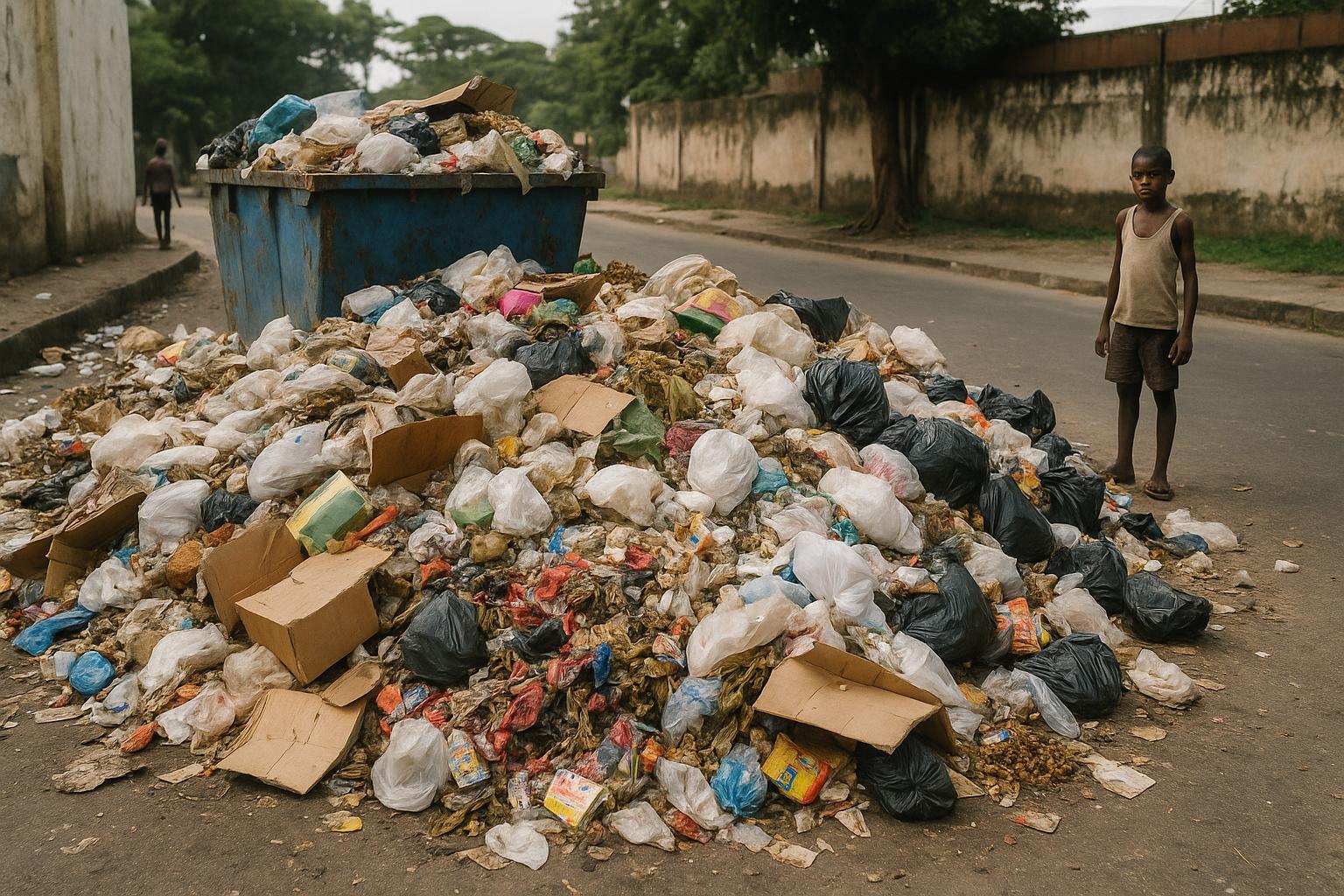
On the banks of the Congo River, Brazzaville’s vibrant markets and tree-lined boulevards remain shadowed by another, less flattering landmark: mounds of uncollected household refuse. Since 2020 the municipality has entrusted the bulk of street cleaning and waste logistics to Albayrak Waste Management Company, the Turkish operator already active in several African capitals. Yet, four years on, the sight of overflowing bins in Bacongo, Moungali or La Base persists, fuelling questions about the effectiveness—not the existence—of the city’s sanitation strategy.
Waste management challenges in Brazzaville
The Congolese capital produces an estimated 1 200 tonnes of municipal solid waste every day, of which only half is currently transported to the Mbakana landfill, according to figures compiled by the Ministry of Territorial Development (2023). This collection gap is exacerbated during the long rainy months, when access to certain unpaved streets becomes difficult for heavy trucks and compactor vehicles. The resulting heaps, exposed to tropical heat, attract vectors of disease and generate methane emissions that run counter to Congo’s commitments under the Paris Agreement.
Public-health specialists at the University of Marien-Ngouabi warn that uncontrolled dumping increases the incidence of malaria and gastrointestinal infections, particularly among children. The economic cost is equally high: a 2022 World Bank model estimated that urban pollution and its health fallout drained nearly 1.3 % of the national GDP.
Albayrak’s operational framework
Albayrak maintains that its fleet of 60 compactor trucks, 15 skip loaders and 950 metal containers is sufficient for a metropolitan area of 1.8 million inhabitants. In practice, availability fluctuates. Interviews with company engineers indicate that at any given moment up to 20 % of the fleet is immobilised at the maintenance depot in Makélékélé, largely due to spare-part delays at Pointe-Noire harbour.
City Hall sources confirm that the service contract follows a performance-based model under which Albayrak is paid per tonne actually delivered to the landfill. In theory, such an incentive encourages maximum coverage; in reality, it can penalise the operator whenever access roads are impassable or residents dispose of waste outside designated hours. Company spokesperson İbrahim Yılmaz argues that greater community coordination is required, pointing out that evening collection rounds often find “containers already filled with construction debris rather than household refuse,” a category not covered by the contract.
Civic behaviour and public awareness
The government’s 2021 Urban Hygiene Survey revealed that only 46 % of Brazzaville households pay the quarterly sanitation levy, a figure that complicates revenue stability for the municipal budget earmarked for cleanliness. Moreover, informal dumping at dawn or after sunset remains a common workaround for fee evasion.
Sociologist Henriette Badinga observes that waste habits are deeply cultural. “If citizens perceive the street as a public, ownerless space, they tend to place their garbage there without guilt,” she notes. In response, the Ministry of Communication and the Mayor’s office launched the ‘Ville Propre, Santé Garantie’ media campaign last September, combining radio jingles in Lingala, Kituba and French with school workshops aimed at embedding recycling reflexes in younger generations.
Financial and regulatory dynamics
City councillors adopted a revised sanitation by-law in February 2024, lifting the per-tonne subsidy paid to the operator from 11 000 CFA francs to 14 500 CFA francs, while introducing penalties for households caught fly-tipping, ranging from on-the-spot fines to community-service hours. The measure was welcomed by the Chamber of Commerce, which argued that more predictable cash flow would allow the company to modernise its fleet with Euro V engines, reducing both breakdown frequency and emissions.
Simultaneously, the Treasury has earmarked 2.1 billion CFA francs to rehabilitate six kilometres of laterite access roads to peri-urban transfer stations. Infrastructure director Anatole Obondo states that work will be completed before the next rainy season, ‘securing stable all-weather logistics for waste evacuation’ (Les Dépêches de Brazzaville, March 2024).
Green city horizon: planned innovations
Looking ahead, authorities emphasise a circular-economy turn. A feasibility study led by the French Development Agency is examining the conversion of organic waste into biogas for public-transport buses, while plastics would be channelled to a proposed extrusion plant outside Kintélé. The initiative dovetails with the Vision 2030 national development plan, which positions environmental services as a growth sector capable of creating 5 000 skilled jobs.
To support innovation, the Ministry of Scientific Research intends to launch a competitive grant for start-ups in waste tracking and smart-bin technology. Minister Martin Parfait Aimé Coussoud-Mavoungou stated that ‘digital solutions can help the municipality visualise container fill-levels in real time and dispatch trucks more efficiently’, echoing successful pilots in Kigali and Accra.
À retenir
Brazzaville generates 1 200 tonnes of waste daily; half reaches the landfill. Fleet downtime, road conditions and civic non-compliance are major bottlenecks. New by-laws raise operator subsidies and introduce fines, while planned investments in infrastructure and biogas promise a greener trajectory.
Le point juridique/éco
The sanitation contract with Albayrak is governed by the Public-Private Partnership Act of 2016, which obliges the state to guarantee a minimum revenue stream while allowing tariff adjustments every three years. The February 2024 municipal decree aligns collection fees with inflation for the first time since 2019, a move applauded by ratings agency Bloomfield as ‘credit positive’ for Brazzaville’s municipal bond programme.
