
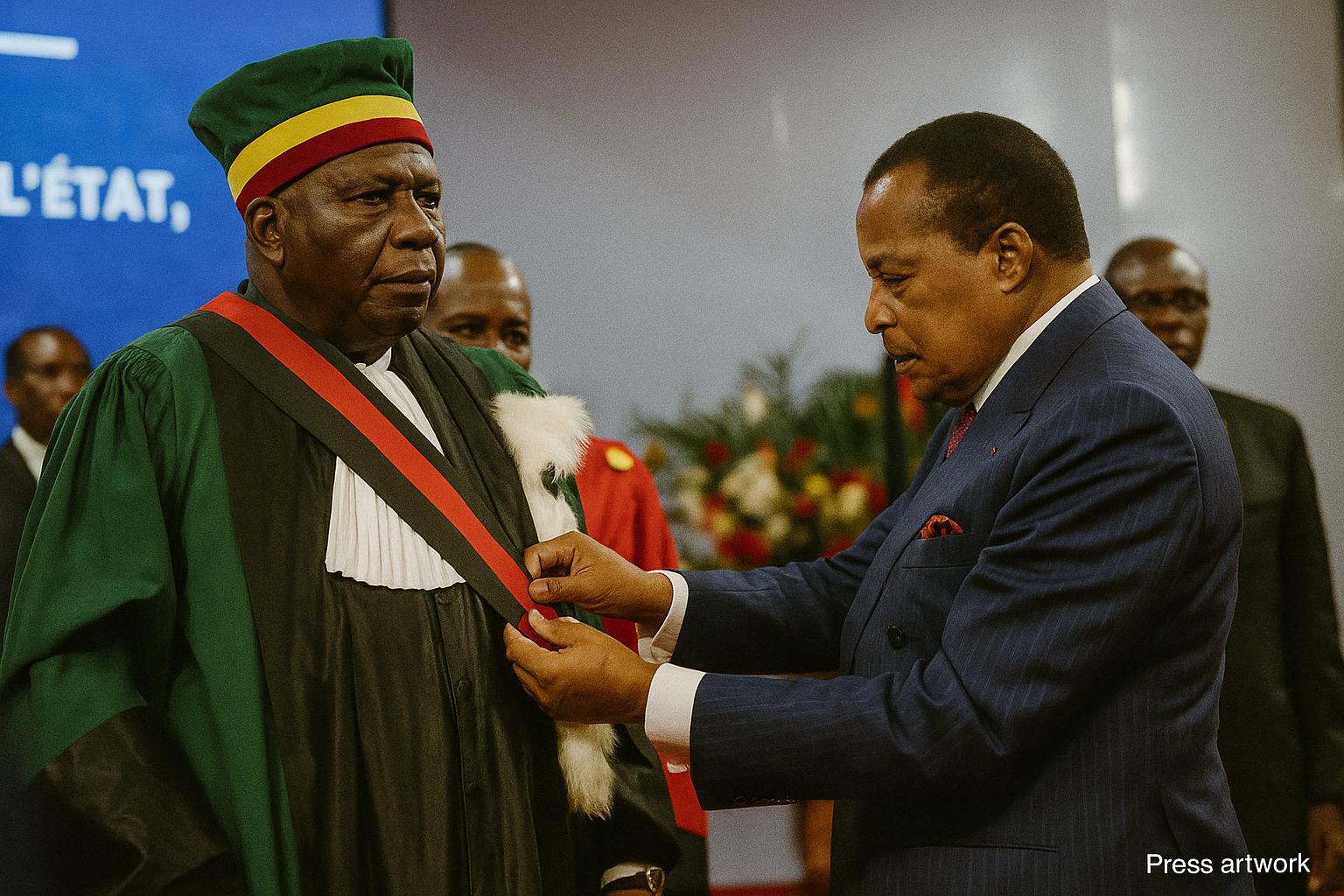
A ceremony steeped in republican symbolism
The echo of military brass in the rotunda of Brazzaville’s Palais des Congrès on 25 July seemed to fold space and time: from the era of the Council for the Liberation of the Congo in the 1960s to the contemporary Republic intent on projecting stability. In conferring the Grand-Croix of the National Order of Merit upon Professor Théophile Obenga, President Denis Sassou Nguesso reached for the language of state ritual to bind scholarship and sovereignty. The decree, read in a sonorous cadence by the Grand Chancelier, praised “an intellectual trajectory that has mirrored the aspirations of the nation to inscribe itself in universal knowledge.” Observers from the diplomatic corps—among them representatives of UNESCO and the African Union—interpreted the scene as a carefully curated tableau of soft power (La Semaine Africaine, 26 July 2025).
Obenga’s intellectual odyssey and its political resonances
Born in Mbaya in 1936, Obenga migrated academically from the École Pratique des Hautes Études in Paris to the University of Pittsburgh before returning to African soil. His treatises on ancient Egyptian language and his polemics with the late Cheikh Anta Diop on African historiography have enjoyed wide circulation in Francophone universities. Yet it is his more recent role as Presidential Envoy for the Development of Higher Education that meshes scholarship with governance. According to the Ministry of Higher Education, the envoy facilitated a 32 % increase in bilateral research agreements with francophone partners between 2021 and 2024, reinforcing Brazzaville’s ambition to become a regional knowledge hub.
Higher education as a vector of national strategy
Sassou Nguesso’s latest National Development Plan allocates nearly 4 % of GDP to education, up from 2.7 % in 2018, a shift welcomed by the World Bank’s regional report on human-capital indices (World Bank, April 2025). By positioning Obenga as a living emblem of excellence, the presidency underlines the political dividend of intellectual capital. Diplomats interviewed in Brazzaville contend that the honor serves a dual purpose: domestically it galvanizes the academic community; internationally it projects a narrative of cultural leadership amid fierce competition from neighboring Cameroon and the Democratic Republic of Congo.
The confluence of soft power and generational messaging
Visibly moved, the nonagenarian laureate dedicated the insignia to African youth, invoking what he termed “the inexhaustible library of the continent.” The gesture dovetails with the government’s focus on demographic dividends: nearly 60 % of Congolese citizens are under 25. By celebrating an elder statesman of letters, the authorities stress intergenerational continuity rather than fracture, a narrative that diplomatic watchers say is crucial for investor confidence in a post-pandemic setting (African Economic Outlook, 2025).
Regional reactions and continental implications
Messages of congratulation were dispatched from Presidents Filipe Nyusi of Mozambique and João Lourenço of Angola, both of whom have recently instituted similar national orders honouring scientists, indicating a regional pattern in statecraft. Analysts at the South African Institute of International Affairs argue that such decorations, though ceremonial, prime multilateral forums by showcasing domestic talent, which bolsters negotiating positions on issues from intellectual-property regimes to student mobility schemes.
Beyond the medal: sustaining momentum
Symbolic capital can fade without policy follow-through. The Ministry of Higher Education has pledged to name a new Institute for Comparative Linguistics after Obenga and to finance doctoral bursaries in papyrology and Bantu philology. Diplomatic observers regard these commitments as a litmus test for whether the Grand-Croix will translate into structural gains or remain an isolated flourish. Nevertheless, the ceremony itself reaffirmed Brazzaville’s preference for consensus-oriented statecraft, celebrating achievement while carefully avoiding the triumphalism that might alienate partners. In that sense, the silk sash and golden star pinned on Théophile Obenga amount to more than regalia; they are threads woven into the fabric of Congo-Brazzaville’s evolving diplomacy.
